

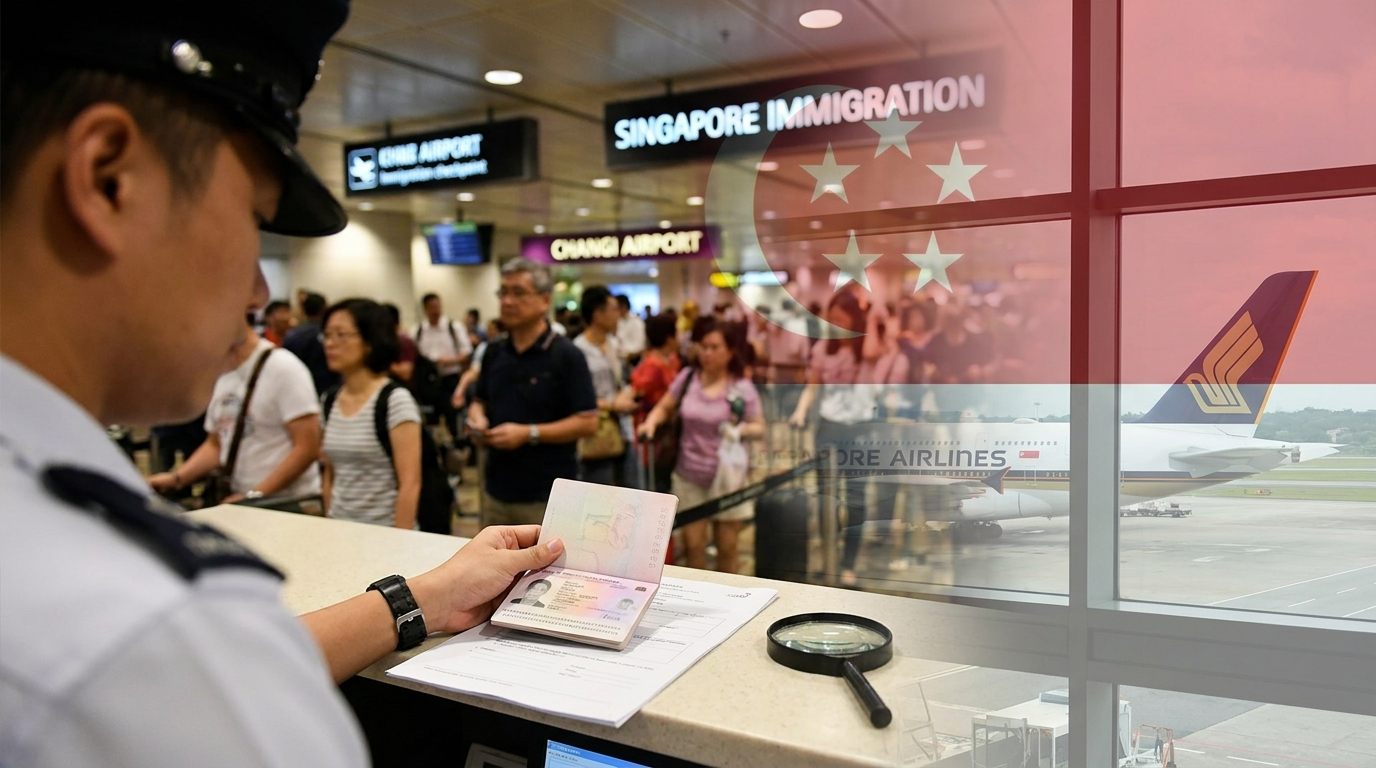
A Singapore tourist visa is one of the cheaper visas in the region on paper. SGD 30 to ICA, no in-person interview, fully electronic, and in most cases the answer comes back inside a working week. The friction sits elsewhere: an applicant from a visa-required country can’t submit the application themselves. ICA’s system, called SAVE, only accepts submissions from a Singapore-based contact or a registered visa agent.
This guide covers the visa types ICA recognises, who falls into which category, the documents that actually matter, what the application looks like in practice, and what changed in 2026. For the wider context, including country-specific rules and the multi-entry options, see our Singapore visa overview for foreign visitors.
Who needs a Singapore visa
Singapore splits the world into three groups for short visits.
The first group is visa-exempt, which is most of the world: the UK, US, Canada, Australia, the Philippines, Japan, the EU bloc, and around 160 other passports and travel documents. They walk in with a passport, an onward ticket, and an SG Arrival Card. The immigration officer at Changi grants a Short-Term Visit Pass of 14 to 30 days, occasionally longer, depending on the passport and the officer’s read of the visit.
The second group is Assessment Level I. ICA flags these nationalities as needing a visa, but the assessment is administrative rather than security-heavy. The list covers India, the Commonwealth of Independent States (Armenia, Azerbaijan, Belarus, Kazakhstan, Kyrgyzstan, Moldova, Russia, Tajikistan, Turkmenistan, Ukraine, Uzbekistan), Georgia, and holders of the Hong Kong Document of Identity and the Macao SAR Travel Permit. Selected PRC Travel Document holders (non-ordinary passport) also fall here; ordinary PRC passport holders have been visa-exempt for stays of up to 30 days since 9 February 2024. Level I applicants file online through SAVE via a local sponsor or an authorised visa agent.
The third group is Assessment Level II, where ICA wants a closer look. This list includes Afghanistan, Algeria, Bangladesh, Egypt, Iran, Iraq, Jordan, Kosovo, Lebanon, Libya, Mali, Morocco, Nigeria, Pakistan, Somalia, South Sudan, Sudan, Syria, Tunisia, Yemen, and holders of the Palestinian Authority passport and certain travel documents. Level II applicants use the same SAVE channels as Level I (a local contact, a business sponsor, or an Authorised Visa Agent), but ICA applies heavier scrutiny. A Letter of Introduction (Form V39A) is required and additional supporting documents are often requested. Processing remains roughly three working days for routine cases.
The official list is on ICA’s site at ica.gov.sg/enter-transit-depart/entering-singapore/visa_requirements. It does change, so confirm before applying.
Why you can’t apply directly
This catches a lot of first-time applicants off guard. ICA’s SAVE portal is not a public-facing tourist application form. It only accepts submissions from one of three parties: a Singapore citizen or PR with a SingPass account, a Singapore-registered company acting as business sponsor, or an Authorised Visa Agent (AVA) in the applicant’s home country.
That means the practical question for a visa-required applicant isn’t “how do I apply” but “who is submitting on my behalf”. The two main options are:
A friend, relative, or business contact in Singapore who can log into SAVE with SingPass. Cheapest route, since the only cost is the SGD 30 government fee. Works well when the sponsor is comfortable taking on the formal local-contact role.
An AVA in the home country. India has the deepest agent network through VFS Global and IVS Global, but most countries on the visa-required list have at least one or two AVAs operating. Service fees vary, typically the equivalent of SGD 20 to 60 on top of the government fee.
The full list of AVAs by country is maintained on the Ministry of Foreign Affairs site at mfa.gov.sg.
What the application actually needs
The document list is short and the same across nationalities.
A passport biodata page scan, with at least six months’ validity from the date of entry to Singapore. A recent colour passport photograph that matches ICA’s spec: 35mm by 45mm, plain white background, taken within the last three months. A completed Form 14A, submitted electronically through SAVE. An introduction letter from the local contact, on whatever letterhead is appropriate.
For business visits, add a Letter of Introduction (LOI) signed by the Singapore sponsor on company letterhead, submitted via CorpPass, confirming the commercial purpose. Without it, business applications stall. Form V39A is a separate document: it’s the LOI used by an individual Singapore citizen or PR sponsor (with SingPass) and is typical for social visits rather than business.
Beyond that, ICA may ask for supporting documents on individual files: financial statements, return air tickets, hotel bookings, or details of past travel. These are case-by-case rather than standard requirements.
The Singapore e-Visa
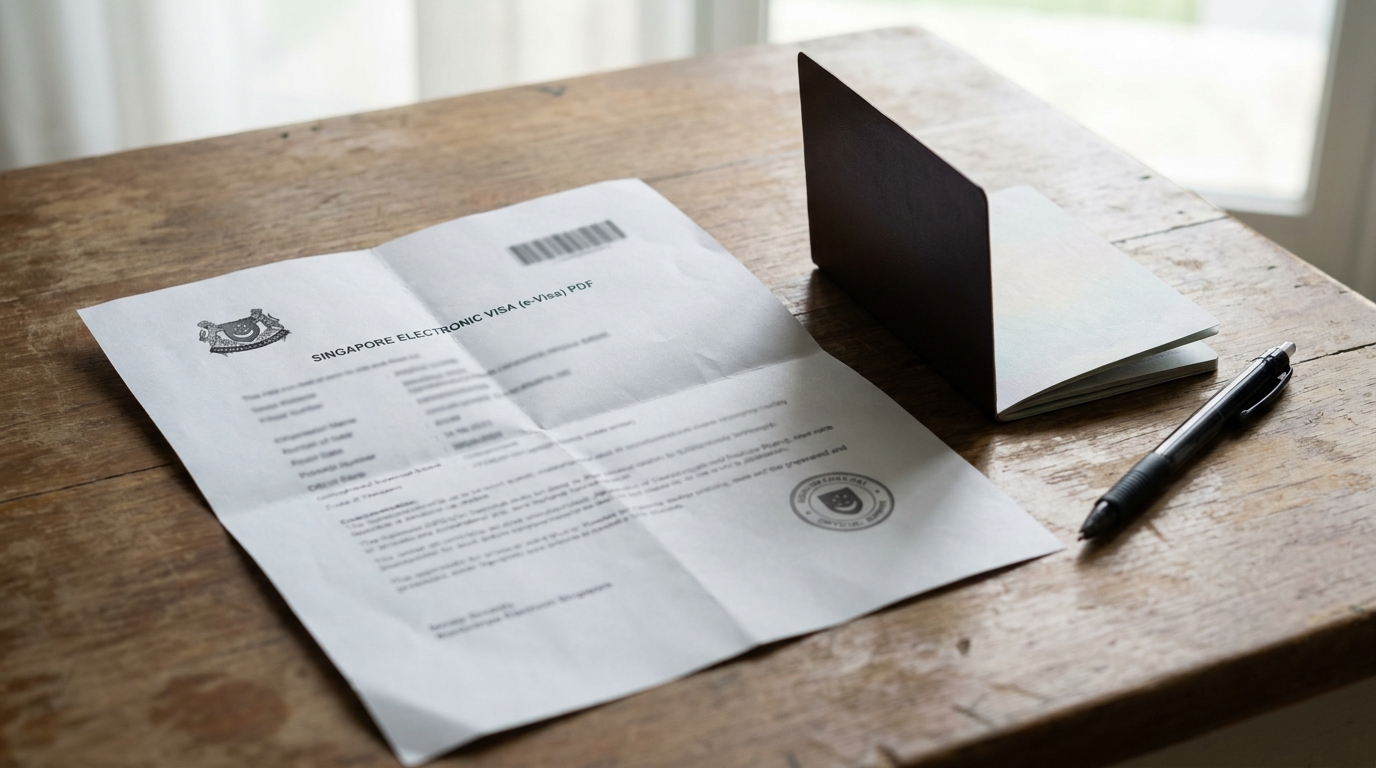
There is no longer a physical visa sticker. ICA stopped that years ago. What gets issued is an electronic visa, a PDF that the applicant prints and carries with their passport on the day of travel. The e-Visa is tied to the passport number, so renewing the passport after issuance means starting over.
The e-Visa’s defining quirk is the gap between validity and stay. A Single Journey Visa is generally issued with a validity window of a few months, often around three, determined at issuance rather than fixed by policy. A Multiple Journey Visa is typically issued for a maximum validity of one, two, or five years depending on the case. PRC nationals may be granted up to a 10-year MJV under a 2015 ICA arrangement, usually for prior visitors with supporting Singapore agency sponsorship. Ordinary PRC passport holders have been visa-exempt for stays of up to 30 days since 9 February 2024, so the 10-year MJV mainly applies to non-ordinary passport holders and repeat business visitors. The validity period is only the window in which the visa can be used to enter Singapore. The actual length of stay is decided by the ICA officer at the checkpoint, and the standard grant is 14 to 30 days regardless of how long the visa itself runs.
For a deeper walkthrough of the application screens, the SAVE process, and what the printed e-Visa looks like, see how to apply for a Singapore e-Visa online.
Need a Singapore-based sponsor to file your visa through SAVE? We act as the local contact, submit the application, and manage the ICA follow-up.
What it costs and how long it takes
The government fee is SGD 30 per application. It applies whether the result is a single journey or multiple journey visa, whether ICA grants 14, 30, or 60 days of stay, and whether the visa runs for three months or two years. The fee is non-refundable. A refused application and a withdrawn application both lose the SGD 30.
Authorised Visa Agents add their own service charge on top. For Indian applicants the all-in figure is usually in the range of INR 1,800 to INR 2,500. Other markets sit in a similar band. Filing through a Singapore-based local contact avoids the agent fee entirely, which is the cheapest legal route when it’s available.
ICA’s published processing time is three working days for routine cases. In practice, three to five working days is a safer planning figure, with weekends and Singapore public holidays excluded. Cases that ICA flags for additional review can sit longer. For specific cost breakdowns by route and nationality, see our Singapore visa fees and costs guide.
The working rule for travellers: don’t book non-refundable flights until the e-Visa is in hand. This is the single most common avoidable loss we see.
What happens at Changi
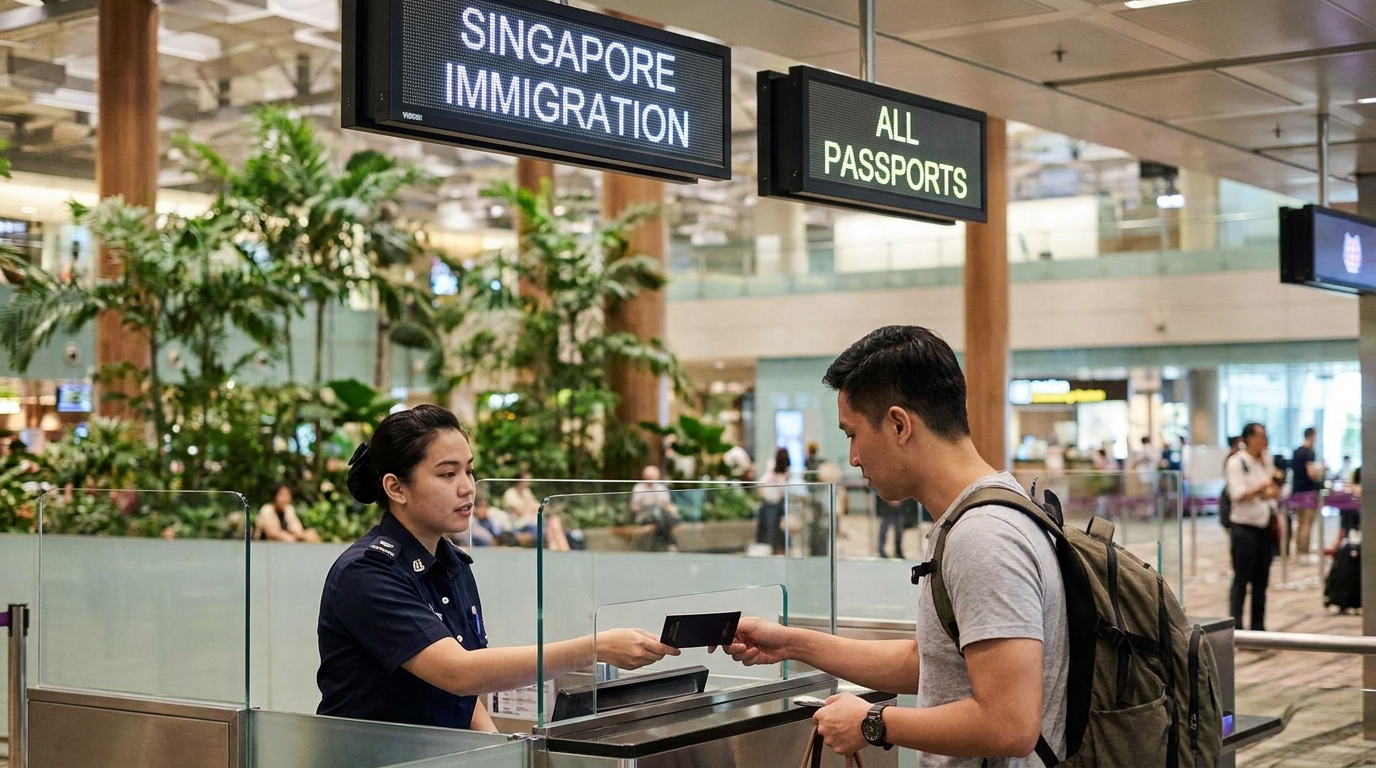
The e-Visa gets the applicant onto the plane. It doesn’t guarantee entry. The ICA officer at the checkpoint makes the final call, and refuses a small percentage of arriving passengers each year, usually for documentary or credibility issues rather than the visa itself.
The officer asks the standard questions: purpose of visit, where you’re staying, how long, return ticket, funds for the stay. Have the answers and the supporting documents ready: hotel booking, return flight confirmation, the sponsor’s contact details if relevant.
If everything is in order, the officer stamps in a Short-Term Visit Pass for 14 to 30 days. UK passport holders get up to 90 days as a standard, which is the most generous grant on the visa-exempt list. The pass dictates the maximum stay, not the e-Visa’s validity. Overstaying is treated seriously, especially under the No-Boarding Directives that came into effect on 30 January 2026, which give ICA the power to bar future arrivals at the check-in counter rather than at the Singapore border.
Country-specific routes
The application mechanics are the same, but the path differs by passport. For Indian applicants, the standard route is through an AVA, and the typical wait is three to five working days. For Filipinos and Canadians, no visa is needed at all, and the only pre-arrival task is the SGAC. For UK citizens, the visa-exempt grant runs to 90 days, longer than for most other passports.
The leaf guides cover the specifics: Singapore visa for Indians, Singapore visa for Filipinos, Singapore visa for Canadians, and Singapore visa for UK citizens.
There are also two route-specific options worth knowing: the Singapore Multiple Entry Visa for repeat travellers, and the Singapore transit visa (VFTF) for layovers where the traveller wants to leave Changi. Business visitors should also read the Singapore business visa application page, which covers the LOI requirements and the activities ICA does and doesn’t permit on a Visit Pass.
The SG Arrival Card sits on top of everything
The SGAC is mandatory for every traveller entering Singapore, with the narrow exception of citizens, PRs, and Long-Term Pass holders coming through land checkpoints. It applies whether the traveller is visa-exempt or visa-required, whether the visit is one day or sixty, and whether arrival is at Changi, Tuas, Woodlands, or a sea checkpoint.
Submission is free and digital, through the SGAC e-Service or the MyICA Mobile app. The window is three days before arrival, inclusive of the arrival day. Submitting earlier than that doesn’t work, and submitting late risks the No-Boarding Directive triggering at the airline check-in counter.
The form includes a short health declaration. For applicants who already cleared the e-Visa step, the SGAC is straightforward administration. For visa-exempt travellers, it’s the only pre-arrival action required.
Planning a Singapore visit and want a quick check on which route applies to you? We’ll tell you whether you need an e-Visa, qualify for visa-free entry, or fit the VFTF transit window.