

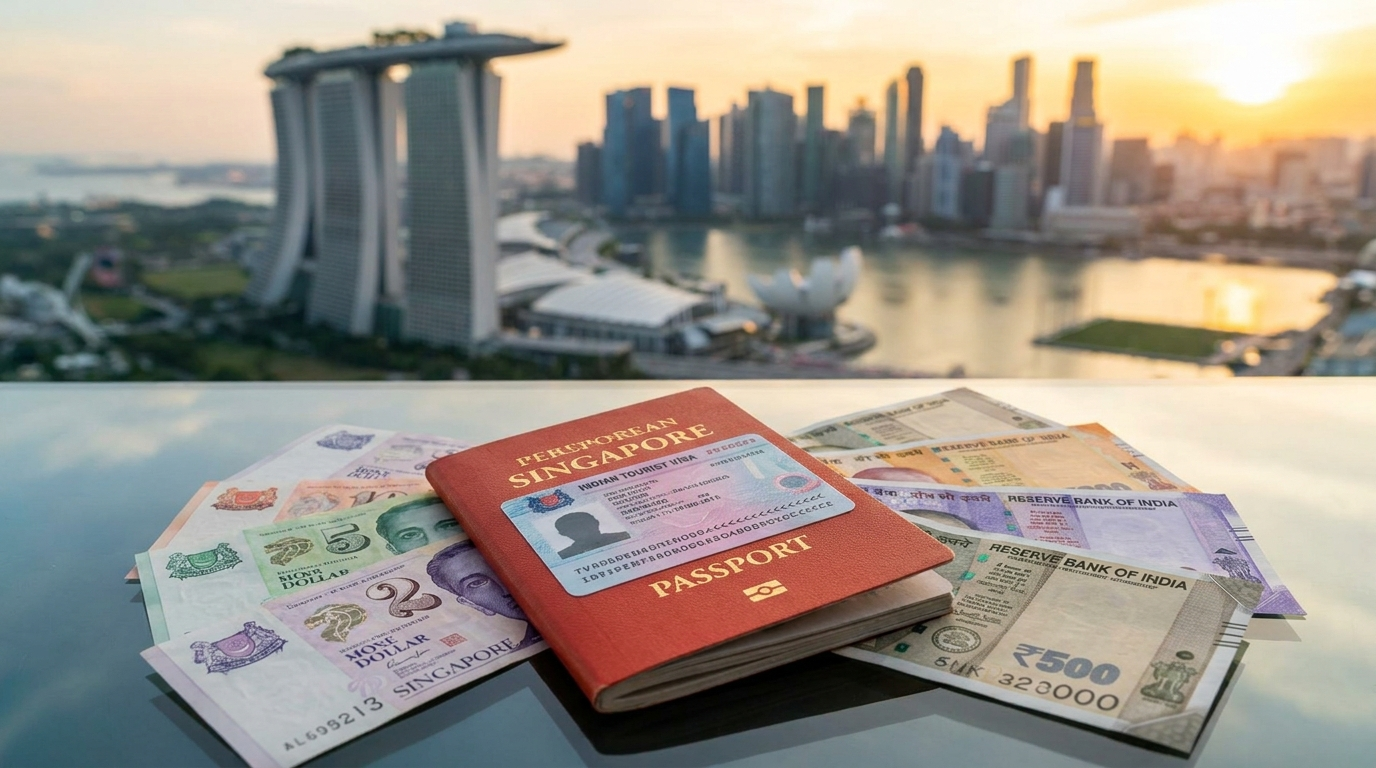
A Singapore tourist visa is one of the cheaper visas in the region on paper. The ICA government fee is SGD 30. The number that catches first-time applicants is the all-in cost, which depends on how the application gets filed and from where. Some travellers pay nothing at all because their passport is visa-exempt. Others end up around INR 3,280 after the authorised agent’s service charge.
This guide breaks down what every component costs in 2026, what an applicant actually pays by nationality, and the hidden costs that aren’t on the headline number.
The SGD 30 ICA fee, and what it covers
The Immigration and Checkpoints Authority charges SGD 30 per visa application. That figure has been stable for years and applies whether the outcome is a Single Journey Visa or a Multiple Journey Visa, whether ICA grants 14 days or 30 days of stay, and whether the visa runs for three months or two years.
The fee is non-refundable. A refused application loses the SGD 30. A withdrawn application loses the SGD 30. An application with the wrong supporting documents that ICA closes also loses the SGD 30. The money goes the moment SAVE accepts the submission, not when the e-Visa is issued.
As of 2026, SGD 30 converts to roughly USD 22 and roughly INR 2,100. Exchange rates move, so the rupee figure on the agent invoice will not match what a converter shows yesterday. Pay attention to the rate the AVA uses, not the live mid-market rate.
Authorised Visa Agent service fees by country
ICA does not accept tourist visa applications directly from overseas. Visa-required applicants either route through a Singapore-based local contact with SingPass, or through an Authorised Visa Agent (AVA) in the home country. The AVA fee sits on top of the SGD 30.
India
The Singapore High Commission in New Delhi has set the AVA service charge at INR 1,000 across all authorised handlers, including VFS Global and IVS Global. Authorised agents add 18% GST on the service charge, bringing the effective service fee to INR 1,180. The total payable through an AVA is the government fee in rupees plus INR 1,180. In practice that lands at roughly INR 3,280 in 2026, though the exact rupee figure fluctuates with the SGD-INR rate. Agents who quote significantly above INR 3,280 are usually adding express, courier, or photo services that the applicant can opt out of. The deeper walkthrough sits in our Singapore visa for Indians complete guide.
Other visa-required nationalities
For applicants from China, the CIS countries, Nigeria, Myanmar, and other Assessment Level I passports, the AVA service charge varies more. Most countries on the visa-required list have at least one operating AVA, with service fees typically equivalent to SGD 20 to SGD 60 on top of the government fee. The cheapest legal route is always a Singapore-based sponsor with SingPass, which skips the agent fee entirely.
Filing through a Singapore-based local contact
A Singapore citizen or PR can submit on a foreign applicant’s behalf through SAVE. The only cost in that case is the SGD 30 government fee. No agent service charge, no postage, no courier. The trade-off is that the local contact takes on the formal responsibility of confirming the applicant’s purpose and supporting their stay.
Not sure which route is cheapest for your nationality? We can sponsor your e-Visa application through SAVE and skip the agent fee entirely.
Visa-free passports: when the cost is zero
Most travellers reading this page need a visa. Many do not. The ICA visa-exempt list covers around 150 passports, and a few are worth calling out because the question keeps coming up.
Filipinos
Filipino passport holders are visa-exempt for short visits of up to 30 days. No visa fee, no SAVE application, no agent involvement. The only pre-arrival cost is whatever the airline charges for the flight, plus the free SG Arrival Card.
Canadians
Canadian passport holders are also visa-exempt for up to 30 days. The Government of Canada’s travel advisory and ICA’s own list confirm this. As with Filipinos, the visa cost is zero.
UK citizens
British passport holders can be granted up to 90 days at the ICA officer’s discretion, though 30 days is more common as an initial grant. US passport holders qualify for up to 90 days on the same terms. Cost: zero.
For all three groups, the only required pre-arrival action is the SG Arrival Card, which is free and digital, submitted within three days of the arrival date.
What “expedited processing” actually means
Singapore’s tourist visa does not have an official express service tier at ICA’s end. The published processing time is three working days for routine Level I cases, with five working days as a realistic planning figure. ICA either approves the file or it doesn’t, on its own timeline.
What AVAs call “express” is typically faster front-end handling on the agent’s side: document checks, queue priority at the submission counter, courier turnaround on the e-Visa printout. None of that speeds up ICA. If an agent quotes a guaranteed 24-hour turnaround on the visa itself for an extra INR 1,500 or USD 50, treat the offer with caution. The agent does not control ICA’s queue.
The Multiple Journey Visa: same fee, longer validity
A common assumption is that a multi-year visa must cost more. It doesn’t. ICA charges the same SGD 30 for a Single Journey Visa, a one-year MJV, a two-year MJV, a five-year MJV, and for Chinese passport holders, the ten-year MJV. The validity period is set by ICA’s assessment of the applicant’s profile and travel history, not by what the applicant pays.
The per-visit stay cap is still 30 days regardless of how long the visa runs. A two-year MJV means two years of being allowed to enter, with each entry capped at 30 days, not two years of staying in Singapore. The wider context is in our Singapore visa requirements and application guide.
Hidden costs that don’t appear on the quote
Three costs catch applicants who only budget for the headline figure.
An unsuccessful application is the most painful. The SGD 30 is gone, and reapplying means a fresh SGD 30 plus a fresh agent fee. For an Indian applicant who routed through VFS Global twice, that’s around INR 6,560 spent before an approval lands.
Document notarisation is rare for tourist visas but occasionally requested for business visits, particularly when the Letter of Introduction is from a foreign company rather than a Singapore sponsor. A notarised LOI costs whatever the local notary charges, usually a small fee in the home country.
The e-Visa is a PDF that the applicant prints. Printing is on the traveller, not the agent. Most don’t notice this because it costs a few cents, but it does need to be a printed copy carried with the passport. A screen on a phone is not the standard the airline check-in counter expects.
The SG Arrival Card is free. It is also mandatory. Any third-party service charging for SGAC submission is selling something that ICA gives away.
How Singapore compares to the region
For a sense of scale, the SGD 30 ICA fee is on the lower end for Southeast Asia. Vietnam’s single-entry e-Visa is USD 25. A multi-entry Vietnam e-Visa is USD 50. Thailand’s tourist visa-on-arrival fee is currently 2,000 THB for a 15-day entry, applicable to nationalities not covered by the country’s visa-exemption arrangements. Indonesia’s Visa on Arrival is IDR 500,000, about USD 32. Malaysia is visa-free for most ASEAN and major Western passports.
What makes Singapore different is the cost stack, not the headline fee. The SGD 30 is cheap. The AVA service charge for visa-required applicants pushes the all-in figure up, and the fact that overseas applicants cannot apply directly means the agent fee is unavoidable unless a Singapore sponsor is available.
Want a clear number for your specific case? Tell us your passport, your purpose of visit, and whether you have a Singapore sponsor, and we’ll quote the all-in cost upfront.