


Most travellers who pass through Changi never need a visa for the layover. If you stay airside, between flights, you don’t clear immigration at all and nothing is required beyond the boarding pass. The transit-visa question only matters when you want to leave the terminal, and even then, a lot of people who think they need a paid transit visa actually qualify for Singapore’s 96-hour Visa-Free Transit Facility (VFTF) instead.
This guide is about the VFTF: who qualifies, what counts as a qualifying visa, how long it gives you, and what to do if you don’t qualify.
Who actually needs a transit visa
Singapore splits travellers into three groups, and the transit question maps onto them differently.
Visa-free passport holders, which is most of the developed world plus around 150 other nationalities, never need a transit visa. They walk in on a Short-Term Visit Pass (STVP) of 14, 30, or 90 days like any other visitor. The VFTF is not for them, and there’s no reason to apply for it.
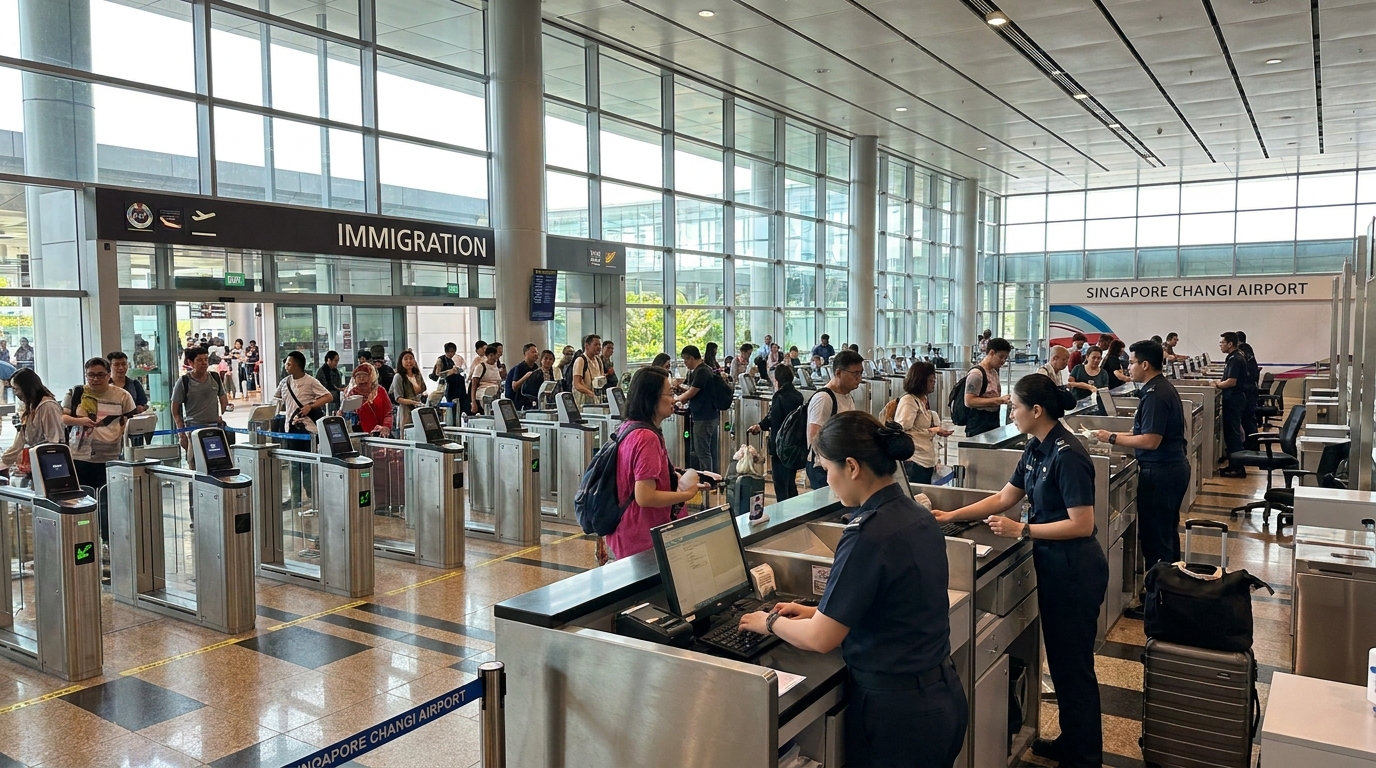
Visa-required nationals (ICA’s Assessment Level I and Level II lists) are the group that needs to think about transit. That covers Indian, Chinese and CIS passport holders, plus Georgia, Turkmenistan, Ukraine, and the Level II list. For them, the choice is between the 96-hour VFTF and a paid transit visa filed through SAVE.
The third group: people staying airside the entire layover. No immigration clearance, no pass, no VFTF needed. Just transfer between terminals on the Skytrain and board the next flight.
What the VFTF gives you
The VFTF is a free, on-arrival facility, not a visa you apply for in advance. ICA officers at the checkpoint assess your documents and either grant it or refuse it. There’s no online form, no fee, and no advance approval.
If granted, it gives you up to 96 hours in Singapore for transit purposes. Four days, counted from the moment you enter. It’s a one-time thing per journey: you can use it on the outbound or return leg, but not both. The one carve-out is for Single Journey Visa holders. If you used a paid SJV on the outbound leg and are heading directly home from the SJV-issuing country via Singapore without having returned home in between, ICA may still grant VFTF on the return leg. Extensions are not allowed under any circumstances. If you need to stay longer than 96 hours, the answer is a regular tourist visa, applied for the normal way.
Eligible nationalities
The VFTF is narrower than the Indian-passport coverage suggests. ICA lists four groups, and the rules that apply to each group are not identical:
- CIS nationals: Armenia, Azerbaijan, Belarus, Kazakhstan, Kyrgyzstan, Moldova, Russia, Tajikistan, Uzbekistan.
- Georgia, Turkmenistan, Ukraine nationals.
- Indian passport holders.
- Selected People’s Republic of China nationals. This excludes ordinary, diplomatic, public-affairs and service PRC passport holders, but covers holders of the PRC Travel Document, the Hong Kong SAR Document of Identity, and the Macao SAR Travel Permit.
The CIS group plus Georgia, Turkmenistan and Ukraine sit on one set of rules. India and selected PRC nationals sit on a stricter set. The difference matters and is the single biggest source of confusion about the VFTF.
Visa-required nationalities not on this list (most of ICA’s Level II countries, for example) cannot use the VFTF and need a paid transit visa instead.
Not sure whether you qualify for the VFTF or need a paid transit visa? Send us your passport and itinerary and we’ll confirm before you book the flight.
What each group has to show
This is the part most applicants miss. The VFTF isn’t a blanket facility, and the document rules split by group.
CIS nationals, Georgia, Turkmenistan and Ukraine
If you hold a passport from one of these countries and are in transit to or from any third country, you do not need a qualifying visa from anywhere else. The requirement is simpler: a valid onward air ticket out of Singapore within 96 hours of arrival, and departure has to be by air. No Australian, Canadian, German, Japanese, New Zealand, Swiss, UK or US visa is required at all. A Russian, Belarusian or Ukrainian passport with a confirmed onward flight to a third country is enough.
Indian and selected PRC nationals
For this group the rule is stricter. You have to hold a valid visa or long-term pass from one of eight specific countries, and it has to be valid for at least one month from the date you enter Singapore. On top of that, you need an onward air, ferry or cruise ticket out of Singapore within 96 hours, with departure by air or sea.
The eight qualifying countries:
- Australia
- Canada
- Germany
- Japan
- New Zealand
- Switzerland
- United Kingdom
- United States
A used US B1/B2 with three months left, a current UK Standard Visitor visa, a Canadian study permit, an Australian ETA still inside its 12-month window: all of these count. A Schengen uniform C-visa also fits, because it is valid for entry into Germany and Switzerland by default, whichever Schengen state issued it. The one carve-out is a Schengen visa with limited territorial validity that excludes both Germany and Switzerland: that would fall outside the VFTF. A German national visa qualifies in its own right on the Germany line.
A long-term pass works too: a Japanese student visa or an Australian temporary resident visa, for instance. The “one month of remaining validity from date of entry into Singapore” rule applies in both cases.
How to enter on VFTF
There’s no application step. You arrive at Changi, queue at immigration, hand over the passport, and tell the officer you’re transiting on the VFTF. Be ready to show:
- The onward ticket leaving Singapore within 96 hours
- If you are Indian or in the selected PRC group: the qualifying visa or long-term pass (in the passport, or in a secondary document if it’s an Australian ETA)
- Whatever else ICA wants to see (return ticket, hotel, the usual visit-pass checks)
If everything checks out, the officer grants entry under the VFTF and stamps you in. The SG Arrival Card still has to be submitted within the three-day window before arrival; the VFTF doesn’t exempt you from that. Our Singapore visa guide for Indian passport holders covers the SG Arrival Card details in full.
Departure mode rules
ICA imposes different exit rules depending on which group you’re in, and this catches people out:
- CIS, Georgia, Turkmenistan, Ukraine: must depart by air. Land or sea exits don’t qualify under VFTF.
- India and selected PRC: can depart by air or sea. A ferry to Batam or Bintan counts, as does a cruise from Marina Bay Cruise Centre. Land departures to Malaysia don’t.
Entry mode is more flexible — any mode is fine across the board — but the departure restriction is firm, and it’s the most common reason for VFTF being refused.
When you can’t use the VFTF
If you’re an Indian or selected PRC national without a qualifying AU/CA/DE/JP/NZ/CH/UK/US visa, or you’re in the CIS/Georgia/Turkmenistan/Ukraine group planning to leave by land or sea, or your onward leg is by land, or your stay is going to exceed 96 hours, the VFTF is out. The route is the regular Singapore visa applied for through SAVE, ICA’s online system, for the standard SGD 30 fee. It runs through the same authorised visa agent or Singapore sponsor channel as a tourist application. The full process sits in the parent Singapore visa requirements and application guide.
The paid transit visa works the same way as a Single Journey Visa: SGD 30 to ICA, processed in around three working days, and good for a STVP of up to 30 days at the checkpoint. It’s slower and costs more than the VFTF, but it’s the right answer when the VFTF doesn’t fit.
A quick reality check on airside transit
One last point worth being explicit about. If your itinerary lands in Singapore and departs from Singapore on connecting flights without leaving the terminal, the VFTF is irrelevant. Changi’s terminals are connected airside by the Skytrain, and there’s no immigration clearance involved. You don’t need a visa, a pass, or a VFTF. Just walk to the next gate.
The VFTF is for people who want to step into Singapore proper during the layover — to spend a night downtown, see family, attend a meeting — and who don’t already have a Singapore visa. For that specific case, it’s a clean and free option if you fit the eligibility rules.
Planning a Singapore layover and want it sorted before you fly? We assess eligibility, file the transit or tourist visa where needed, and confirm what documents to bring to Changi.