

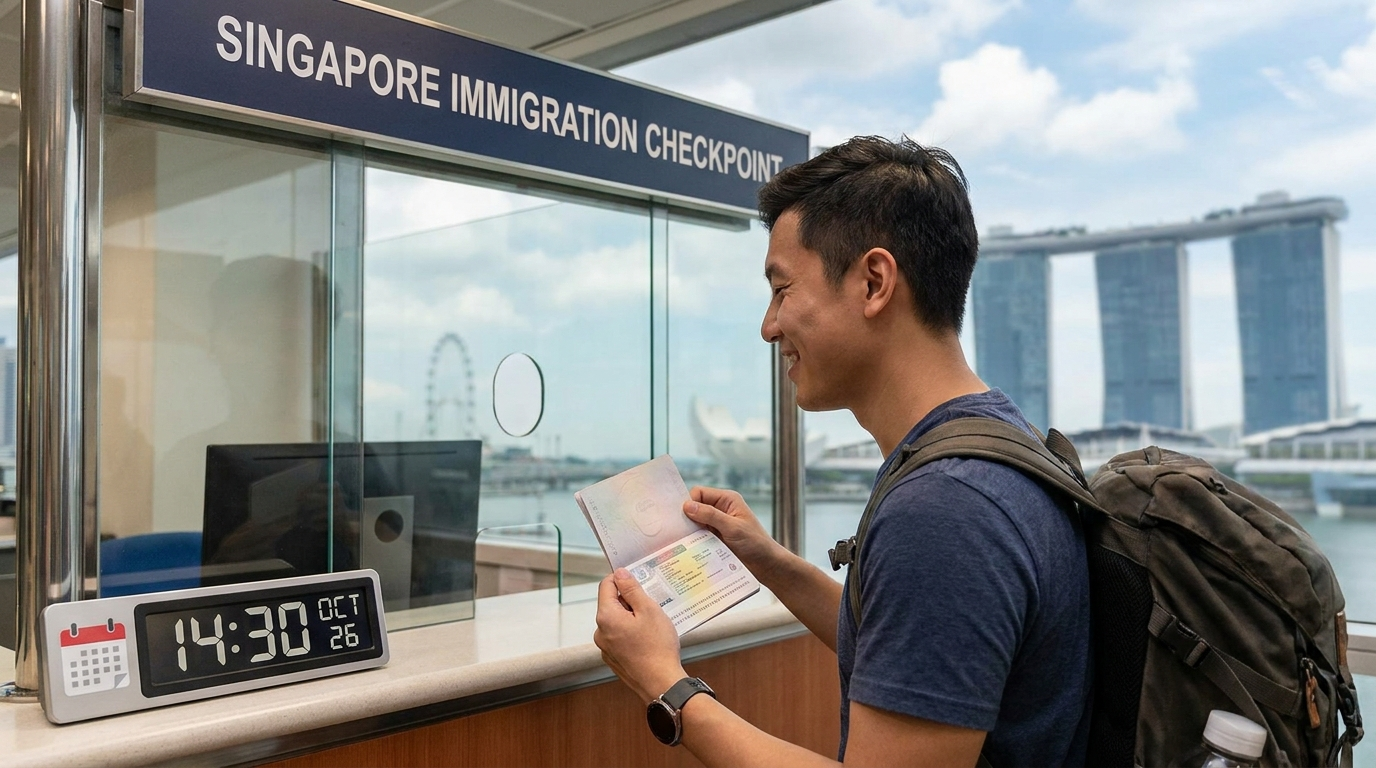
The Singapore Multiple Journey Visa (MJV) is the option for travellers who’ll be coming back to Singapore more than once over a longer period. One application, one SGD 30 fee, one e-Visa PDF that covers every entry inside the validity window. The catch is that getting it on a first attempt is uncommon. ICA usually wants to see a clean single-entry trip on the file first.
This guide covers what the MJV actually is, who qualifies, the validity tiers ICA grants, what each visit looks like once you’ve got it, and the most common confusion: that an MJV does nothing to lengthen the stay you get at the checkpoint.
What the MJV is and what it isn’t
An MJV is the visa-stage equivalent of buying a season pass. Inside the validity period, the holder can enter Singapore as many times as they want without filing again. A Single Journey Visa (SJV) is single-use and expires the moment it’s been clocked at the checkpoint.
The MJV has nothing to do with how long you can stay each time. The Short-Term Visit Pass (STVP) handed out by the ICA officer at Changi is what dictates that, and the standard grant is up to 30 days regardless of how long the underlying MJV runs. Every entry resets the stay clock from zero.
This is the single most common confusion we see. A two-year MJV does not give you a long stay. It gives you the right to enter Singapore over a two-year window, with each visit capped by whatever STVP the officer stamps in. Travellers planning a stay of more than 30 days need a different pass entirely, not an MJV.
Who qualifies
Not every visa-required nationality can apply for an MJV directly. ICA generally wants to see a clean single-entry trip on the file first, ideally with the visit completed inside the granted STVP and no red flags on the record. After one or two successful trips, an MJV becomes realistic to ask for on the next application.
There are two practical exceptions. Business travellers with a credible Singapore-based sponsor and a Letter of Introduction sometimes get an MJV on a first application, especially when the documented purpose involves recurring meetings, training, or contract work. Family members of Singapore citizens and PRs also tend to be assessed more generously.
The application route is the same as for an SJV: submission through ICA’s SAVE system, by a Singapore-based local contact, a registered sponsor, or an Authorised Visa Agent in the applicant’s home country. Overseas applicants still can’t file directly. Full mechanics are in the parent Singapore visa guide on requirements and application.
Validity tiers
ICA grants MJVs in three standard validity tiers (1, 2, and 5 years), with a separate 10-year band opened for PRC nationals in 2015. Most applicants get the shorter tiers first and work up.
The 1-year MJV is the entry-level tier, commonly granted to first-time MJV applicants with a clean SJV trip behind them. It covers a typical pattern of two or three return visits.
The 2-year MJV is the most commonly granted MJV for repeat travellers with two or more clean trips on file. For Indian passport holders in particular, the 2-year MJV is now the default after a successful first SJV.
The 5-year MJV is the standard upper tier and reaches travellers with a longer documented history of clean visits and a stable purpose for repeat travel. Business travellers backed by a long-running Singapore sponsor often sit in this tier.
The 10-year MJV is a country-specific arrangement opened to PRC passport holders on 1 June 2015. PRC nationals who have previously visited Singapore and whose application is supported by a relevant Singapore agency may be granted the 10-year validity automatically when applying through the usual route. No separate application form is involved.
ICA doesn’t publish a guaranteed-tier table. The validity granted is at ICA’s discretion based on the strength of the file.
Want a quick read on whether an MJV is realistic for your situation? We assess your travel history, sponsor strength, and purpose, then file through SAVE if the case is solid.
Per-visit stay and the SGAC
The per-visit cap is the part travellers most often miss. Every entry under an MJV gets a fresh STVP, decided at the checkpoint by the ICA officer, with typical grants of up to 30 days and shorter grants possible at officer discretion. A clean record and a clear short-stay purpose tend to get the longer end of the range.
The SG Arrival Card (SGAC) has to be submitted within three days of arrival (including the day of arrival) before every single entry. The MJV doesn’t replace the SGAC, and there’s no exemption for repeat visitors holding a long-validity MJV. Submission is free, done through the SGAC e-Service or the MyICA Mobile app, and includes a short health declaration.
Since the No-Boarding Directives came into effect on 30 January 2026, ICA has been using advance traveller information, including the SGAC, to flag travellers who don’t meet entry requirements and instruct airlines not to board them. NBDs target identified high-risk or non-compliant travellers rather than routine submission slips, but airlines are also doing their own visa and SGAC checks at the counter, and a missing or stale SGAC can still hold up boarding. Submit the SGAC fresh for every trip.
When the MJV isn’t the right tool
If the goal is to spend more than 30 days in Singapore in one stretch, an MJV doesn’t help. There are two routes for that situation.
The first is to apply for an extension of the current STVP through ICA’s e-XTEND service before the existing pass expires. For most visitors, ICA typically grants up to 30 additional days on a standard extension. A longer extension of up to 89 days total from the date of entry is reserved for immediate family members (spouse, parents, children, or siblings) of Singapore citizens or PRs. There is no extension fee while total stay stays under 90 days. The moment an extension carries total stay to 90 days or more from the date of entry, an SGD 40 extension fee kicks in (and again at each subsequent 90-day block). The original SGD 30 MJV fee is not charged again. Extensions are at ICA’s discretion and are usually granted for specific, documented reasons such as ongoing medical treatment or family circumstances.
The second is to apply for an appropriate long-term pass entirely. Work passes, student passes, Long-Term Visit Passes for family members of citizens and PRs, and other route-specific options exist for stays that are genuinely not short-term in nature.
The MJV is the wrong tool when the question is duration. It’s the right tool when the question is frequency.
Fees and processing
The government fee for an MJV is SGD 30. The same SGD 30 as a single-entry visa, regardless of whether ICA grants 1, 2, 5, or 10 years of validity. The fee is non-refundable. A refused application or a withdrawal both lose the SGD 30.
Authorised Visa Agents add their own service charge on top. For Indian applicants filing through VFS Global or IVS Global, the all-in cost is typically INR 3,280 (INR 2,100 government fee plus an INR 1,000 service charge and 18% GST), the same as for an SJV. Filing through a Singapore-based local contact who can log into SAVE with SingPass avoids the agent fee entirely, leaving just the SGD 30 government charge.
Processing usually takes three to five working days for clean applications, the same window as an SJV. ICA can hold an application for further review if anything on the file raises a question, in which case the wait extends. As with any visa application, the working rule is to wait for the e-Visa in hand before booking non-refundable flights. The wider cost breakdown is in our Singapore visa fees and costs guide.
What to send and what to ask for
The document list is the same as for a single-entry application: passport biodata page with at least six months of validity from entry, a recent colour passport photograph to ICA’s spec, a completed Form 14A submitted through SAVE, and an introduction letter from the local contact. Business applicants add the Letter of Introduction (Form V39A) signed by the Singapore sponsor.
The one thing applicants can do at the application stage to push for a longer MJV is to make the case explicit. SAVE doesn’t have a tickbox for “give me a two-year MJV”. The application itself just gets assessed. A covering note from the local sponsor explaining the pattern of past and planned visits, attached to the file, is the practical way to make the case for the validity tier you want.
For applicants who’ve already used an SJV cleanly and want to apply for an MJV next, the first SJV’s record is on the ICA system already. There’s no separate “graduation” form. The same SAVE application gets filed; ICA’s assessment looks at the full history.
Ready to apply for a Singapore MJV with a local sponsor on the file? We file through SAVE, prepare the supporting letter for the validity tier you’re aiming for, and handle the ICA follow-up.
Have a question about your own situation? Tell us on WhatsApp and a consultant will reply.
Chat with an OCSC consultant