

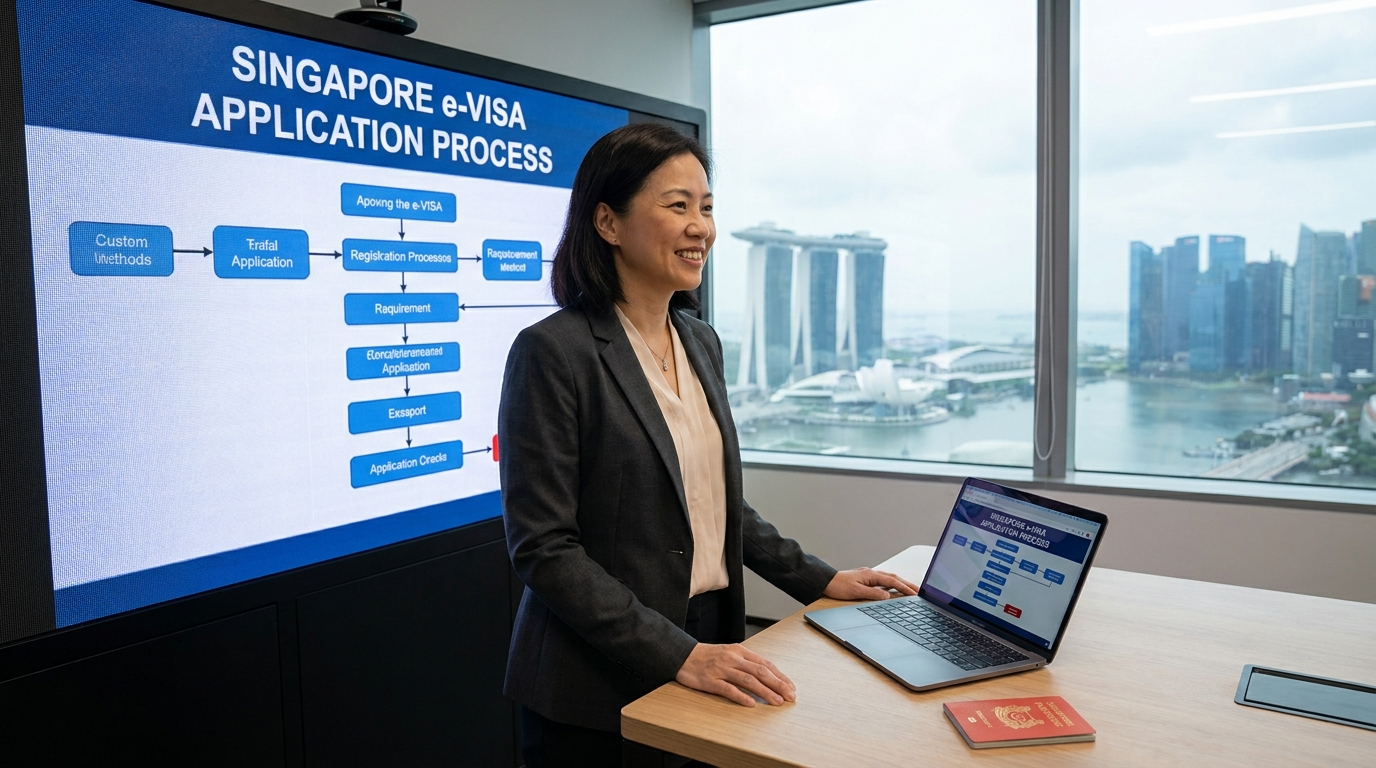
The Singapore e-Visa is fully digital, costs SGD 30, and usually comes back inside three working days. The friction is in the first step, before any form gets filled in. ICA’s online system, SAVE, isn’t open to a foreign tourist sitting in Delhi or Beijing. It only accepts submissions from a Singapore-based contact with a SingPass account, or from an Authorised Visa Agent (AVA) in the applicant’s home country.
Once that part is sorted, the rest is mechanical. This guide covers who qualifies for the e-Visa route, how the application actually works through SAVE and the AVA channel, what the e-Visa looks like when it arrives, and what to do if ICA turns the file down. For the broader context, see the Singapore visa requirements and application guide.
Who qualifies for the online e-Visa route
Only nationals on the ICA visa-required list need a Singapore visa in the first place. Visa-exempt passport holders just file the SG Arrival Card and clear immigration on arrival.
The visa-required list splits into two assessment tiers. Assessment Level I covers most visa-required nationalities, including India, China, the Commonwealth of Independent States, and Georgia. These applicants can apply online through SAVE via a Singapore-based contact or an AVA. Assessment Level II is the higher-scrutiny tier, including Afghanistan, Bangladesh, Iran, Iraq, Nigeria, Pakistan, and Saudi Arabia among others. Level II applicants face stricter scrutiny and typically apply via a Singapore embassy or consulate or an authorised agent, though SAVE submissions through a local contact or a strategic partner are also permitted in certain cases.
The other catch: there’s no public ICA portal where a foreign tourist can sign in and self-apply. SingPass, the login system SAVE runs on, is the digital identity for individuals (Singapore citizens, PRs, and certain pass holders aged 15 and above); Singapore-registered businesses use a separate system called CorpPass. So even a Level I applicant doesn’t open a SAVE account themselves. Someone in Singapore, or an authorised agent overseas, does it for them.
The three submission routes
For a Level I applicant, three paths exist. Pick whichever fits your situation.
The first is a Singapore-based contact, a friend, relative, or business host who has SingPass. This is the cheapest route because the only cost is the SGD 30 government fee. The local contact logs into SAVE, completes Form 14A on the applicant’s behalf, uploads the documents, and submits.
The second is an Authorised Visa Agent in the home country. VFS Global runs the deepest AVA network, operates online portals in India (visa.vfsglobal.com), China, and several other markets, and is the dominant AVA for Indian applicants. The all-in cost is the SGD 30 government fee plus an agent service charge, usually SGD 20 to 60 equivalent depending on the country and the speed of service.
The third is a Singapore embassy or consulate, which is the required route for Assessment Level II nationalities. Submission is in person or through the post’s appointed channel.
The full list of AVAs by country lives on the Ministry of Foreign Affairs site at mfa.gov.sg.
The step-by-step application
The application is the same regardless of which route handles it.
Gather the documents first. A scan of the passport biodata page, valid for at least six months beyond the planned date of entry. A digital colour photograph: 35mm by 45mm, plain white background, taken within the last three months, full face, no tinted lenses or sunglasses (clear, untinted everyday glasses are allowed if the eyes are fully visible with no glare). A copy of the return or onward flight booking. Hotel confirmation or the local contact’s address. For sponsored visits, whether social or business, the Letter of Introduction (LOI), sometimes referenced as Form V39A, signed by the Singapore-based contact (citizen or PR aged 21 and above with SingPass) on personal or company letterhead.
The local sponsor or AVA opens Form 14A in SAVE. Form 14A is the Application for Entry Visa. It captures the applicant’s biodata, travel dates, purpose of visit, accommodation in Singapore, and the local contact’s details. The form is completed online, not printed. Hardcopies of Form 14A and V39A aren’t needed unless ICA specifically asks for them later.
Documents are uploaded as digital attachments. The biodata scan, photograph, and any supporting paperwork go up at this stage. The photograph upload is where most files get held: ICA’s spec on background colour, dimensions, and recency is checked automatically, and a near-miss gets bounced back for resubmission.
Pay the SGD 30 government fee. Payment is made through SAVE at the point of submission. The fee is non-refundable. An unsuccessful application or a withdrawn application both lose the SGD 30.
Wait for the ICA decision. Routine Level I cases clear in three working days. Three to five working days is the safer planning figure, with weekends and Singapore public holidays excluded. Cases flagged for additional review can take a week or more.
Download the e-Visa PDF. Once approved, the e-Visa arrives by email as a PDF. The applicant prints it and carries it with the passport. There’s no physical sticker, no embassy collection, and no in-person interview.
Need a Singapore-based contact to file your e-Visa through SAVE? We act as your local sponsor, complete Form 14A, and manage the ICA follow-up.
What the e-Visa actually looks like
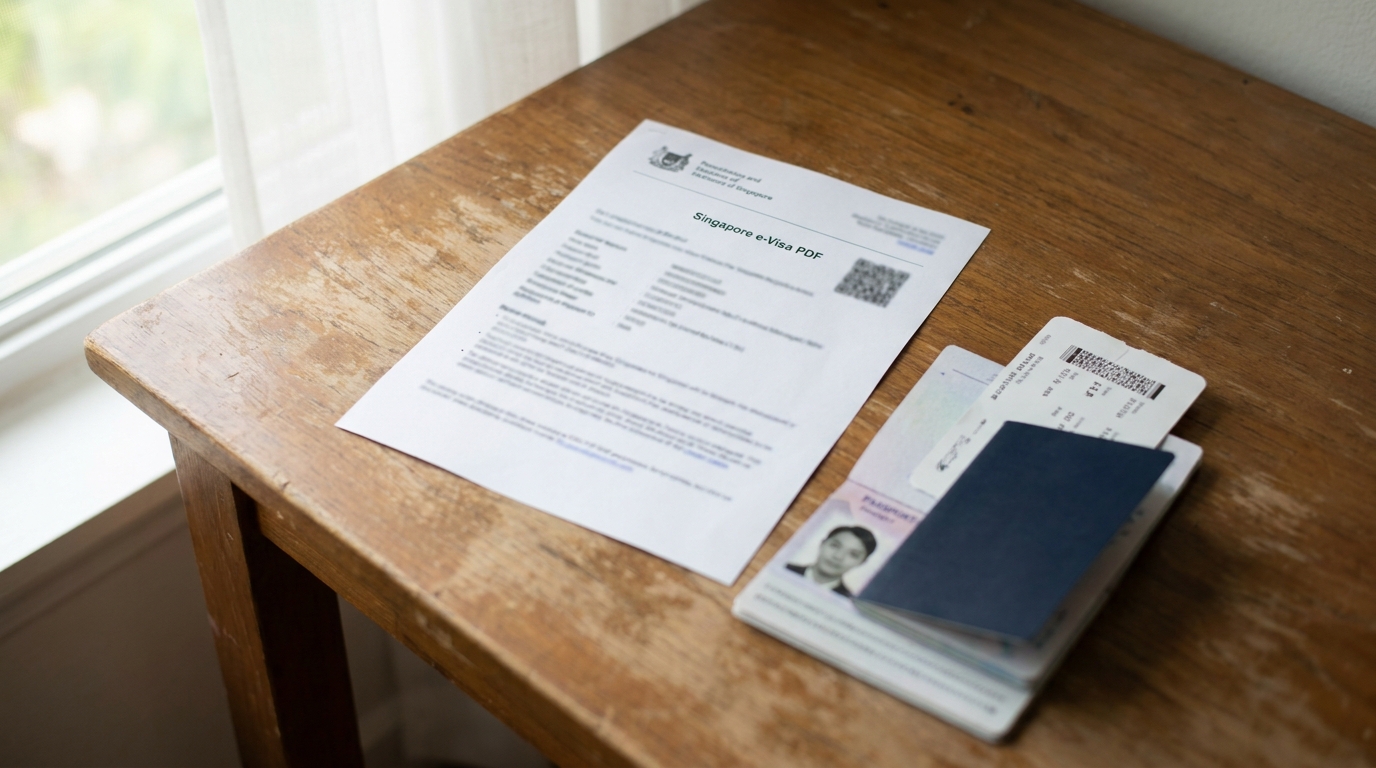
The Singapore e-Visa is a single-page PDF with the applicant’s name, passport number, visa number, type (single or multiple journey), period of validity, and an ICA reference. It’s tied to the passport number, not the document itself. Renewing the passport after issuance means going through the application again.
The most common point of confusion is the gap between validity and stay. A Single Journey Visa is valid for one entry only, and its validity period varies with ICA’s assessment. Tourist SJVs are commonly granted with shorter validity of one to three months, occasionally longer, up to a maximum of two years. A Multiple Journey Visa can run one, two, or five years. But that validity is only the window in which the visa can be used to enter Singapore. The actual length of stay is decided by the ICA officer at Changi, and the standard grant is a Short-Term Visit Pass of 14 to 30 days regardless of how long the visa itself runs.
At the checkpoint, the printed e-Visa goes to the ICA officer alongside the passport. The officer matches the passport number, asks the standard questions about purpose, accommodation, and funds, and stamps in the Visit Pass. No physical visa stamp is applied to the passport.
The breakdown of fees by route and nationality is in the Singapore visa fees and costs guide.
Common mistakes to avoid
The wrong form is the most frequent issue. Form 14A is the application; Form V39A is the LOI used by a Singapore-based sponsor for social or business visits. A sponsored applicant who submits Form 14A without the V39A LOI gets the file held until the sponsor produces it.
The photograph is the second. ICA’s spec is strict: 35mm by 45mm, plain white background, taken within the last three months, full face, neutral expression, no tinted lenses or sunglasses (clear, untinted everyday glasses are fine if the eyes are fully visible with no glare). A photo that’s six months old, taken against an off-white wall, or scaled from a larger image is the most common reason for a SAVE submission getting bounced.
Missing supporting documents is the third. Return flights, hotel bookings, and the local contact’s letter aren’t always asked for, but when ICA does ask, the file pauses until they arrive.
Mistaking visa validity for permitted stay is the fourth, and it’s the one that catches people after the e-Visa is granted. A two-year MJV does not grant two years of staying. Each visit is capped at the Visit Pass the officer grants, usually 30 days. Indian applicants get caught by this more than any other group; the Singapore visa for Indians complete guide covers the per-visit limits in detail.
What to do if ICA turns the application down
ICA doesn’t publish detailed reasons when an e-Visa is unsuccessful. The notification through SAVE simply states the outcome.
The standard next step is a fresh application with stronger supporting documents. Common gaps to close: a clearer local sponsor relationship, a more detailed itinerary, proof of funds, and evidence of past clean travel to other developed countries. The SGD 30 fee on the original application is gone, and a new SGD 30 has to be paid on the resubmission.
For repeated unsuccessful applications, or for Level II nationalities going through an embassy, a local immigration consultant in Singapore can sponsor the application directly through SAVE. The advantage is that the file goes in with a Singapore-registered entity as the local contact, which carries more weight than an overseas-only application.
If you’re planning to file from outside Singapore and want a local sponsor to handle the SAVE submission end-to-end, that’s the route we run for most of our clients.
Ready to file your Singapore e-Visa? We complete Form 14A, submit through SAVE, manage document checks, and follow up with ICA.