

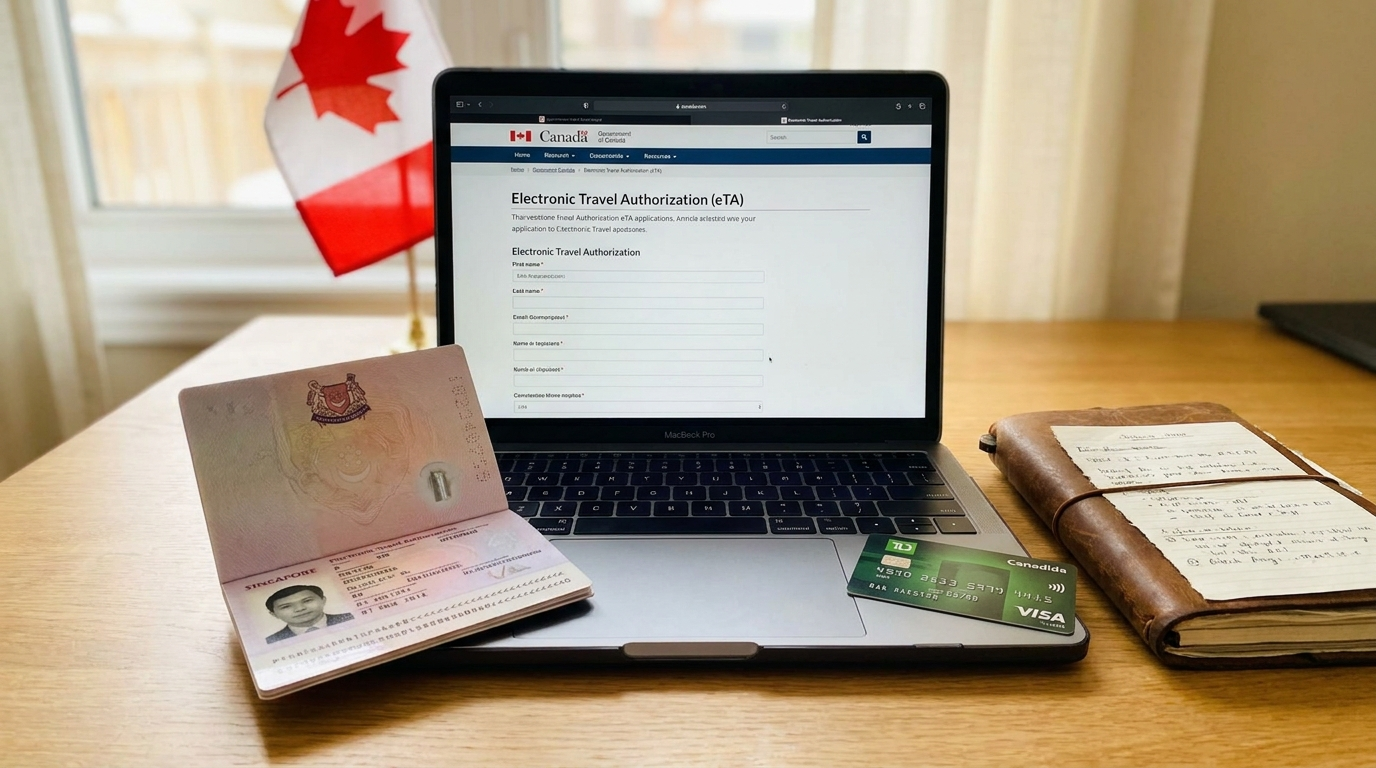
Going to Canada from Singapore is one of the easier travel routes for a Singapore passport holder. There is no embassy queue, no sticker in your passport, and the government fee is CAD 7. For most leisure or business trips, the whole “visa” step is an online form that gets approved by email in minutes.
The catch is that “easy” only applies if your trip and your passport both fit into a fairly narrow box. Flying instead of driving in, staying longer than six months, working remotely while you are there, or holding a non-Singapore passport while living in Singapore all change the rules. This guide pulls together the pieces so you can figure out which path you are actually on before you book a flight.
Who this guide is for
We see two main groups of Singapore-based travellers heading to Canada. The first group holds a Singapore passport and is going for tourism, family, a conference, a wedding, or a short business trip. The process for this group is almost entirely online and finishes with an Electronic Travel Authorization (eTA).
The second group lives in Singapore but travels on a passport from a visa-required country. That includes a lot of Employment Pass holders, S Pass workers, Dependant’s Pass holders, students, and even Singapore PRs who have not yet taken up Singapore citizenship. This group applies for a full visitor visa, called a Temporary Resident Visa (TRV), through the IRCC online portal, with biometrics done at the VFS centre in Singapore.
The document you need is decided by the passport in your hand, not by where you live. That is the single most useful thing to know before you start. For a closer read on this question, see our guide on whether Singaporeans need a visa for Canada.
eTA: the path most Singapore passport holders take
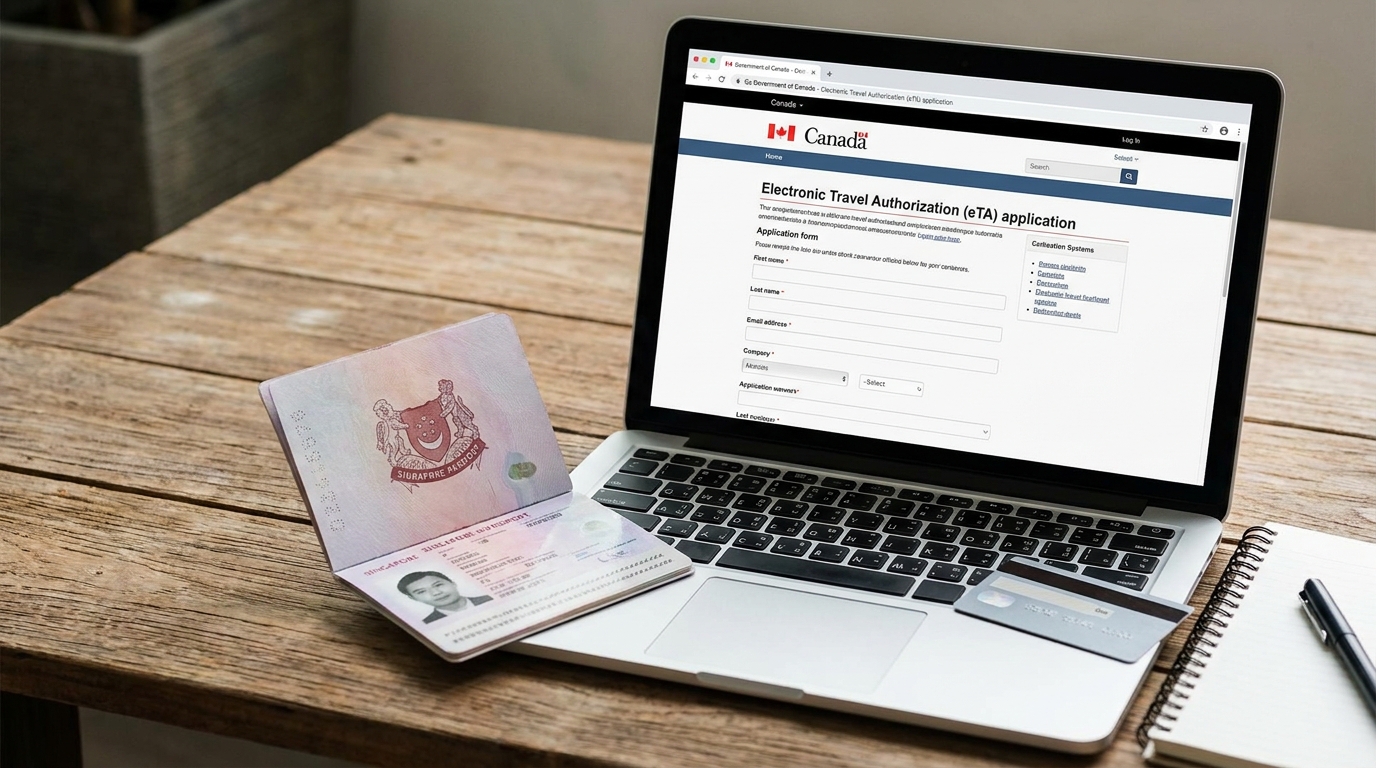
If you carry a Singapore passport and you are flying into Canada, you need an approved eTA linked to your passport before you board. The eTA covers commercial and charter flights, including stops where you only transit through a Canadian airport. Travelling by land or sea, you skip the eTA entirely and just show your passport at the border.
The fee is CAD 7 through the official canada.ca website. Most approvals come back within minutes of submitting the form. A small share of applications get flagged for review, in which case IRCC may ask for more documents and the wait can stretch to several days or longer.
Once approved, the eTA stays valid for five years or until your passport expires, whichever happens first. During that window you can enter Canada as many times as you want, normally for stays of up to six months per visit. The CAD 7 covers all of that.
A few practical points to keep in mind:
- Apply before you book a flight, not after. Most approvals land in minutes, but if IRCC needs extra documents you will normally hear within 72 hours of submitting. Boarding can be refused if the approval has not come through.
- Use the official canada.ca domain. Third-party sites charge SGD 50 to SGD 100 for the same form and offer nothing extra.
- Renew your passport and the old eTA stops working, even if it still has years left. You will need a new one before the next flight.
TRV: the path for non-Singaporean passport holders
If you are based in Singapore but travel on a passport from India, China, Vietnam, Pakistan, Bangladesh, Nigeria, or most of the Middle East and Africa, you fall under Canada’s Temporary Resident Visa rules. Citizens of Indonesia, Malaysia, and the Philippines also sit in the visa-required bucket by default, though as of May 26, 2026 some Indonesian and Malaysian citizens who meet IRCC’s requirements may be eligible to apply for an eTA by air instead, and a similar partial eligibility exists for the Philippines. If you are not sure where your passport sits, run IRCC’s official entry-requirements tool before you start. The TRV is filed online through your IRCC Secure Account. Biometrics are collected at the Canada Visa Application Centre in Singapore, run by VFS Global.
The basic IRCC fees are CAD 100 for the visitor visa and CAD 85 for biometrics, with a family cap of CAD 170 for biometrics when spouses and dependent children apply together. Both are paid to IRCC during the online application. VFS Global typically charges a separate VAC service fee on top at the appointment, plus optional add-ons like courier return or photocopying, so check the VFS Singapore site for the current amount before you book. An issuing officer can grant a multiple-entry visa valid for up to ten years, but the validity is also capped by whichever expires first: your passport or your biometrics (biometrics are normally good for ten years from the date you give them).
The paperwork is more involved than an eTA. You will need:
- A current passport that stays valid through your intended stay (IRCC will not issue a visa beyond your passport’s expiry, so most applicants aim for at least six months past the trip)
- Proof of legal status in Singapore (Employment Pass, S Pass, Dependant’s Pass, Student Pass, or Re-Entry Permit)
- Evidence of funds for the trip (bank statements, payslips, employment letter)
- A travel itinerary and proof of accommodation
- A purpose-of-visit letter explaining the trip
- Any documents that show ties to Singapore, like a tenancy agreement, CPF statement, or family obligations
The full walkthrough of the TRV is in our Canada visitor visa application guide, including the IRCC Secure Account setup, the document checklist, the biometrics process at VFS Singapore, and what to do when the system asks for medical exams or upfront medicals.
Not sure which path applies to you? Send us a quick message with your passport and pass details and we will tell you exactly what to file.
The Canadian government offices in Singapore
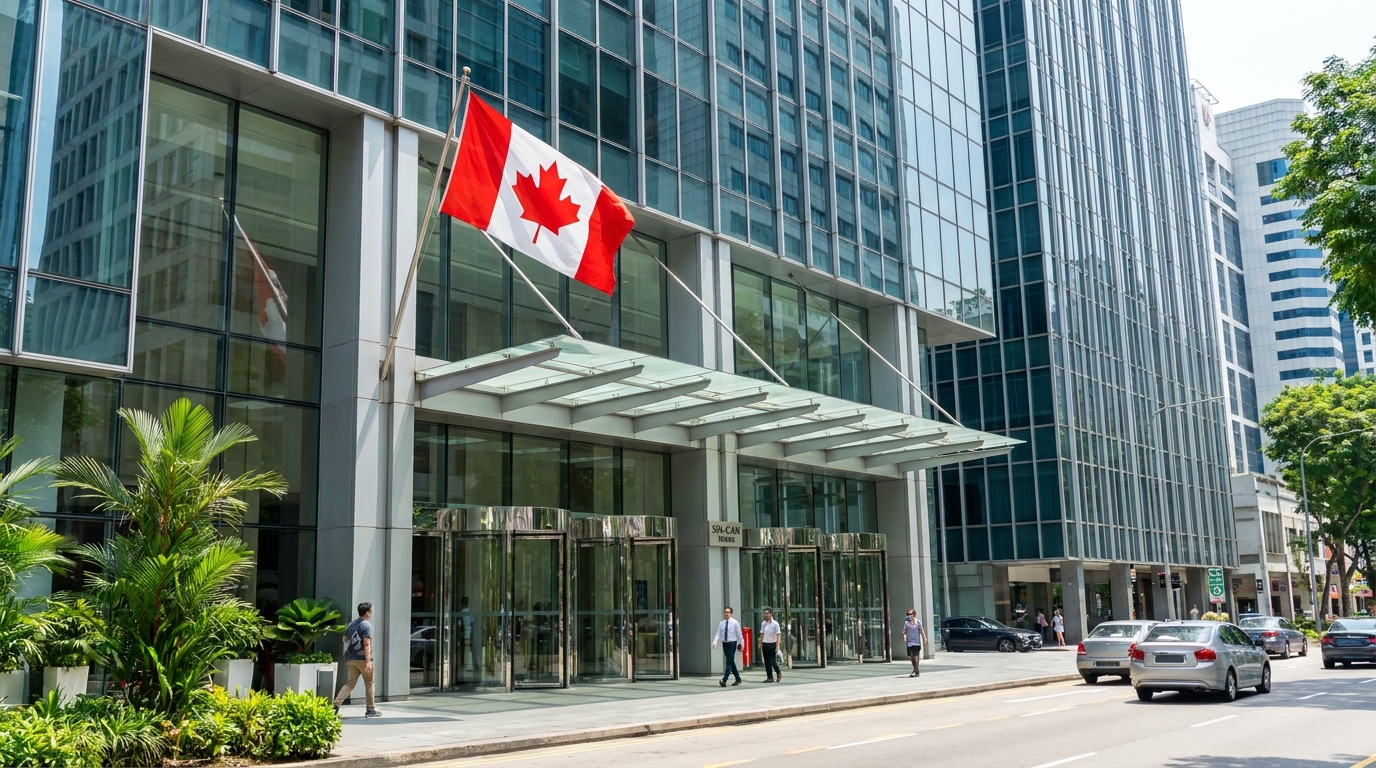
A common search is “IRCC Singapore office,” and the results are usually confusing because IRCC does not run a standalone immigration office here. What you have instead is the High Commission of Canada in Singapore at One George Street, which handles consular and diplomatic work, and a separate Canada Visa Application Centre run by VFS Global. The VAC handles biometrics enrolment and document submission. Neither office decides your application. Files are processed by IRCC centres in Canada or by regional visa offices abroad.
For most Singapore residents this means you never set foot in a Canadian visa office. You upload the application online, you visit VFS once for biometrics, and the decision comes by email. The High Commission does not take walk-ins for visa or immigration enquiries.
The split between the High Commission and the VAC is worth understanding before you start hunting for a phone number. For a full breakdown of what each office actually does and the right contact channels, see our piece on IRCC Singapore and the Canada immigration office.
How long it really takes
Processing times depend almost entirely on which document you are after. For Singapore passport holders applying for an eTA, the answer is usually minutes. For a TRV filed out of Singapore, the wait varies and is best checked against IRCC’s official processing-times tool, which gives a country-specific estimate. Clean files filed out of Singapore tend to land at the faster end of that range, but the tool’s number is an indication rather than a guarantee.
The longest delays usually have nothing to do with IRCC’s backlog. They come from incomplete applications, missing supporting documents, or biometrics that have not yet been submitted. Each of those resets the clock. If IRCC requests an extra document or a medical exam, the file pauses until you respond.
A more detailed look at current ranges, plus where the delays come from in practice, is in our Canada visa processing time guide. We update it through the year as IRCC publishes new figures.
Work, study, and longer stays
The eTA and the TRV both cover visiting. Neither lets you work for a Canadian employer or study a program longer than six months. Those situations need their own permits.
A work permit usually depends on a Canadian employer’s job offer and, in most cases, a Labour Market Impact Assessment. There is also the International Mobility Program, which covers things like intra-company transfers and certain trade agreement categories. Either route is its own application with its own fees and processing times.
A study permit is needed for any program longer than six months at a Designated Learning Institution. The application opens once you have a Letter of Acceptance and includes a proof-of-funds requirement on top of tuition.
A grey area worth flagging: remote work. Working remotely for a Singapore employer while in Canada on a visitor status sits in a thin space between “tourism” and “work.” For short trips it usually goes unnoticed. For longer stays, especially anywhere close to the six-month mark, a work permit or a clear non-work purpose is the cleaner answer.
A few common mistakes
Three patterns come up almost every week in our inbox.
The first is paying a third-party site for an eTA. The fee is CAD 7 directly through the Canadian government. Anything more than that is markup.
The second is applying for the wrong document. A Singapore PR on an Indian passport applying for an eTA gets refused, because that passport is not on the visa-exempt list. A Singapore citizen applying for a TRV gets told they only need an eTA. The passport decides, not the residence.
The third is leaving everything to the last minute. eTAs usually come back in minutes, but the cases that get pulled for review can take a week or two. TRVs need weeks even in good conditions. Booking flights before you have the approval in hand is how trips get cancelled.
What the trip actually costs
For a Singapore passport holder doing a standard holiday, the visa side of the trip costs CAD 7 and takes one online form. The eTA covers you for five years.
For a non-Singapore passport holder applying for a TRV from Singapore, the IRCC government fees come to CAD 185, which is the CAD 100 visa fee plus the CAD 85 biometric fee. A family applying together caps the biometric portion at CAD 170. On top of that, VFS Global usually charges its own service fee at the appointment, with optional extras like courier return billed separately. You will spend a few hours collecting documents and one short visit to the VFS centre for biometrics. The visa itself is usually multiple entry and valid for up to ten years, but capped by your passport or biometrics expiry, whichever comes first.
Anything involving work or study sits in a different bracket entirely, with its own permit fees, employer compliance fees, and document checks. Those cases are worth a closer conversation before you commit to dates.
Planning a Canada trip or move from Singapore? Whether it is an eTA, a TRV, a work permit, or a study permit, we handle the paperwork end to end so you can focus on the trip.