

For a Singapore passport holder, Canada sits in an unusual spot. A short holiday needs nothing more than a CAD 7 online form approved by email within minutes. A move there to live and work permanently goes through the same federal immigration system as every other applicant in the world, with a multi-year timeline and a five-figure budget. The gap between the two ends of the spectrum is where most people get lost.
This guide is the map. It covers what document you actually need based on your passport and your plan, how Canada’s permanent residence system works for Singapore-based applicants in 2026, and what the realistic costs and timelines look like once you stop reading marketing pages and start filing.
Who actually needs what
The first question is not “do I need a visa.” It is “what document does my passport require for what I am going to do in Canada.” Those are different questions and the answer matters.
Singapore passport holders are visa-exempt for short visits. For air travel into Canada, you need an Electronic Travel Authorization (eTA) linked to your passport, which costs CAD 7 and arrives by email. For land or sea entry from the US, you skip the eTA entirely and present your passport at the border. Either way, the standard stay is up to six months per visit, and there is no embassy interview and no sticker in your passport.
The second group is everyone living in Singapore who travels on a different passport. Employment Pass holders, S Pass workers, Dependant’s Pass holders, Long-Term Visit Pass holders, and PRs who have not yet taken Singapore citizenship typically need a Temporary Resident Visa (TRV) for Canada. The TRV is applied for online through IRCC, with biometrics collected at the VFS centre in Singapore. Multiple-entry visas can run up to ten years, but the visa cannot outlast your passport or your biometrics, whichever expires first. Indonesian and Philippine passport holders who have either held a Canadian visa in the last ten years or hold a valid US non-immigrant visa can apply for an eTA instead of a TRV for flights into Canada, which is faster and cheaper.
A short tour through the right answer for each common situation sits in our guide on whether Singaporeans need a visa for Canada. The headline rule is simple: the passport in your hand decides the document, not where you currently live.
Visiting Canada from Singapore
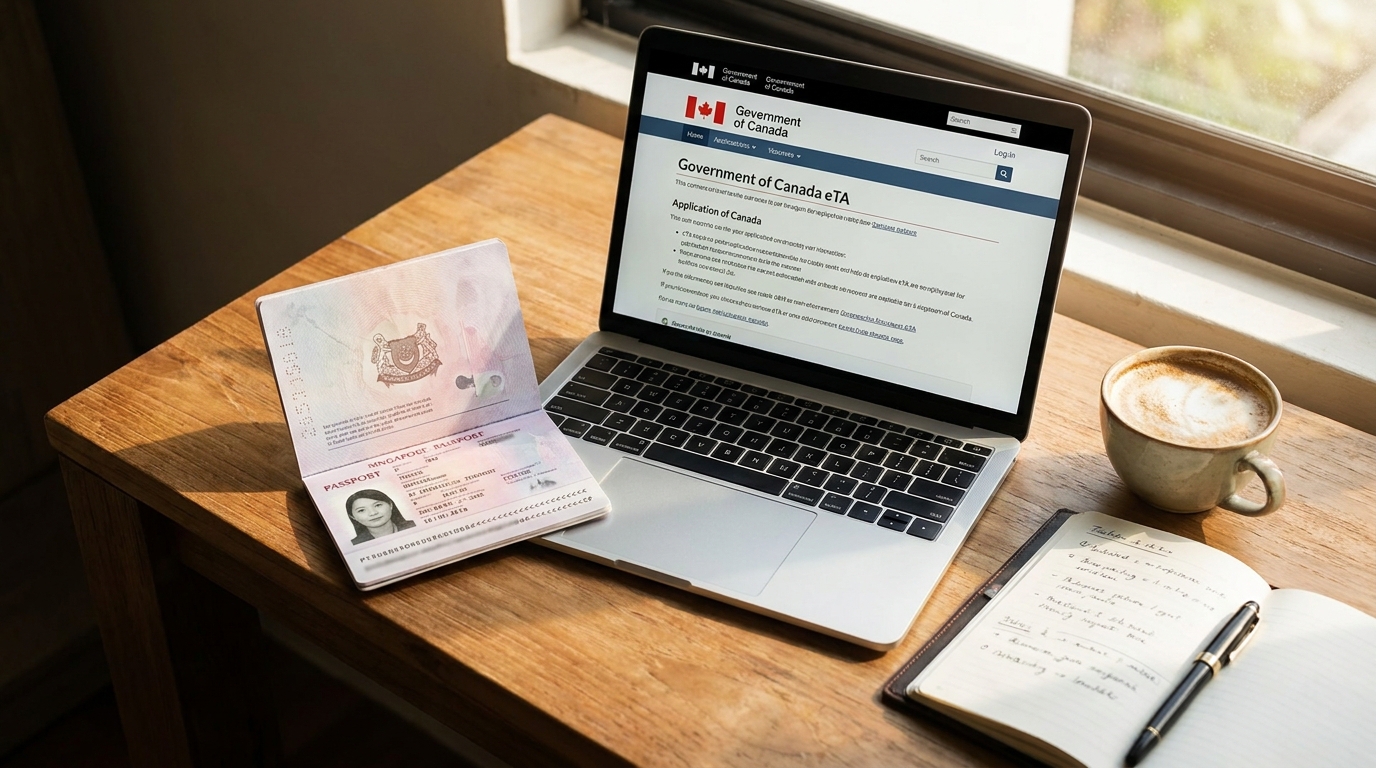
For most Singapore-based travellers heading over for tourism, family visits, conferences, weddings, or short business trips, the visa side of the trip is the easiest part. The eTA is filed at canada.ca, takes about ten minutes to complete, and is usually approved within minutes. Once issued, it stays valid for five years or until your passport expires, whichever comes first.
A few practical notes that catch first-time applicants. Apply at least 72 hours before flying, and ideally before you book a non-refundable ticket. Use the official canada.ca domain. Third-party sites charge SGD 50 to SGD 100 for the same form and add nothing. Renew your passport and the eTA stops working, so check the dates before your next trip.
For TRV applicants, the basic government fees are CAD 100 for the visa and CAD 85 for biometrics (capped at CAD 170 per family applying together, or CAD 255 for a group of three or more performing artists). The biometrics fee covers VAC collection, with no mandatory VFS service fee on top. The paperwork is heavier: proof of legal status in Singapore, evidence of funds, a travel itinerary, a purpose-of-visit letter, and documents showing ties to Singapore. The application sits with a regional IRCC office for two to six weeks in normal conditions.
Both routes are covered in detail, with document checklists and step-by-step screenshots, in the Canada visa from Singapore guide. Expected timelines for each document type are in the Canada visa processing time article.
Travelling to Canada in the next six months? Send us your passport and pass details and we will tell you which document you need and how to file it without paying any markup.
Permanent residence: the actual system
Tourism is the easy half. Permanent residence is the part that drives most of the searches and most of the confusion. Canada runs a federal economic immigration system that is open to applicants from any country, including Singapore, with no special quota or shortcut for any one passport.
Five main pathways exist. For Singaporean applicants, three of them matter.
Express Entry is the default. It is a federal online pool that manages three programs: the Federal Skilled Worker Program (FSWP), the Canadian Experience Class (CEC), and the Federal Skilled Trades Program (FSTP). You build a profile, the system calculates a Comprehensive Ranking System (CRS) score out of 1,200, and IRCC issues invitations to apply on a rolling weekly cadence based on score and category. Most Singaporeans qualify under FSWP because they have not worked in Canada before.
Provincial Nominee Programs (PNPs) sit alongside Express Entry. Every province except Quebec and Nunavut runs its own streams. A provincial nomination adds 600 CRS points to your Express Entry profile, which almost guarantees an invitation at the next general draw. Some PNP streams run outside Express Entry with lower thresholds but slower processing.
Family sponsorship is the third route, narrower in scope. Spouses, common-law partners, and dependent children of Canadian citizens or PRs can be sponsored. Spousal sponsorship has no annual cap. The Parents and Grandparents Program is invitation-only — its 2025 intake closed on 9 October 2025 and no new intake had opened by mid-2026.
The smaller routes – Quebec’s separate system, the Atlantic Immigration Program, the Rural Community Immigration Pilot, the Start-up Visa – exist but apply to a small share of Singaporean applicants. Quebec requires French proficiency and runs through its own MIFI process.
The deep dive on each program sits in the Canada PR from Singapore guide, including category draws and what’s changed in 2026.
What a Singaporean profile usually scores
A standard Singapore profile – a degree from NUS, NTU, SMU, SIM, or SUTD, four years of work experience in their field, IELTS 7.0 across the board, single, age 28 – lands somewhere between CRS 460 and 490 before any provincial nomination or job offer.
That number is below where CEC-only draws have been running through 2026 — cut-offs have ranged from CRS 507 to 518 between February and late May — and IRCC has not held a general all-program draw since 23 April 2024. It is above many category-based draws, which now do most of the heavy lifting. The 20 February 2026 healthcare draw cleared at CRS 467. The 2 April 2026 skilled trades draw landed at 477. Physicians have been getting invitations as low as 169 in their dedicated draws. STEM is on the current category list for 2026 but had not held a dedicated draw by the end of May 2026; historical STEM draws in 2023 and 2024 cleared between CRS 481 and 491. Cut-offs change every round, so any single number is a snapshot, not a threshold. If your occupation matches a target category, the practical bar is meaningfully lower than the headline CEC number suggests.
The levers that move a score most are age (peaks at 29 then declines), language (CLB 9 versus CLB 7 is a big jump), and adding French at CLB 7 (50 extra points plus access to French-language draws, which between February and late May 2026 cleared at cut-offs ranging from CRS 393 to 419). A provincial nomination still adds 600. The old 50- to 200-point bonus for a Canadian job offer was removed on 25 March 2025 and has not returned, so a job offer no longer moves your CRS directly — though it can still help you build the Canadian work experience that drives CEC eligibility.
The full breakdown of Canada PR requirements, including the FSWP 67-point grid and the CLB minimums for each program, sits in its own article. Working out your real CRS before lodging is the single most useful pre-application step.
What 2026 changed
A few shifts that affect every Singaporean application this year.
IRCC raised PR processing fees on 30 April 2026. The principal applicant fee went from CAD 950 to CAD 990. The Right of Permanent Residence Fee went from CAD 575 to CAD 600. Small individually, noticeable across a family of four.
The 2026 to 2028 Immigration Levels Plan stabilises total PR admissions at 380,000 per year across all three years. Economic immigration accounts for roughly 63% of that in 2026 and rises to 64% in 2027 and 2028, with Express Entry remaining the biggest single channel.
Category-based draws and CEC-only rounds now do all of the work. IRCC has not held a general all-program draw since 23 April 2024. Anyone whose occupation matches a category is significantly better positioned than the headline CEC cut-offs suggest.
The minimum work experience to qualify for the current category-based draws — French, healthcare, education, STEM, trades, transport, physicians, researchers, senior managers, and skilled military recruits — is twelve months of full-time experience in the past three years, up from the six-month threshold used in earlier rounds. A lot of borderline applicants who had built profiles around the old six-month rule had to wait or pivot.
Provincial PNP allocations were cut sharply in 2025 and have been increased for 2026, though still below the roughly 114,000 admissions the PNP delivered in 2024. Streams are moving again, but the bar remains higher than the pre-2025 norm.
Working in Canada without PR
Canada has two main work-permit tracks. The Temporary Foreign Worker Program (TFWP) usually requires the Canadian employer to obtain a Labour Market Impact Assessment (LMIA) showing no Canadian could be hired. The International Mobility Program (IMP) covers LMIA-exempt categories like intra-company transfers, trade agreement workers, and post-graduation work permits.
For Singaporeans, the IMP routes are usually the more realistic entry. A senior role with a multinational that has Canadian operations can sometimes be moved over as an intra-company transfer. CUSMA, CETA, and CPTPP categories cover specific occupations and contracts.
The Global Talent Stream, an expedited LMIA route for in-demand tech occupations, sometimes lands work permits in two to four weeks for eligible roles. Permit holders accrue Canadian work experience, which then becomes CEC-eligible after a year, which is one of the fastest realistic paths to PR.
The two routes most Singaporeans never use: open work permits via Working Holiday Visa (Canada does not have a bilateral agreement with Singapore for this) and direct H-1B-style work visas (Canada does not have one).
Studying in Canada from Singapore
A study permit is required for any program longer than six months at a Designated Learning Institution. The application opens once you have a Letter of Acceptance and includes a proof-of-funds requirement of CAD 22,895 per year on top of tuition (outside Quebec), raised from CAD 20,635 in September 2025 and CAD 10,000 before that.
Singaporeans apply through the regular study permit stream. The old Student Direct Stream fast-track was closed by IRCC on 8 November 2024, and Singapore was never on its eligible country list in any case. Standard study permit processing for Singaporean applicants runs in weeks rather than days, so build the timeline in before semester starts.
The post-study side matters as much as the study itself. The Post-Graduation Work Permit (PGWP) gives graduates of eligible programs up to three years of open work authorization, which is enough time to qualify for CEC and apply for PR through Express Entry. The PGWP rules tightened in late 2024 and 2025, with stricter program eligibility lists and language requirements added.
For most Singaporean families considering Canada through the study route, the actual question is whether the tuition and three to five years of cost adds up against the more direct skilled worker route. The right answer depends on age, current qualifications, and how much weight you put on the experience of living in Canada before committing.
What it really costs to immigrate
The number that scares people – “you need CAD 15,000 to apply for Canada PR” – is the settlement funds requirement, not a fee. It is a balance IRCC needs to see in your account at the time of application, not money you pay anyone.
The cash you actually spend on a single Express Entry application splits into two buckets. Pre-application costs (language tests, ECA, medical exam, police certificates, translations) typically run SGD 1,800 to 2,400 per adult. Government fees (processing fee, Right of Permanent Residence Fee, biometrics) come to about SGD 1,640 for a single applicant after the April 2026 fee increase.
On top of that, you have to show settlement funds of CAD 15,263 for a single applicant, CAD 19,001 for two, and CAD 4,112 more per additional family member. Canadian Experience Class applicants are exempt, as are applicants already authorised to work in Canada who hold a valid job offer.
Total cash out for a single applicant: roughly SGD 3,500 to 4,000. Plus the settlement balance held aside. Families and applicants needing to retake language tests can run higher.
The full numbers, including the costs most calculators leave out, sit in how much do I need to immigrate to Canada.
Want to know if Canada PR is realistic for your profile? A free consultation gives you a CRS score against current 2026 draws and an honest read on the cheapest, fastest route for your situation.
How long the whole thing takes
The number IRCC currently publishes for Express Entry — both Federal Skilled Worker and Canadian Experience Class — is about seven months. That is the federal post-submission service standard at the 80th percentile, not the time from deciding to apply to landing in Canada.
The Singapore-side preparation – IELTS booking and resits, WES credential assessment, police certificates from every country you have lived in for six months since age 18 – typically runs three to six months. Then your profile sits in the pool, anywhere from a week (a strong category match) to indefinitely (no category match and a CRS below the CEC cut-off, with no general all-program draw since April 2024). Then federal processing runs around seven months. Then there is a gap between approval and physically landing.
A realistic end-to-end timeline for an organised single Singaporean applicant is twelve to eighteen months. Families, applicants pushing their language scores, and anyone going through a slower base PNP stream tend to land closer to twenty.
For a TRV visit, the equivalent figure is closer to two to six weeks depending on the season and how clean the file is. The eTA is minutes.
Where to start, and what to skip
The most common mistake is starting the IELTS booking before checking whether your profile clears any current draw. The second most common is paying a third-party agent SGD 5,000 to “guarantee” an outcome that no agent can guarantee, because the system runs on points, not relationships.
A useful order of operations for someone considering Canada PR:
First, score yourself honestly using the official CRS tool, with rough estimates for IELTS and ECA results you have not yet earned. If the number lands above 470, Express Entry is realistic. Below 430, a base PNP or a study-then-CEC route is usually more realistic.
Second, check which category-based draws your occupation matches. The category cut-offs are typically 30 to 60 points lower than general draws, and the path forward can be much shorter if your job code is on the list.
Third, only after the score makes sense, book IELTS and the WES credential assessment. Skip these in the wrong order and you spend SGD 600 to SGD 1,000 confirming what was already obvious from the calculator.
Fourth, do the medical exam and police certificates last. Both have validity windows. Get them too early and they expire mid-application.
The handover point for going pro is the moment you actually receive an Invitation to Apply. The 60 to 90 days after that are paperwork-intensive and unforgiving on small mistakes, and the cost of one rejection at that stage is typically a full re-file plus a year of lost momentum.
A note on the offices and agencies
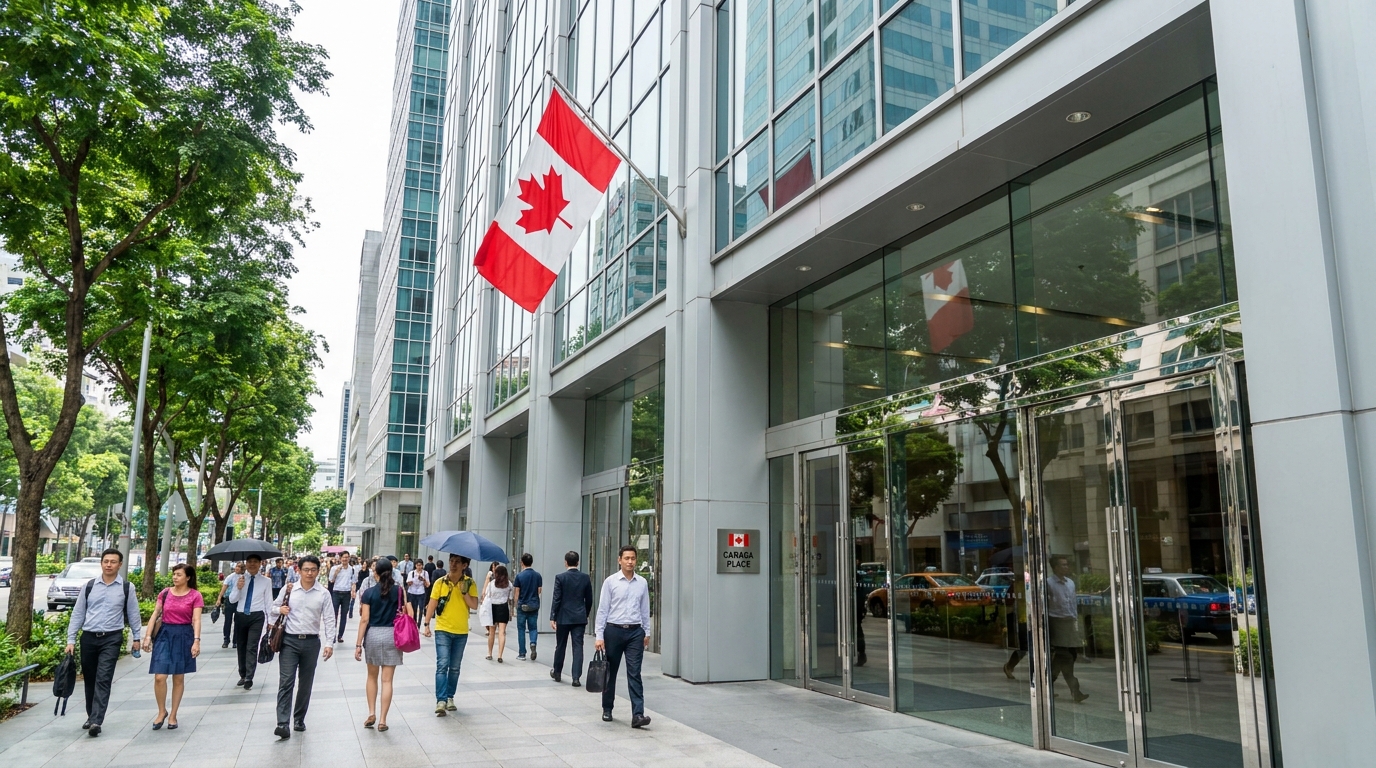
Singapore does not have an IRCC office, despite what some Google results suggest. The High Commission of Canada in Singapore at One George Street handles consular and diplomatic work. A separate Canada Visa Application Centre run by VFS Global handles biometrics enrolment and document submission — check the current address and opening hours on the official VFS Canada Singapore site before you turn up, as it can move. Neither office decides your application; files go to IRCC processing centres in Canada or to regional visa offices.
For most Singapore residents this means you never set foot in a Canadian visa office for a temporary visa or PR application. You upload everything online, you visit VFS once for biometrics, and the decision comes by email. The full breakdown of what each office actually handles is in our piece on IRCC Singapore and the Canada immigration office.
Picking the right path
For most Singaporeans, the choice between routes simplifies down to a few cases.
If you have a degree, decent English, and any kind of skilled work experience, Express Entry is the default. Score yourself first, then decide between pushing language higher, learning French, or pursuing a PNP based on what the number tells you.
If you have Canadian work experience already through an intra-company transfer or work permit, CEC is the fastest route and exempts you from settlement funds.
If you have a Canadian spouse, partner, or dependent family member, spousal sponsorship runs in parallel to economic options with no cap and no draw.
If your CRS is genuinely below 450 with no category match, a base PNP stream may be the realistic route, accepting the longer timeline as a trade-off. The Atlantic Immigration Program and Rural Community Immigration Pilot are also worth a look for applicants open to specific regions.
The honest answer is that there is no single best path. The right route depends on your age, occupation, score, family situation, and how flexible you are on which province you settle in. Most applicants gain the most ground by working that out before spending money on tests and assessments.
Ready to figure out your real Canada path? Whether you are planning a holiday next month or weighing a PR application this year, our consultants will look at your passport, pass, and profile and tell you exactly what to file, in what order, and at what cost.