

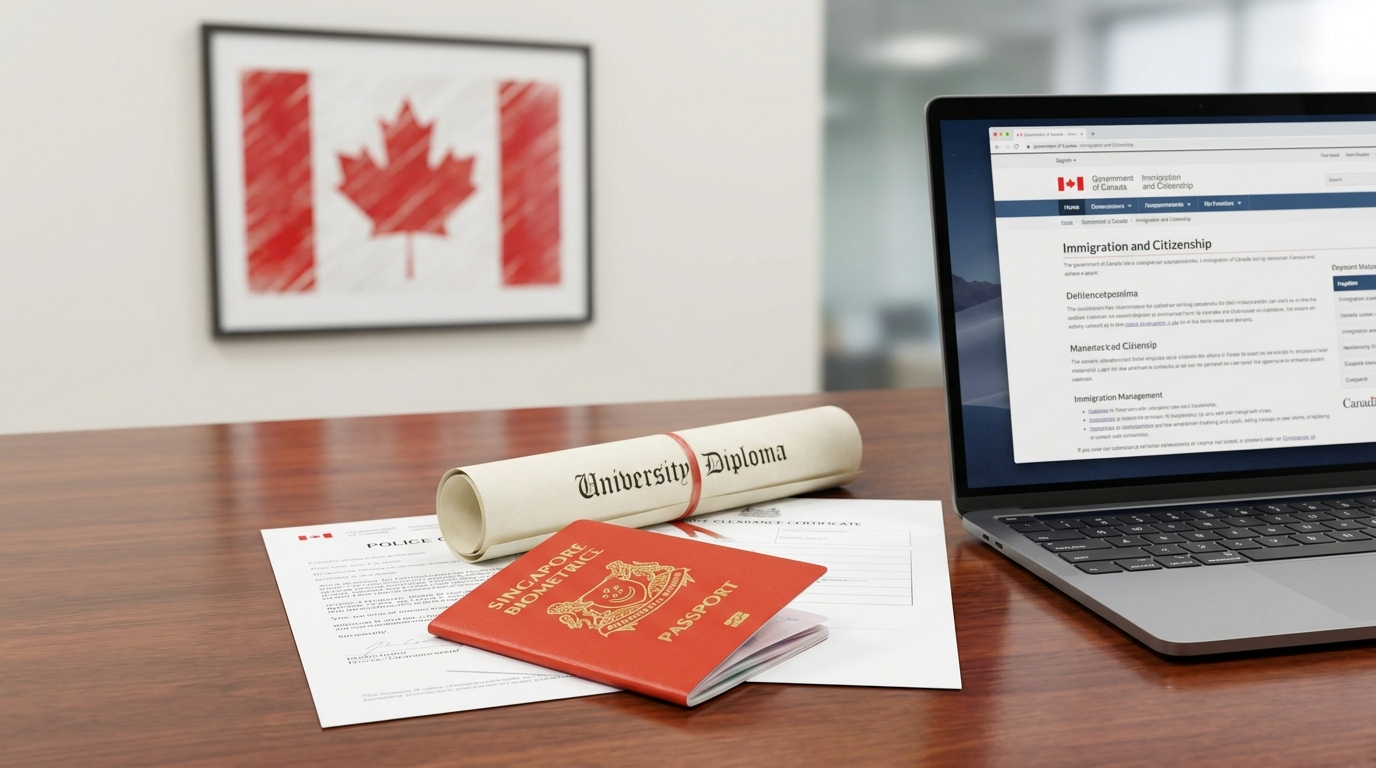
Singaporeans get into Canada as tourists with no visa, but permanent residence is a different track entirely. There is no special pathway for Singapore passports, no reserved quota, and no shortcut through any consulate here. You go through the same federal economic immigration programs as everyone else.
The good news is that Singaporean applicants tend to do well in those programs. Strong English, recognised universities, clean police records, and traceable employment history make the file straightforward. The work is in choosing the right pathway, hitting the score, and not tripping over the costs and timelines that catch most first-time applicants.
This is the overview. The detailed numbers for requirements, processing times, and budget live in the linked articles below.
The pathways most Singaporeans actually use
There are five main routes into permanent resident canada status, but only two or three matter for most applicants from Singapore.
Express Entry is the default. It is a federal system that manages three economic programs through a single online pool: the Federal Skilled Worker Program (FSWP), the Canadian Experience Class (CEC), and the Federal Skilled Trades Program (FSTP). Most Singaporeans applying without prior Canadian work qualify under FSWP. The system ranks every profile in the pool using the Comprehensive Ranking System (CRS), and IRCC issues invitations to apply based on score and category.
Provincial Nominee Programs (PNPs) sit alongside Express Entry. Every province except Quebec and Nunavut runs its own streams targeting specific occupations and skills gaps. A provincial nomination adds 600 CRS points to your Express Entry profile, which almost guarantees an invitation at the next general draw. Some PNP streams run outside Express Entry entirely and have lower language and points thresholds, but slower processing.
Family sponsorship is the third option, narrower in scope. If you have a spouse, common-law partner, parent, grandparent, or dependent child who is a Canadian citizen or PR, they can sponsor you. Spousal sponsorship has no annual cap and runs continuously. The Parents and Grandparents Program has not opened to new interest-to-sponsor forms since 2020 – the 2025 intake drew invitations from that existing pool and closed on 9 October 2025 – and IRCC has not yet announced a new intake; until they do, no new PGP applications are being accepted.
The other routes – Quebec’s separate system, the Atlantic Immigration Program, the Rural and Northern Immigration Pilot, the Start-up Visa – exist but apply to a small share of Singaporean applicants. Quebec’s system requires French proficiency and has its own application process through MIFI, with periodic intake pauses across its economic streams – check Quebec’s site before counting on it.
Express Entry: how it works in practice
You build a profile online showing your age, education, language scores, work experience, and any Canadian connections. The system calculates your CRS score out of 1,200 and places you in the pool. Every two to four weeks IRCC issues invitations through either a general draw or a category-based draw.
IRCC has not run a general all-program draw since April 2024. The active programs have been Canadian Experience Class (CEC), Provincial Nominee Program (PNP), and category-based draws. CEC cut-offs in the first five months of 2026 have sat in a 507 to 518 band. That is a high bar. The single biggest change this year is that IRCC has shifted heavily toward category-based draws with lower thresholds: healthcare landed at CRS 467 (20 February 2026), skilled trades at 477 (2 April 2026), French-language between 393 and 419 across the recent rounds, senior managers (Canadian work experience) at 429 (5 March 2026), and the new physicians (Canadian work experience) category as low as 169 (19 February 2026). STEM, education, transport, researchers, and military categories have been quiet in 2026 to date. If your occupation matches a target category that IRCC does invite, the bar is meaningfully lower than the headline number.
The category list for 2026 covers ten categories: healthcare and social services, STEM, trades, transport, French-language, education, physicians with Canadian work experience, senior managers with Canadian work experience, researchers with Canadian work experience, and skilled military recruits. Agriculture and agri-food was dropped. The minimum work experience to qualify for any of the renewed categories is now twelve months in the past three years (up from six months), per IRCC’s 18 February 2026 announcement, which caught a lot of borderline applicants.
The detailed canada pr requirements article breaks down each program’s eligibility, language minimums, and the CRS scoring grid in full.
What a Singaporean profile typically scores
A standard Singaporean applicant – degree from NUS, NTU, SMU, SIM, or SUTD, four years of work experience in their field, IELTS 7.0 across the board, single, age 28 – lands somewhere between CRS 460 and 490 unranked. That is below the general-draw threshold and above many category thresholds.
The levers that move the score most are age (peaks at 29 then declines), language (CLB 9 versus CLB 7 is a big jump), and adding French at CLB 7 (unlocks 50 points plus the French draws). Provincial nominations add 600. Note that arranged-employment points (the old 50/200 for an LMIA-supported job offer) were removed on 25 March 2025, so a job offer no longer adds CRS – only the underlying work-experience points and any category eligibility do. A spouse with their own English scores adds another 20 to 40.
Working out your real number before lodging is the single most important pre-application step, because the decisions on whether to retake IELTS, learn French, or pursue a PNP all flow from it.
Want to know your CRS score before you start spending on tests? Our consultants run a free profile assessment against current 2026 draws and tell you exactly where the gaps are.
Provincial Nominee Programs worth a look
The PNP landscape has reshuffled in 2026. Federal allocations were cut sharply in 2025 and have been restored in part under the 2026-2028 Levels Plan, which sets a PNP target of 91,500 admissions for 2026 (range 82,000-105,000). Streams are more active this year than last, though still below 2024 highs. Some are worth considering for Singaporean applicants:
British Columbia’s PNP Tech stream targets specific technology occupations and runs a fast, predictable draw every two weeks. Ontario’s Human Capital Priorities stream targets high-CRS profiles in the pool and pulls in candidates from healthcare, tech, and skilled trades. Saskatchewan’s International Skilled Worker – Occupation In-Demand stream accepts applications without a job offer if your occupation is on their list. Nova Scotia and New Brunswick run niche streams targeted at specific industries.
Alberta has been the most active for technology and finance occupations in 2026. Manitoba and Saskatchewan are the most accessible for applicants with mid-range CRS scores. Provincial fees range from CAD 250 to CAD 1,500, processing for the provincial nomination takes two to six months depending on the province, and Express Entry-aligned PNPs then move at the standard federal pace.
Outside Express Entry, base PNP streams are slower – typically fourteen months federal plus the provincial nomination on top. They are useful if your CRS is genuinely too low to clear an Express Entry cut-off and you have time on your side.
Timelines from decision to landing
The number IRCC publishes for Express Entry is six months. That is the federal post-submission service standard at the 80th percentile. It is not the same as the time from deciding to apply to landing in Canada.
The Singapore-side preparation – IELTS booking and resits, WES credential assessment, police certificates from every country you have lived in for six months since age 18 – typically runs three to six months. Then your profile sits in the pool for anywhere from a week (categories) to indefinitely (general draws are not running and CEC has been clearing in the 507-518 range across the first five months of 2026). Then federal processing runs around six months. Then there is the gap between approval and landing.
A realistic end-to-end timeline for an organised single Singaporean applicant is twelve to eighteen months. Families, applicants needing to push their language scores, and anyone going through a slower PNP route tend to land closer to twenty.
The full breakdown by program and the things that slow files down sit in the canada pr visa processing time article.
The real cost of applying
The number that scares people – “you need CAD 15,000 to apply for PR” – is the settlement funds requirement, not a fee. It is a balance IRCC needs to see in your account, not money you pay anyone.
The cash you actually spend on a single Express Entry application breaks into two buckets. Pre-application costs (language tests, ECA, medical exam, police certificates, translations) typically run SGD 1,800 to 2,400 per adult. Government fees (processing fee, Right of Permanent Residence Fee, biometrics) come to about SGD 1,640 for a single applicant after the April 2026 fee increase.
On top of that, you have to show settlement funds of CAD 15,263 for a single applicant, CAD 19,001 for two, and roughly CAD 4,112 more per additional family member. Canadian Experience Class applicants and applicants who have a valid job offer and authorization to work in Canada are exempt from this requirement.
Total cash out for a single applicant: roughly SGD 3,500 to 4,000. Plus the settlement balance held aside. The full numbers, including the lines most calculators miss, sit in how much do I need to immigrate to Canada.
What changed in 2026 that matters
A few shifts that affect every Singaporean application this year:
IRCC raised PR processing fees on 30 April 2026. The principal applicant fee went from CAD 950 to CAD 990. The RPRF went from CAD 575 to CAD 600. Small in isolation, noticeable across a family.
The 2026-2028 Immigration Levels Plan stabilises total PR admissions at 380,000 per year for all three years. Economic immigration rises from about 59% of the mix in 2025 to roughly 63% in 2026 and 64% in 2027-2028, with Express Entry and PNP as the biggest channels.
Category-based draws now do most of the work. General all-program draws have not run since April 2024. Anyone whose occupation matches a category is significantly better positioned than the headline CEC cut-off suggests.
The minimum experience for the renewed category-based draws jumped from six months to twelve months on 18 February 2026. Anyone applying close to the line should check this before lodging.
Provincial PNP allocations were cut sharply in 2025 and have been partially restored for 2026 under the new Levels Plan. Streams are more competitive than 2024 but moving faster than in 2025.
Choosing your route
For most Singaporeans applying from Singapore, the decision tree is reasonably simple.
If you have a degree, decent English, and any kind of skilled work experience: build an Express Entry profile and see your real CRS first. If the score is borderline, the choice is between pushing language scores higher, learning French to CLB 7, or pursuing a PNP nomination. If you have a category-eligible occupation, category draws are usually the fastest path.
If you have Canadian work experience already through an intra-company transfer or work permit: CEC is the fastest route and exempts you from settlement funds.
If you have a Canadian spouse, partner, or close family member who is a citizen or PR: spousal sponsorship runs in parallel to economic options and has no cap or draw mechanism.
If your CRS is genuinely below 450 and you have no category match: a base (non-Express Entry) PNP stream may be the most realistic route, accepting the longer timeline as a trade-off.
The honest answer is that there is no single best path. The right one depends on your age, occupation, score, family situation, and how flexible you are on which province you settle in. Working that out before spending money on tests and assessments is where most applicants gain the most ground.
Ready to map your Canada PR pathway against your real profile? Our consultants benchmark you against current 2026 draws, score you against the live cut-offs, and tell you the cheapest, fastest realistic route.