

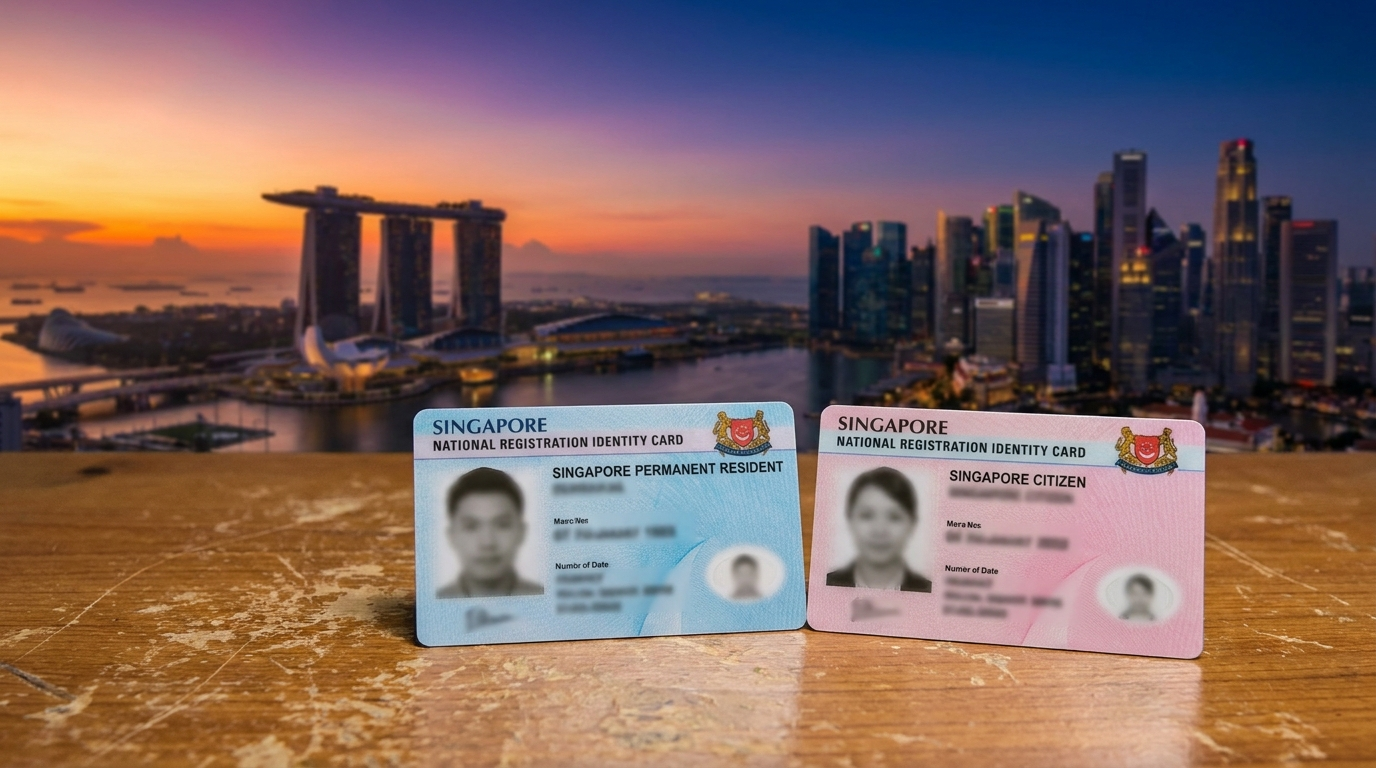
Most people who weigh PR against citizenship in Singapore already have the blue NRIC. The question is whether the pink one is worth giving up the home country passport, because that is the actual trade-off the law forces on you. Singapore does not allow dual citizenship at adulthood, so converting means renouncing whatever you came in with.
This guide walks through the practical differences between the two statuses in 2026: what each lets you do, what each requires of you, and where the line between “PR is enough” and “citizenship makes sense” actually sits. It sits inside the broader Singapore PR application guide, which covers the route to PR in the first place.
The dual citizenship rule decides everything
Singapore’s citizenship laws set the floor. A foreign-born adult who naturalises as a Singapore citizen has to renounce their original citizenship through ICA’s Oath of Renunciation, Allegiance and Loyalty. Article 134 of the Constitution lets the Government deprive Singaporeans of citizenship by order if they voluntarily acquire another nationality. Children can hold two nationalities until 21, after which they have a 12-month window to renounce the other citizenship and take the Oath. Miss that window and Singapore citizenship lapses at 22.
That single rule is what pushes most long-term residents to stay on PR instead of converting. PR is open-ended and lets you keep your home country passport. Citizenship is a one-way door. If you carry a strong passport (a US, UK, EU, or Australian one in particular), the swap is not obvious, and the Singapore passport has to do enough extra work to justify the loss.
Voting and civic rights
Only citizens can vote in Singapore. That covers both the General Election and the Presidential Election. Voting is compulsory for citizens. PRs are not on the electoral roll and cannot register, regardless of how long they have held the blue NRIC.
Citizenship also opens up parts of the civil service that PRs cannot access. Sensitive roles in defence, intelligence, the Foreign Service, and certain statutory boards are limited to citizens for security clearance reasons. Most general public sector jobs are open to PRs, but the senior and security-cleared positions are not.
National Service: the obligation that catches families out
National Service is where the trade-off gets concrete. Male citizens serve two years of full-time NS from around age 18, then continue as operationally ready reservists until 40 (or 50 for officers). The same obligation applies to second-generation male PRs, which means any son who gets PR as a dependant of a PR parent.
The trap is in the second-generation part. A foreign professional who takes PR for himself and brings in a young son as a dependant has just made that son NS-liable when he turns 18. Leaving Singapore as a teenager to avoid NS is treated as a serious matter and effectively closes off any future Singapore status, including PR re-entry and work passes. Families who plan to convert often do it before the son turns 13, since first-generation male PRs who took PR as the main applicant under the Professional/Technical Personnel and Skilled Workers Scheme or the Investor Scheme are exempt from NS, while their children brought in under their PR are not. First-generation male PRs granted PR as foreign students or sponsored by a parent remain NS-liable.
If NS is a deal-breaker, citizenship is not on the table for a household with sons, and PR for the father needs to be timed carefully against the children’s ages.
Tax and CPF
Income tax is the same for citizens and PRs. Both are taxed as residents on Singapore-sourced income at the resident rates. No worldwide taxation. No citizenship-based tax. A US citizen converting to a Singapore citizen still files with the IRS until they formally expatriate, which is a separate process.
CPF contribution rates are also the same for citizens and PRs from the third year of PR onward. In the first two years, PR contribution rates are tapered (lower employee and employer rates) to soften the transition. Citizens hit the full rates from day one of employment.
Where the difference shows up is in some of the housing and healthcare top-ups. Government schemes like the Enhanced CPF Housing Grant, MediShield Life premium subsidies at certain tiers, and the Workfare Income Supplement are citizen-only or set higher for citizens. PRs get the underlying CPF and MediShield Life coverage, but not all of the layered benefits.
Trying to model the citizenship swap against your home country passport? Send us your nationality, your family situation, and where you are on the PR timeline. We will give you a straight read on whether converting actually makes sense for your case.
Housing: the BTO question
This is the one most PRs end up running into. PRs cannot buy a new HDB BTO flat directly from HDB. The BTO scheme is restricted to citizen households, with a small allowance for citizen-PR couples. PR-only households are limited to the resale HDB market.
Two further conditions apply to PRs buying a resale flat. Both buyers have to have held PR for at least three years. And a PR cannot buy alone — you need a family nucleus, which for most people means a PR or citizen spouse, parents, or a fiancé under the relevant scheme.
The ABSD layer adds the financial sting. A PR buying their first residential property in 2026 pays a 5 percent ABSD on top of the regular stamp duty. A citizen pays zero on the first. On a second property, the PR rate jumps to 30 percent. The numbers compound across a property career and are one of the cleanest reasons people convert.
Travel: the passport question
A Singapore PR still travels on their home country passport. To re-enter Singapore after travel, the PR needs a valid Re-Entry Permit (REP). Most first-time REPs run for five years and renew online through the ICA e-Service. Let it lapse while you are overseas and PR is at risk. Under the rules effective 1 December 2025, you have 180 days from either your departure (if you left without a valid REP) or your REP’s expiry date (if it lapsed while you were abroad) to apply for a new REP. Fail to apply in that window, or have the application rejected, and PR is lost. The Singapore PR processing time page covers a related issue: keeping pass status clean during the wait.
The Singapore passport is the offset on the citizenship side. It is ranked first in the world in 2026 for visa-free access, covering 192 destinations. For holders of weaker passports who already live here long-term, that upgrade is real and tangible. For holders of strong Western passports, the marginal access gain is small, and the renounced passport may have been worth more.
Losing status: PR is conditional, citizenship is not
PR can be revoked. The grounds include criminal conviction (including drug offences), undesirable conduct, fraud in the original application, prolonged absence from Singapore without a valid REP, and breach of the Entry Permit conditions. Revocation is administrative — ICA makes the call without a court process. Appeal prospects after a criminal-related revocation are slim.
Citizenship is much harder to lose. It can be renounced voluntarily, deprived for fraud in the application, or stripped for treason or service in a hostile foreign power. The bar for an involuntary loss of citizenship is high and the process goes through formal channels. The practical difference is that a citizen with a serious criminal conviction goes to prison and comes back to Singapore. A PR with the same conviction is likely to lose status and be removed.
When PR is enough, and when citizenship makes sense
Stay on PR if you carry a strong home country passport you do not want to give up, if your children are male and approaching the second-generation NS age window, or if your stay in Singapore might end and you want the option of a clean exit. The Singapore PR vs Singapore citizen calculus tips toward PR when the home country status has real value of its own.
Convert to citizenship if you have committed to staying for the long term, you want to buy a BTO and avoid ABSD on housing, you want a vote and a stake in the country’s direction, and your home country passport does not carry meaningfully more access than the Singapore one. The clearest case is a young family from a weaker-passport country whose sons will grow up here either way.
Working out the right call between PR and citizenship for your household? A consultation covers the passport math, the NS timeline for your children, and the housing implications in one session.