

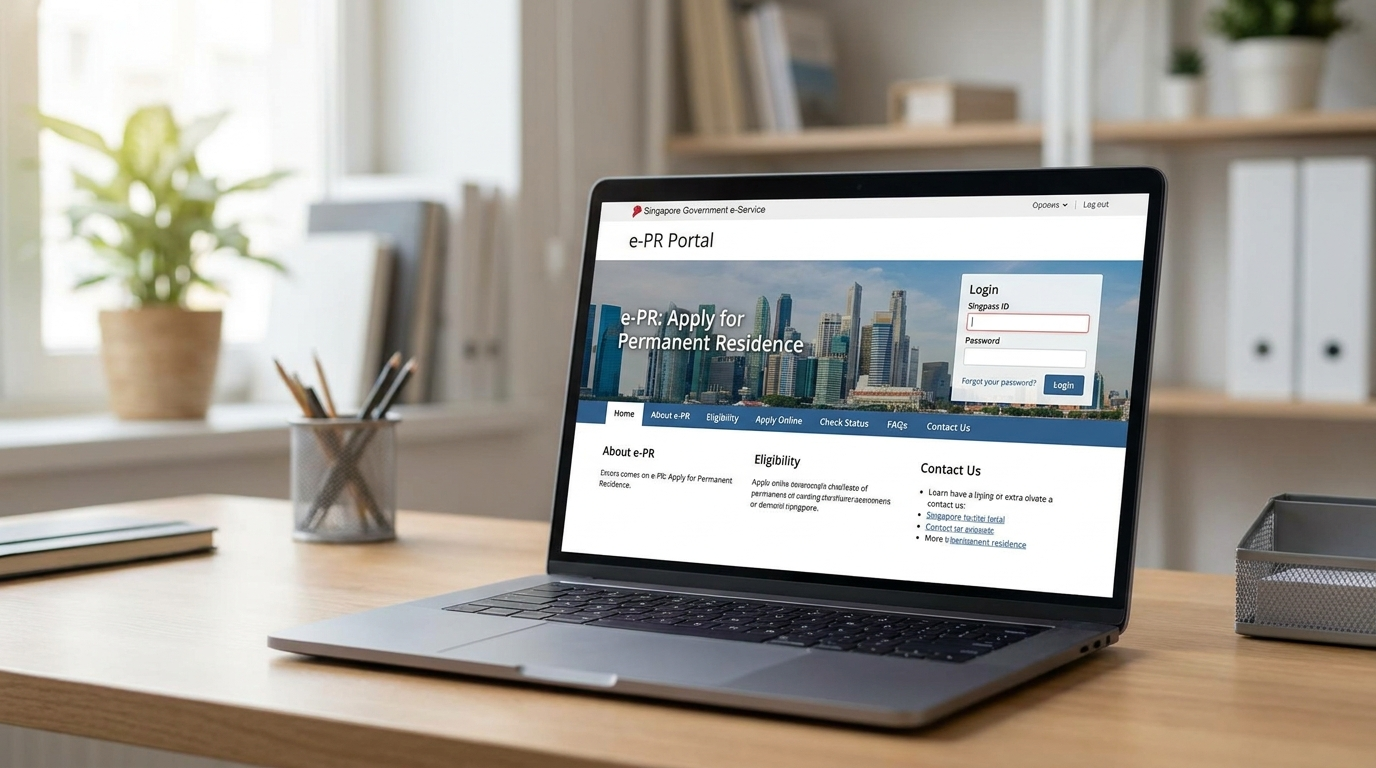
If you have been searching “electronic permanent residence” for Singapore, you are almost certainly looking for one of two things. The ICA e-PR portal, which is where the whole PR application now lives. Or the Re-Entry Permit renewal screen, which is what keeps an existing PR alive between trips overseas. Both run from the same e-Service. Neither is the blue identity card itself, which is still a physical piece of plastic that gets handed to you in person.
This page sits inside the broader Singapore PR application guide and explains the e-PR system specifically: what the portal is, how the Singpass login works, what gets uploaded, what gets paid, and where this slots in next to the REP and the physical PR identity card. If you are after the wider application picture, the Singapore PR, LTVP and long-term passes guide is the parent read.
What e-PR actually means
The “e-PR” name covers two related ICA e-Services at eservices.ica.gov.sg. The first is the PR application itself, where new applicants file under PTS, Family Ties, GIP, or ForArts. The second is the Re-Entry Permit application and renewal screen, where existing PRs keep their travel rights current. Both sit behind the same Singpass login and share the same portal navigation, which is why the terms get used loosely.
There is no separate “electronic PR card” in Singapore. PR status is recorded against the new NRIC issued on approval; the old FIN becomes obsolete. Your identity sits in the ICA database, but the document you carry is the standard blue NRIC. The portal is the front door; the card is the artifact you walk out of ICA with after collection.
Logging into the e-PR portal

Singpass is the only login route for residents already in Singapore on a work pass. If you hold an EP, S Pass, Dependant’s Pass, or LTVP, you should already have a Singpass account tied to your FIN. The PR application uses that same Singpass to authenticate.
For Singapore citizens and PRs filing as sponsors for family-ties applicants, the same Singpass login works. The sponsor logs in, starts the application on behalf of the family member, and fills in the principal applicant’s details.
Applicants overseas who do not hold a current Singapore pass cannot use Singpass directly. ICA’s standard guidance is to file through the nearest Singapore Overseas Mission or have a local sponsor file on your behalf. There is no foreign-applicant version of e-PR that bypasses Singpass.
What the portal asks for
Once you log in, the application form is broken into sections you fill out and save as you go. The portal lets you part-complete and return later, which matters because the document collection takes most people a few sittings.
The core upload list in 2026:
- Passport bio-page and current pass
- Birth certificate
- Home country national identity card
- Educational certificates and academic transcripts
- Employment support letter from your current employer
- Last six months of payslips
- For self-employed applicants, ACRA BizFile and the last three years of P&L statements
One recent change catches out anyone working from older checklists. The Annex A employer declaration, which used to be a signed attachment, was discontinued on 26 June 2024. Its details are now declared directly in the portal. IRAS Notices of Assessment for Singapore-earned income are no longer required either, since ICA now pulls IRAS data directly once you consent on the form. If you have foreign income, three years of foreign tax assessments are still required.
Dependants get appended into the same submission rather than filed separately. Spouse and unmarried children under 21 are entered as additional applicants on the principal’s file.
Paying through e-PR
Payment runs at submission. The S$100 application fee is charged per applicant, including spouse and children, and is non-refundable regardless of outcome. The portal accepts Visa, Mastercard, AMEX, internet banking direct debit, and PayNow.
If the application is approved, three more fees come up at the IC collection stage, also payable through the portal or in person at ICA:
- S$20 for the Entry Permit per approved applicant
- S$50 for the Identity Card, for applicants aged 15 and above
- S$10 per year of validity for the Re-Entry Permit. A standard five-year REP works out to S$50
A common budgeting figure is around S$220 in government fees per successful applicant. The portal walks you through each payment as the file progresses through the stages.
Need help working out which scheme to file under, or whether your salary band clears the unwritten PTS baseline? Send us your pass type, salary, length of service, and family situation and we will give you an honest read before you click submit.
e-PR vs the Re-Entry Permit
The Re-Entry Permit (REP) is the other thing people mean when they say “e-PR”. It is the screen on the same portal where existing PRs renew their travel rights. The REP is what keeps PR status alive while you are out of Singapore.
REP rules to know:
- The first REP is typically issued for five years on PR approval
- You renew online through the e-Service within three months before expiry
- Renewal needs Singpass, a valid passport, the current REP, and a credit or debit card
- Decisions through the e-Service are usually processed within one week, and within one day for applicants in Singapore. Overseas applicants filing through a Singapore Overseas Mission should submit at least two months before expiry, since processing times vary by mission and can stretch beyond a month
- The renewed REP is electronic. ICA no longer stamps the REP into your passport. You print the e-REP once from the portal, and only once
The practical point: if you let an REP lapse while you are outside Singapore, you no longer lose PR immediately. Since 1 December 2025, ICA gives PRs whose REP has expired a 180-day grace period to apply for a new REP. The system does not warn you in the way a passport expiry reminder might, and 180 days goes quickly. Diary the renewal window six months out.
PRs who do not hold a Singpass account, usually because they have been out of Singapore for a stretch, can apply through the nearest Singapore Overseas Mission. The Mission route is slower and is best used as a backup rather than a first choice.
e-PR is not the PR identity card
This is where the terminology gets muddled. The blue Permanent Resident Identity Card is the physical document. It is issued at the IC collection appointment at ICA, after approval, after fees are paid, and after photographs are taken on the day. ICA’s public-facing services now run out of the ICA Services Centre at 2 Crawford Street, which opened on 7 April 2025. The older ICA Building at 10 Kallang Road has been closed to the public since 1 April 2025. The card carries your name, your NRIC number (which replaces the FIN), your date of birth, and a chip with biometric data.
The e-PR portal does not issue this card. It collects the application, processes the payment, books the appointment, and tracks status. The card itself is produced at ICA and collected in person. PRs aged 15 and above must collect their IC personally. Since 1 October 2021, eligible holders can also choose to collect at a designated SingPost office instead of ICA, selected through eAppointment. Children under 15 are issued a Permanent Resident Birth Certificate at the same appointment, and graduate to a full IC at 15.
If you lose the physical IC later, replacement is filed through a different ICA e-Service, not the e-PR system. The two flows look similar but track different records.
Checking application status
Status sits in the same portal under “My PR Application” once you log in with Singpass. The status either reads “Application Submitted” or it flips to a decision. ICA does not push interim updates, does not respond to follow-up emails about pending files, and does not flag a file as delayed.
For PR applications submitted before 26 June 2024, decisions may still arrive by physical post. Everything submitted after that flows through the portal first, with an email pointing you to log in. The Singapore PR processing time page goes deeper on what the wait actually looks like.
If the answer is no, the decline letter is also available through the portal, and the six-month appeal window starts from the decision date. Appeals are not filed in the e-PR portal. ICA accepts appeals by email to the address listed in the rejection letter, or by hand-delivering a hardcopy to the ICA Services Centre at 2 Crawford Street.
Working through an e-PR submission or due for an REP renewal and want a second pair of eyes? A free profile review covers your scheme choice, document set, and timing in one session.