

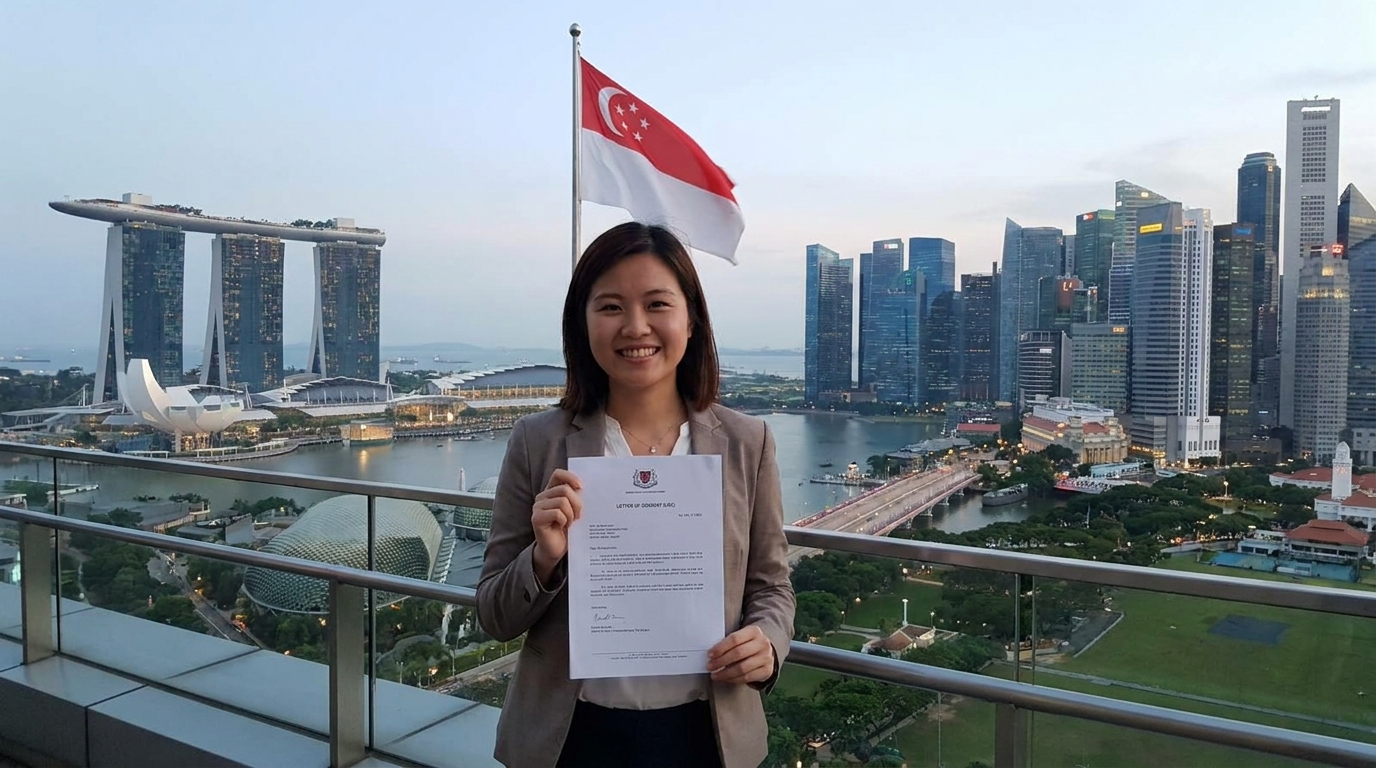
Yes, an LTVP holder can work in Singapore, but the pass itself does not include the right to take up paid employment. The authorisation that does is a Letter of Consent from the Ministry of Manpower. Once an LOC is on file, the holder can work in any legal occupation at the same income tax rates as a citizen or PR.
This page covers who qualifies for an LOC, how the regular and pre-approved versions differ, what employers should know about quota and levy, the edge cases for LTVPs sponsored by EP or S Pass holders, and the tax side once the salary starts coming in. The numbers and rules below reflect MOM and IRAS policy current to mid-2026.
Who can use the LOC route to work
The LOC route applies to LTVP and LTVP+ holders sponsored by a Singapore citizen or permanent resident. The two main categories are foreign spouses of citizens or PRs, and unmarried children under 21 of citizens or PRs who hold an LTVP in their own right.
That covers most LTVPs issued by ICA. If your LTVP card was issued by ICA and your sponsor is a citizen or PR, you fit the LOC route.
The position is different for LTVPs sponsored by an Employment Pass or S Pass holder. Those LTVPs are issued by MOM and cover common-law spouses, step-children without formal adoption, and certain handicapped children who fall outside Dependant’s Pass rules. The LOC pathway available to citizen and PR spouses is not the standard route for this group. A separate work pass, usually an EP, S Pass, or Work Permit through a direct employer, is the cleaner path.
Dependant’s Pass holders sit in a third category that catches a lot of people out. Since 1 May 2021, DP holders can no longer take up employment through an LOC. Existing DP-LOC holders were allowed to continue working only until their then-current LOC expired, and after that point they too need an EP, S Pass, or Work Permit in their own right. No new or renewed DP-LOC has been issued since. The only DP holders who can still use an LOC are business owners with at least 30 percent shareholding in the company they run. That carve-out does not extend to LTVP holders, who keep their LOC access in full.
How the regular LOC works
The regular LOC is applied for by the employer once a job offer is on the table. The employer logs in to MOM’s portal, attaches a copy of the LTVP card, the offer letter, and the sponsor’s NRIC or PR card, and submits the application.
Processing for straightforward cases is around one to two weeks, with seven working days the typical quote MOM gives. The LOC is valid for the same duration as the underlying LTVP, and expires automatically when the LTVP expires or is cancelled. There is no separate validity to track.
If the LTVP holder changes employers, the new employer applies for a fresh LOC. The old one does not transfer, and the holder cannot legally start at the new role until the new LOC is issued.
Need an LOC sorted before your start date? Send us the LTVP card, the offer letter, and the sponsor’s NRIC and we will file the application with MOM and track it through to issuance.
The Pre-approved LOC: the better version
The Pre-approved Letter of Consent is the version worth requesting if you know you will work at some point during the LTVP period.
The PLOC is requested at the LTVP application or renewal stage with ICA, not separately with MOM later. There is a tick-box on the ICA e-Service form for spouses and unmarried children of citizens and PRs. If you missed it at the time of filing, MOM has a FormSG link where you can request it after the LTVP is already issued.
With a PLOC on file, the holder does not need a job offer to be authorised to work. The holder can take up employment, switch employers, or run a business without a fresh LOC each time. The employer notifies MOM before the PLOC holder starts work, and again within 7 days of the last day of work when employment ends. That is faster and simpler than starting a new LOC application from scratch, but both the start and end notifications need to be tracked.
PLOC validity is tied to the LTVP, the same as a regular LOC. When the LTVP is renewed, the PLOC can be renewed alongside it as part of the same ICA submission. The LTVP renewal step-by-step guide covers the renewal mechanics if your pass is coming up.
If you are still at the application stage, the LTVP for spouse guide walks through how to combine the LTVP filing with the PLOC request in one submission.
What employers get out of hiring an LOC holder
The quiet advantage that makes LOC holders attractive to employers is the levy and quota treatment.

An LTVP holder working under an LOC or PLOC does not count against the company’s foreign worker quota. The foreign worker levy does not apply either. That puts the cost of hiring closer to a citizen or PR hire than to a fresh EP candidate, and avoids the quota arithmetic that limits Work Permit hires in services, retail, and construction.
For roles where the choice is between sponsoring an EP for an external candidate and hiring an LTVP holder already in Singapore, the LOC route is usually the cheaper and faster option for the company. It is worth flagging in interviews if the hiring manager has not encountered the pass before.
The trade-off, from the holder’s side, is that the right to work is tied to the LTVP. If the sponsoring relationship ends or the LTVP is not renewed, the LOC stops with it. A separate work pass would survive that kind of change, which is part of why some LTVP holders apply for an EP in their own right once their salary qualifies.
What jobs are allowed and the tax side
LOC and PLOC holders can work across most occupations. There is no industry restriction tied to the LTVP sponsor’s sector, and no fixed salary minimum the way an EP or S Pass requires. The role can be employee work, business owner, freelance, or part-time, as long as the income is declared and tax is paid through the right channel. Two carve-outs are worth knowing about. The regular LOC has an “objectionable occupations” exclusion under MOM rules, such as dance hostess. The PLOC explicitly bars journalist, editor, sub-editor, producer, and any religious occupation, and for those roles the employer has to apply for a regular LOC instead.
Income tax treatment is the same as for a citizen or PR. The 183-day rule sets the line: stay and work in Singapore for at least 183 days in a calendar year and IRAS treats you as a tax resident, with progressive resident rates from 0 to 24 percent. Most LTVP holders are tax resident in practice because their LTVP residence is continuous.
The employer files an IR8A annually for each LOC employee. When employment ends, IR21 tax clearance applies the same way it does for any non-citizen employee. The employer files Form IR21 at least one month before the last day of work and withholds monies due until IRAS issues clearance. LOC holders are not treated differently from EP holders on this point. The narrow exemptions are the standard IRAS ones, such as non-citizens earning under S$21,000 a year with 183 or more days worked.
For holders running a business under a PLOC, the income side flows through the company’s own tax filing rather than IR8A, but the personal income tax residency rule is the same.
Working out which work route fits your LTVP situation? Our consultants can review your LTVP type, sponsor profile, and intended role, and tell you whether LOC, PLOC, or a separate work pass is the right call.