

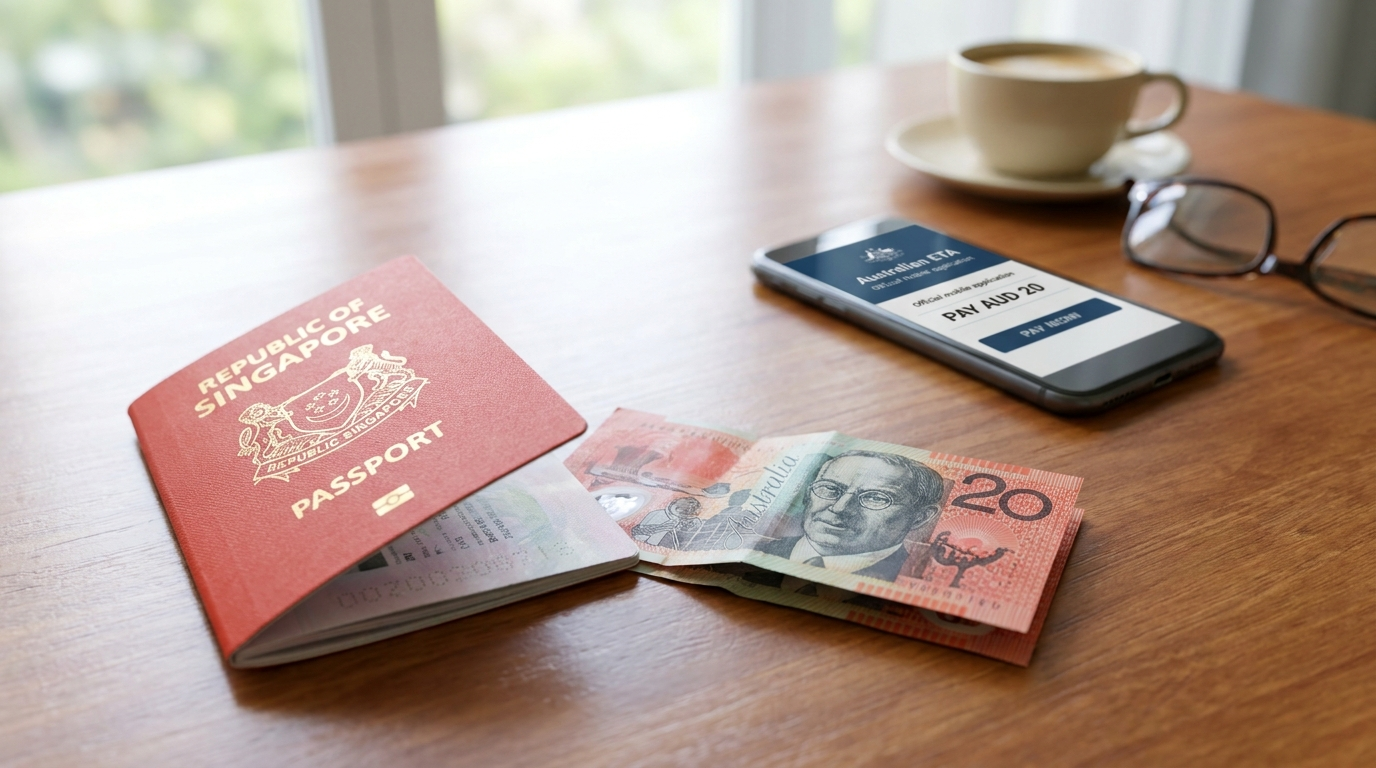
The cheapest Australia visa you can apply for from Singapore costs AUD 20. The most expensive one routinely paid by Singaporeans, the Partner Visa, costs AUD 8,850. Almost every other visa sits somewhere in between, and the figure on the government website is rarely the full bill.
This guide walks through the visa fees that actually matter for Singapore applicants in 2026: the ETA, the Visitor Visa (Subclass 600), and the longer-term study, work, and partner visas. We also cover the side costs that quietly add up once you start the process.
What You Will Actually Pay
These are the headline base charges most Singaporean applicants run into. All figures are in Australian dollars and follow Department of Home Affairs pricing as of 2026.
- ETA (Subclass 601): AUD 20 service charge
- Visitor Visa (Subclass 600), Tourist Stream: AUD 200 offshore, AUD 500 onshore
- Visitor Visa, Frequent Traveller Stream: AUD 1,480
- Student Visa (Subclass 500): AUD 2,000
- Working Holiday Visa (Subclass 417/462): AUD 650
- Temporary Graduate Visa (Subclass 485): AUD 4,600 (Post-Higher Education stream)
- Partner Visa: AUD 8,850
The Australian government usually adjusts these on 1 July each year, sometimes mid-year as well. Treat the numbers as a baseline. Biometrics, medicals, translations, and police certificates often add another 20 to 30 percent on top for longer-stay visas.
Electronic Travel Authority (ETA): AUD 20
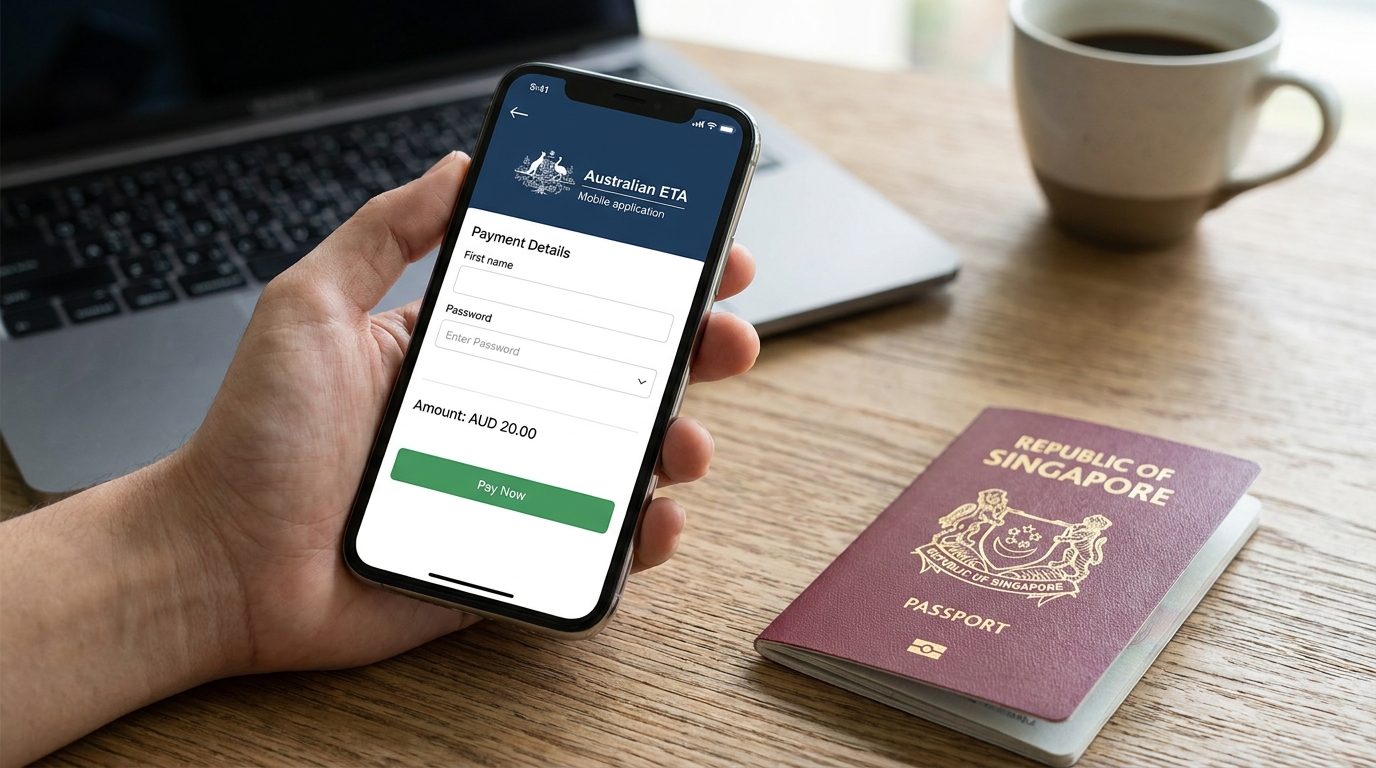
For most Singapore passport holders, this is the only Australia visa fee that ever comes up. Singapore sits on a short list of countries whose citizens qualify for the ETA. The visa covers tourism, business meetings, and transit, with stays of up to 90 days at a time across a 12-month validity period.
Strictly speaking the AUD 20 is a service fee, not a visa application charge. It is non-refundable. If your application is refused, the money stays with the government. Payment runs through the official Australian ETA mobile app on credit card, Apple Pay, or Google Pay.
A word of warning on the resellers. There are dozens of unofficial sites charging USD 50, USD 100, sometimes more, for the same AUD 20 ETA. They cannot speed up processing, they cannot guarantee approval, and most of them are not even based in Australia. Use the official app. For the full walkthrough, see our Australia ETA application guide.
Visitor Visa (Subclass 600) Fees
When the ETA is not an option, the Visitor Visa is. This applies if you are a Singapore PR rather than a citizen, if you need to stay longer than 90 days in one trip, or if your previous ETA was refused. The Subclass 600 splits into four streams, and the fee shifts depending on which stream you pick and where you lodge from.
Tourist Stream
The Tourist Stream is AUD 200 from offshore and AUD 500 from onshore. This is the route most Singapore PRs take, since PR status alone does not qualify you for the ETA. Singaporeans who want to spend three to twelve months in Australia on a single visit also end up here.
Each person on the application pays their own charge. A family of four lodging together is looking at roughly AUD 800 in base offshore fees, before any extras.
Business Visitor and Sponsored Family Streams
Both of these streams cost AUD 200 from offshore. The Business Visitor stream covers short, unpaid activities like attending a conference or sitting in on negotiations, with no salary from an Australian source. The Sponsored Family stream needs an Australian citizen or permanent resident relative to act as your sponsor, and the case officer can require a security bond on top of the fee.
For when the Subclass 600 is the right call versus the ETA, see our Subclass 600 Visitor Visa guide.
Frequent Traveller Stream
The Frequent Traveller stream costs AUD 1,480 and is currently restricted to a small list of nationalities. Singapore is not on that list as of 2026. We mention it only because it shows up in online comparisons and inflates the average Subclass 600 cost figures you might see quoted elsewhere. Ignore it for planning purposes.
Other Visa Categories Singaporeans Commonly Apply For
Outside of travel, the questions we get most often are about studying, working, and settling down with a partner. The fees here are larger and harder to absorb if the application fails, so worth understanding what you are signing up to.
Student Visa (Subclass 500)
The Subclass 500 application charge sits at AUD 2,000 for the primary applicant. Each dependant pays an additional fee on top. Australia raised this charge again in 2025 and now has one of the most expensive student visa fees of any major study destination, well ahead of the UK and Canada equivalents.
Working Holiday and Post-Study Work Visas
The Working Holiday Visa (Subclass 417 or 462) costs AUD 650. The Temporary Graduate Visa (Subclass 485), which lets recent graduates stay on and work in Australia after their studies, was doubled to AUD 4,600 in March 2026 for the Post-Higher Education Work stream. The Second Post-Higher Education Work stream, used for the regional extension, runs at AUD 1,810. Dependant charges were lifted at the same time.
Partner Visa
The Partner Visa application charge is AUD 8,850. The reason that headline figure looks so steep is that the single payment covers both the temporary and permanent stages of the partner pathway. You are paying once for what is effectively a two-stage visa over several years. Among Singaporean applicants, this is the largest single immigration fee most people will ever encounter.
Not sure which visa stream applies to your situation? A short consultation can save you the cost of applying for the wrong visa.
Hidden Costs Beyond the Application Fee
The application charge is rarely the only thing you pay. The exact extras depend on which visa you go for, but the usual suspects are:
- Biometrics: Fingerprints and a facial photo, collected at the VFS Global Australian Biometric Collection Centre at 135 Cecil Street in Singapore. Charged per applicant when biometrics are requested.
- Medical examinations: Required for student and longer-stay visas. A panel physician medical in Singapore typically lands in the low hundreds of Singapore dollars per person.
- Police certificates: Required for several categories. The fee depends on the Singapore Police Force schedule, plus any other country where you have lived for 12 months or more in the last decade.
- Document translations: Anything not already in English needs an accredited translator. Birth certificates, marriage certificates, and academic transcripts are the usual ones.
- Health insurance: Mandatory for several long-stay categories. OSHC for students and private cover for Subclass 485 holders typically runs SGD 200 to 350 per month.
For Visitor Visa applicants none of these are mandatory unless the case officer requests them. For student, work, and partner visa applicants you can assume they are coming, and you should budget for them upfront. Twenty to thirty percent on top of the base charge is a sensible padding figure for any longer-term application.
If you also want to know how long the process takes once you have paid, see our Australia visa processing time breakdown.
Paying for Your Australia Visa from Singapore
All Australia visa fees are quoted and charged in Australian dollars. When you pay with a Singapore-issued card, your bank does the FX conversion at its own rate and usually adds a markup somewhere around 2 to 3 percent. The Department of Home Affairs also slaps on a payment surcharge of about 1.4 percent on Visa and Mastercard transactions.
On a small charge like the AUD 20 ETA, none of this matters. On an AUD 8,850 Partner Visa it absolutely does. A multi-currency debit card or any card that does not load FX margins can save you a noticeable amount. For ETA payments through the app, Apple Pay and Google Pay just route to whichever card is linked, so the same logic applies.
Once paid, the money is gone. Refused, withdrawn, or simply changed your mind, the Department keeps the fee. This is the single most important thing to understand before you submit any Australia visa application: the fee buys you a decision, not a visa.
Working through the numbers for your Australia visa application? Our team can walk you through which visa you actually qualify for and what your total cost is likely to be, so there are no surprises after you pay.