

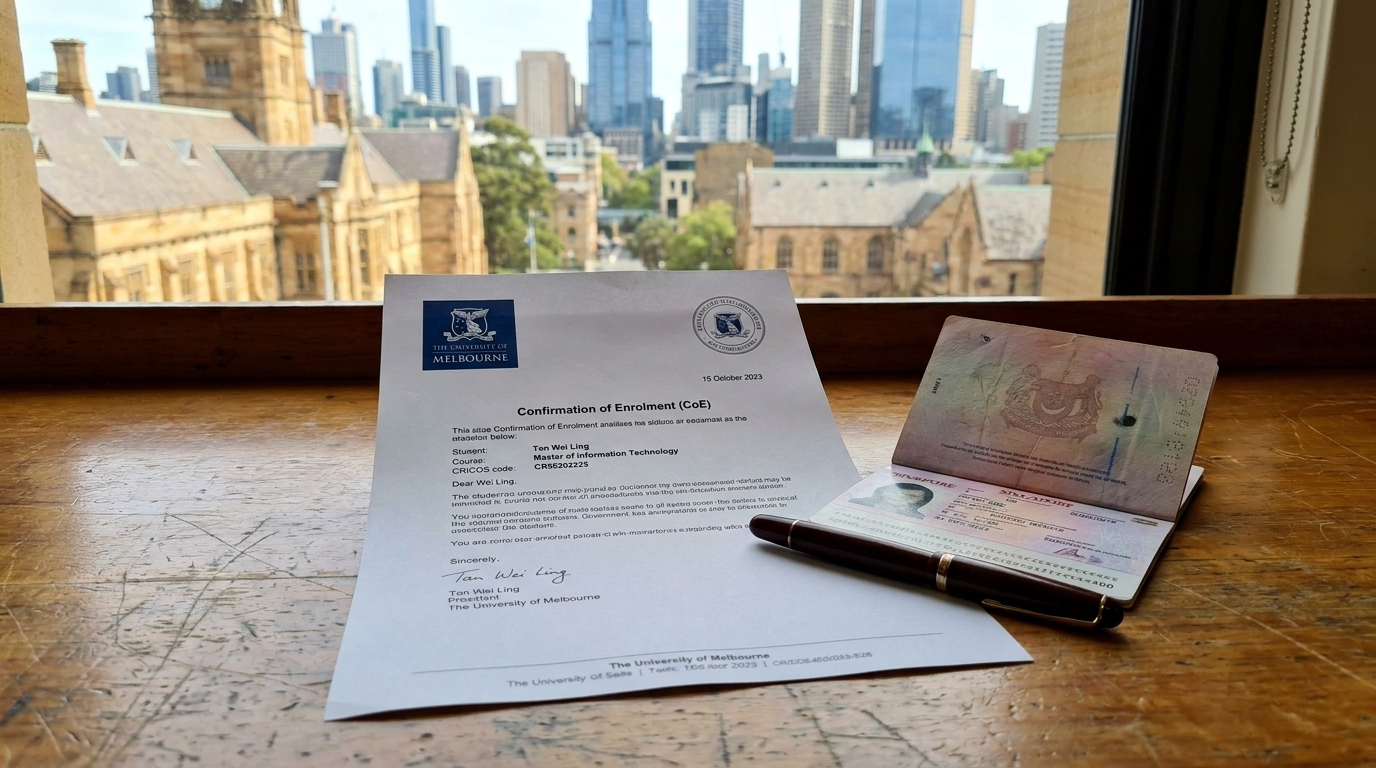
A Singapore passport is about as smooth a starting point as you can ask for when applying for an Australia student visa. Singapore sits in Assessment Level 1, the lowest-risk category the Department of Home Affairs maintains, which means you submit less paperwork and usually get decided faster than applicants from most other countries.
The trade-off is the cost. Australia raised the Subclass 500 application charge to AUD 2,000 on 1 July 2025, one of the highest student visa fees in the world. Singapore applicants still have one of the cleanest paths through the process, but the margins for error are narrower than they used to be.
What the Subclass 500 actually is
The Subclass 500 is the main Australian student visa. It covers full-time study at a CRICOS-registered provider, which means recognised universities, vocational colleges, private English language schools, and some secondary schools. One visa covers the full length of your course, up to five years.
You can study any level from primary school to a PhD on this visa. Dependants, including a spouse and children under 18, can be added to the application and come with you.
The visa also gives you work rights, which matters if you plan to offset living costs. Since 1 July 2023, Subclass 500 holders have been capped at 48 hours per fortnight while the course is in session, and can work unlimited hours during scheduled course breaks. Higher degree research students, meaning masters by research and PhD candidates, have no work cap at all once their course has started.
Requirements for Singapore applicants
Singapore passport holders are in Assessment Level 1 for most CRICOS providers, which cuts the evidentiary bar considerably. You still need all the core documents, just less supporting material around financial capacity and English proficiency than applicants from higher-assessment countries.
The core requirements are:
- A valid Confirmation of Enrolment (CoE) from a CRICOS-registered provider
- Overseas Student Health Cover (OSHC) for the full visa period
- A genuine intention to study, demonstrated through the Genuine Student declaration
- Evidence of English language proficiency, usually met automatically with Singapore secondary or tertiary qualifications
- Evidence of sufficient funds to cover tuition, living expenses, and travel
- Health examinations, if requested
- A Singapore Police Force Certificate of Clearance, for applicants 17 and older
For most Singaporean applicants, the financial evidence is where the Assessment Level 1 benefit shows up clearly. You are generally not required to front 12 months of bank statements or sworn financial affidavits the way a higher-risk applicant would. A clean application with the CoE, OSHC, and a completed Genuine Student statement is often enough.
The Confirmation of Enrolment (CoE)
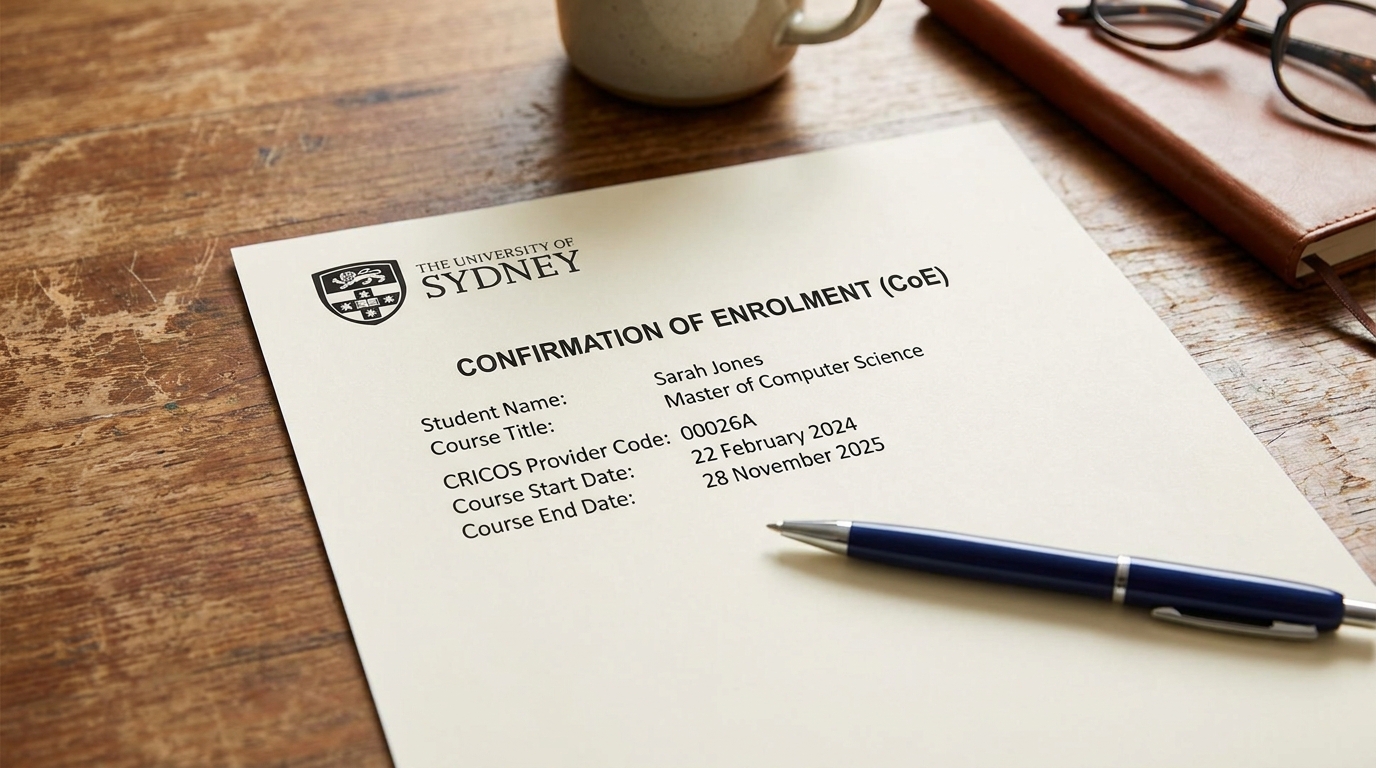
The CoE comes before everything else. You cannot lodge a Subclass 500 without one. The provider issues it after you have been offered a place, paid your initial tuition deposit (usually one semester’s fees), and accepted any conditions on the offer.
The CoE lists your course, start and end dates, tuition fees, and the provider’s CRICOS code. Australian universities typically release CoEs within a week of receiving the deposit. Private colleges and English language schools can be faster. If you are packaging courses, for example an English bridging program followed by a diploma, you will receive a separate CoE for each and lodge all of them together.
Genuine Student (GS) test

The Genuine Student test replaced the old Genuine Temporary Entrant (GTE) requirement in March 2024. The shift was more than cosmetic. GS is a structured declaration embedded in the visa application rather than a free-form statement of purpose, and it is assessed with clearer criteria.
The form asks about your current circumstances, ties to home, why you chose that specific course and provider, how it fits into your career plans, and any previous study or visa history. For Singapore applicants the answers are usually straightforward, but vague or inconsistent answers are the single most common reason a Level 1 applicant trips up in processing. Answer each question specifically, link the course to a concrete career outcome, and make sure your stated plans match your CV.
Not sure whether your study plan will hold up under the Genuine Student test? Our consultants can review your intended course, career rationale, and documentation before you lodge.
Fees, OSHC, and the actual cost
The application charge is AUD 2,000 for the primary applicant, effective 1 July 2025. Each dependant included on the application pays an additional charge, currently AUD 1,500 for an adult partner and AUD 490 for each child under 18.
OSHC is mandatory and must cover the entire duration of the visa, not just the course. A single policy with one of the registered Australian insurers typically runs between AUD 600 and AUD 900 per year for a single student. Family cover is substantially higher. Most applicants buy OSHC through their education provider for simplicity, though direct purchase from an insurer is often cheaper.
Factor in biometrics if requested, a health examination at one of the Singapore panel clinics if flagged, and the Singapore Police Force certificate. Taken together, the realistic out-the-door cost for a single applicant before tuition is usually in the range of AUD 2,800 to AUD 3,500. If you need a broader view of how this sits against other Australian visas, our Australia visa fees breakdown covers the full picture.
Processing times from Singapore
Singapore applicants see some of the fastest Subclass 500 decisions globally. The Department of Home Affairs publishes 50th and 90th percentile times by subclass, but these are global figures. In practice, clean Singapore applications lodged with a complete document set are typically decided within two to four weeks.
Higher education applications, meaning bachelor’s, master’s, and PhD programs at universities, generally clear faster than vocational or English language course applications. This is partly because higher education providers tend to have better compliance records, which feeds into the streamlined processing criteria.
Things that push Singapore applicants into the slower tail:
- Incomplete or inconsistent documentation at lodgement
- A weak or contradictory Genuine Student declaration
- Previous Australian visa refusals or compliance issues
- A study plan that does not obviously match your background or career
- Applying during peak intake windows, particularly December to February for February semester starts
For a more general view of how lodgement timing affects outcomes across Australian visas, our Australia visa processing time guide lays out the patterns.
When to apply
Australian academic years run February to November, with most universities also offering a July intake. For a February start, lodge between October and December of the previous year. For July, lodge between March and May.
You can lodge the Subclass 500 once you have the CoE and OSHC in place, and the Department allows grants up to 124 days before course start. Earlier than that and the visa simply will not be granted, even if processing completes.
If you are applying with a packaged course, make sure your total course end dates line up with the visa end date you need. Subclass 500 visas are granted to cover the course plus a short buffer, not indefinitely.
Common reasons for refusal
Refusal rates for Singapore applicants are low in absolute terms, but refusals do happen. The pattern is consistent.
The most common reason is a weak Genuine Student case. A 32-year-old applicant with an established Singapore career enrolling in an entry-level English course, with no stated career link, will struggle to get past the assessor. Same for applicants whose stated study plan looks like a visa pathway rather than a study decision.
Financial evidence issues come second. While Singapore applicants are not required to provide exhaustive financial documentation, what you do provide needs to be internally consistent. Bank statements that do not match declared income, large unexplained deposits in the weeks before lodgement, or a mismatch between stated sponsor and actual funds all trigger further requests or refusal.
Incorrect CoE details, using the wrong visa subclass, or applying while another Australian visa is active are process errors that also refuse applications. These are fixable with care at lodgement.
A previous refusal on any Australian visa, including ETAs and Visitor Visas, raises the bar for the Subclass 500. It does not disqualify you, but the Genuine Student case needs to address what has changed.
Planning your Australia student visa application from Singapore? We handle the CoE liaison, Genuine Student preparation, and full lodgement so the application holds together the first time.