

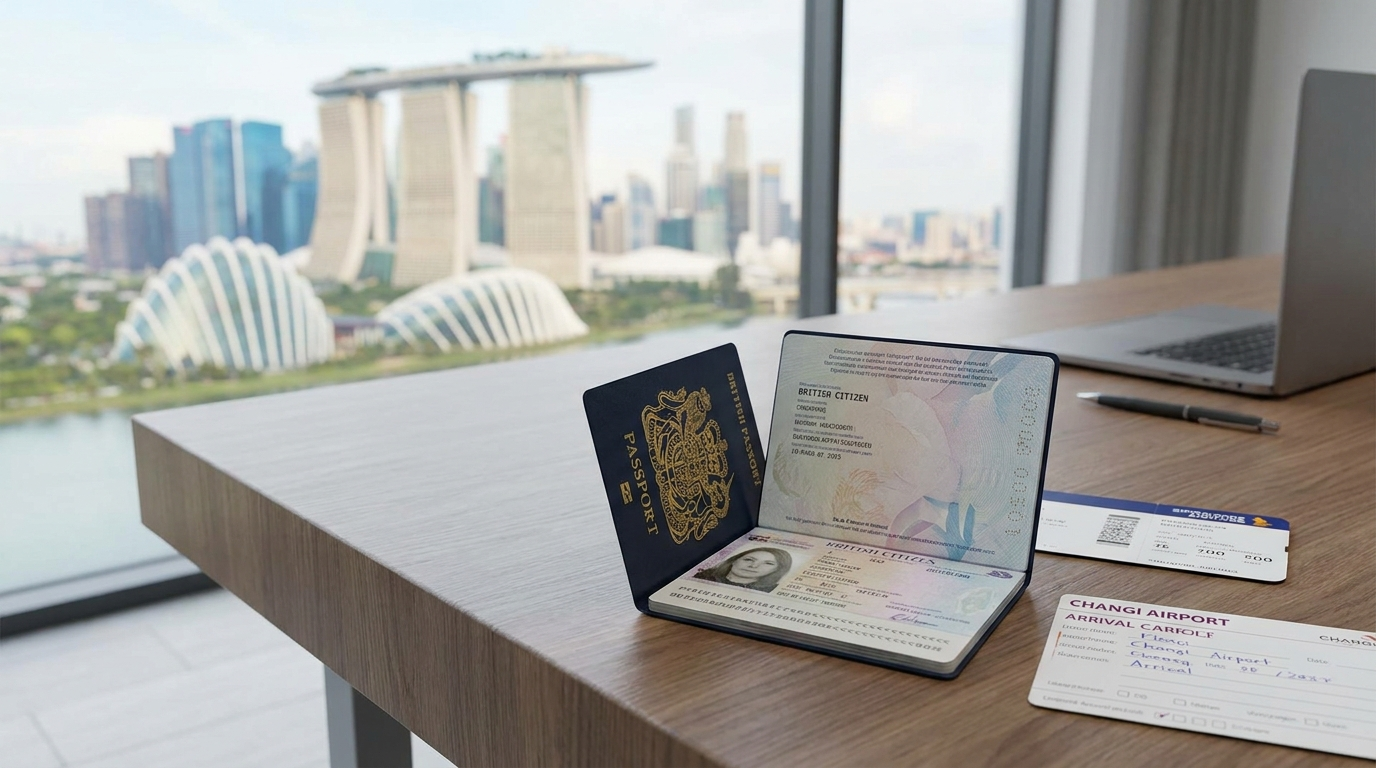
If you hold a UK passport and you’re flying into Changi, the short answer is that you don’t need a visa. British citizens get one of the longest visa-free allowances Singapore offers, and the application most travellers worry about doesn’t exist.
The longer answer matters for a few specific groups: people who hold a British National (Overseas), British Overseas Citizen, or British Protected Person passport, dual nationals carrying two passports, and anyone hoping to stay beyond what the visa-free pass allows. We’ll cover those too, along with the SG Arrival Card, the passport rules, and the cannabis warning every UK traveller should read before they pack.
Who actually qualifies for 90-day visa-free entry
The 90-day allowance is specifically for British citizens with right of abode in the United Kingdom. That’s the wording ICA and the visa policy use, and it matters because “British passport holder” covers more than one category.
A British citizen passport, the dark blue (formerly burgundy) document issued by HMPO with “British Citizen” on the observations page, is the one that gets the 90-day Short-Term Visit Pass on arrival. No SAVE submission, no e-Visa, no fee. ICA places the UK in its visa-exempt group, alongside the US, Canada, Australia, Japan and most of the EU. The Visit Pass is granted at the immigration counter at Changi or any land checkpoint.
A British National (Overseas) passport, typically held by Hong Kong-born BN(O)s, is treated differently. ICA grants visa-free entry, but the standard period is 30 days rather than 90. The same shorter window applies to British Overseas Citizens, British Subjects, and British Protected Persons unless they can show right of abode in the UK. If you’re in this group and unsure, check your passport’s observations page or your status letter from the Home Office before you fly.
What “up to 90 days” means in practice
The 90 days is a single stay, not a cumulative annual allowance. If you arrive on 1 March and leave on 28 May, you’ve used roughly 89 of the 90 days for that visit. Leaving and re-entering reshuffles the clock, but ICA officers do look at the pattern.
Two things to know. First, the 90 days is the maximum the officer can grant, not the default. The Visit Pass stamp can be 30, 60, or 90 days depending on the officer’s read of your visit. A return ticket dated three weeks out usually gets a 30-day stamp. A flexible ticket or a longer accommodation booking helps if you genuinely need the longer allowance.
Second, near-back-to-back visits raise questions. Flying out to Johor Bahru for a weekend and flying straight back to reset the clock is a known pattern, and ICA officers can refuse re-entry or shorten the new Visit Pass if it looks like de-facto residence. If your trip is long enough that you’re tempted to do this, you probably need a different pass.
This is one of the bigger differences from how UK passport holders move around the EU or Schengen. There’s no 90-in-180-day rolling window in Singapore. There’s a per-entry pass, officer discretion at the counter, and a pattern review on repeat visits.
Passport, onward ticket, sufficient funds
Three things every British arrival needs:
A passport valid for at least six months from the date you enter Singapore. ICA enforces this. Airlines check it at the UK end and won’t board you if you’re under the threshold, so a passport expiring in five months and twenty-nine days won’t make it past Heathrow check-in.
Proof of onward travel. A return flight, an onward booking to Bali, KL or Bangkok, or a confirmed Causeway crossing all qualify. The ICA officer doesn’t always ask, but the airline at Heathrow or Manchester routinely does.
Evidence of sufficient funds for your stay. There’s no published threshold. A credit card, a recent bank statement screenshot, or a paid hotel booking covers it for a typical trip.
Flying from London, Manchester or Edinburgh and want a pre-trip document check? We review passport validity, SGAC eligibility, and any visa edge cases before you board.
The SG Arrival Card and No-Boarding Directives
Every traveller to Singapore submits the SG Arrival Card (SGAC) within the three-day window before arrival, including the day of arrival itself. It’s free, online, and takes a few minutes. Filing earlier than three days out won’t be accepted; filing too late can hold you up at check-in.
The SGAC covers travel details, accommodation in Singapore, and a short health declaration. It applies to UK passport holders the same way it applies to everyone else, regardless of the visa-free status.
From 30 January 2026, ICA started issuing No-Boarding Directives (NBDs) to airlines flying into Changi and Seletar. The system uses advance passenger data, including the SGAC and flight manifests, to screen passengers before they board. Travellers flagged as ineligible (invalid travel document, missing SGAC, previous immigration issues) can be denied boarding at the UK departure gate. Airlines face fines of up to S$10,000 for letting flagged passengers board. For a routine British tourist with a valid passport and a submitted SGAC, this is invisible. For anyone with a complicated travel history, the check now starts in the UK, not at Changi.
Cannabis is a hard line, even with UK reforms
UK policy on cannabis is shifting. Singapore’s hasn’t. Cannabis remains a Class A controlled drug under the Misuse of Drugs Act, and the penalties are among the strictest in the world.
ICA can drug-test arriving passengers at the checkpoint. A positive test counts as consumption in Singapore regardless of where the substance was actually used. A joint in Camden three days before your flight can become a custodial problem in Changi. This is not a theoretical risk.
Possession or consumption of cannabis carries up to ten years in prison and a fine of up to S$20,000. Trafficking more than 500 grams carries a mandatory death sentence. CBD products are also illegal, even those labelled THC-free, because trace residues are enough to trigger prosecution. Vapes, including the standard drug-free kind, are banned outright. Don’t pack any of it, including residue in a backpack pocket.
The UK Foreign Office travel advisory for Singapore is explicit on this. Take it seriously.
Dual nationals, longer stays, and the work question
Two situations come up often enough to be worth flagging.
If you hold a UK passport and a passport from a visa-required country (India, Pakistan, China, Nigeria and others on ICA’s Assessment Level 2 list), the rule is to enter on the document you’ll use to leave. ICA cares about the entry passport. Booking the flight on the British passport and entering on it keeps things simple. Switching passports mid-trip is where problems start.
For a stay beyond what the Visit Pass allows, you’re outside the visa-free framework. Working in Singapore needs an Employment Pass, S Pass or Work Permit, sponsored by a Singapore employer. Joining a Singapore citizen or PR spouse goes through the Long-Term Visit Pass route. You can’t arrive visa-free and convert on the ground; the application has to be filed from outside Singapore before you arrive. The Singapore visa requirements and application guide covers which pass fits which situation, and our broader Singapore visa overview for foreign visitors sets the wider context.
If you’re transiting through Changi to Bali, Bangkok or Sydney without leaving the airport, no immigration formality applies. For longer layovers where you want to leave the terminal, the Singapore transit visa guide sets out the 96-hour Visa Free Transit Facility, though as a British citizen you can usually just enter on the standard visa-free Visit Pass instead.
Travelling on a BN(O) passport, holding a second nationality, or planning a stay beyond 30 days? We sort the visa question, document review and any sponsor letters before you book the flight.