

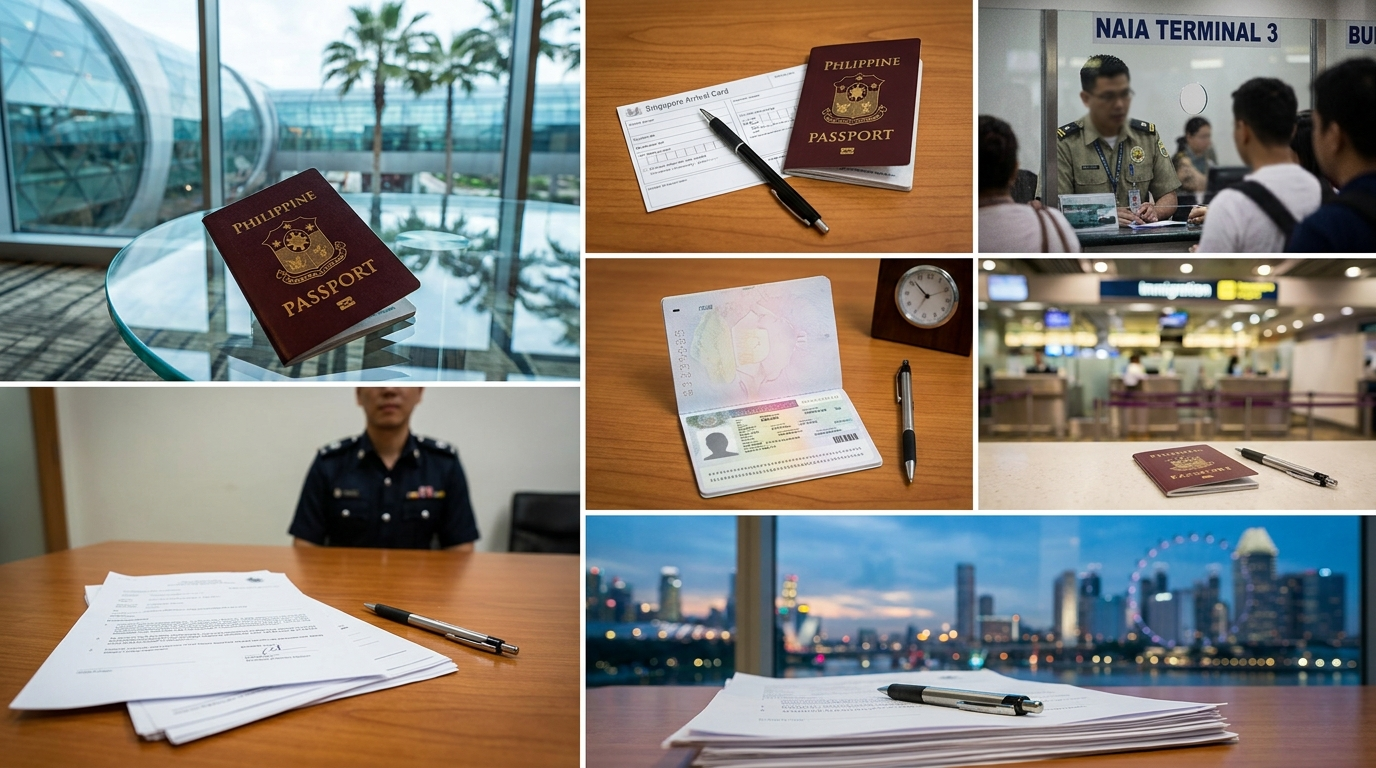
Most Filipinos flying to Singapore never apply for a visa. Philippine passport holders are visa-exempt for short visits of up to 30 days, granted as a Short-Term Visit Pass by the ICA officer at Changi. There is no application form, no SGD 30 fee, no waiting for an e-Visa to come back. The friction sits in two other places: the documents Singapore expects you to show on arrival, and the secondary inspection by the Bureau of Immigration on the Philippine side before you even board.
This guide covers what a Filipino traveller actually has to prepare: the entry documents, the SG Arrival Card, what happens at NAIA on the way out, what ICA officers tend to push back on at Changi, and the situations where a visa or a long-term pass really is required.
Visa-free entry up to 30 days
Philippine passport holders fall into Singapore’s visa-exempt category, the same bucket as the UK, Canada, Australia, Japan, and most of the EU. No pre-arrival visa application is needed for tourism, family visits, or short business meetings up to 30 days.
The Short-Term Visit Pass is granted at the checkpoint by the ICA officer, not booked in advance. The standard stamp for Filipinos is 30 days, but the officer has discretion to grant less. A 14-day pass isn’t unheard of when the traveller’s documentation is thin or the answers at the counter are inconsistent. The pass dictates the maximum stay, so check what was actually granted before leaving the counter.
For the wider context across all visa-exempt and visa-required nationalities, see the Singapore visa requirements and application guide.
When Filipinos do need a visa
The 30-day visa-exempt rule covers tourism and short social or business visits. It doesn’t cover everything. A Filipino traveller needs a separate ICA pass in three main situations.
Stays longer than 30 days. Extensions can be applied for through ICA’s e-Service, but they are granted case-by-case and not guaranteed. For most Filipino tourists without immediate family who are Singapore citizens or PRs, a single 30-day extension is the practical ceiling. For genuine long stays, the right route is a Long-Term Visit Pass or a Student Pass before arrival.
Work in Singapore. Any paid activity for a Singapore employer needs a Work Permit, Employment Pass, or S Pass, applied for by the employer through MOM before travel. Showing up on a Visit Pass and starting work is a hard line ICA enforces.
Study at a Singapore institution. Courses longer than 30 days require a Student Pass through ICA’s SOLAR system (now SOLAR+), sponsored by the school. Short training sessions and exchange programmes under a month can sometimes run on the Visit Pass, depending on how the institution classifies them.
For other passports in the same parent group, see the Singapore visa for Indians complete guide and the broader Singapore visa overview for foreign visitors.
Documents Singapore expects on arrival
The document list for visa-exempt Filipinos is short, but missing any item is a routine reason for ICA to grant a shorter pass or, in worse cases, to refuse entry.
A Philippine passport with at least six months of validity from the date of entry. This is non-negotiable. Airlines also check it at NAIA boarding.
A confirmed onward or return ticket. ICA wants to see that the traveller leaves Singapore within the 30-day window. Open-ended tickets and one-way bookings without a credible reason raise flags.
Accommodation details. A hotel booking, an Airbnb reservation, or the address and contact of the relative or friend hosting the stay. Officers often ask to see this on the phone.
Proof of sufficient funds. There is no official threshold published by ICA. The unofficial figure quoted by travel agents and airlines is around SGD 100 per day, but officers go by the overall pattern: bank statements, a credit card with a reasonable limit, or cash. The real test is whether the funds match the declared trip.
The SG Arrival Card (SGAC), submitted within the three-day window before arrival. Free, digital, through the SGAC e-Service or the MyICA Mobile app. Filing earlier than 72 hours out doesn’t work, and filing late risks the No-Boarding Directive triggering at the airline check-in counter from 30 January 2026.
Need help planning a longer stay or a work move from the Philippines to Singapore? We handle Long-Term Visit Passes, Employment Passes, and Student Pass applications end to end.
The Philippine side: BI secondary inspection at NAIA
Before the ICA officer at Changi ever sees the passport, the Bureau of Immigration at NAIA, Clark, or Mactan-Cebu has to clear the traveller for departure. For most Filipino tourists, that’s a 30-second primary inspection and a stamp. For some, it isn’t.
BI flags travellers for secondary inspection based on a mix of factors: first-time international travel, young women travelling alone, travellers without a stable employer, sponsored trips by someone other than an immediate family member, and inconsistent answers to the primary officer’s questions. The legal basis is the 2015 Revised Guidelines on Departure Formalities, aimed at preventing human trafficking and illegal recruitment.
Secondary inspection is an interview, usually 10 to 15 minutes, in a separate room or counter. The officer asks about the purpose of the trip, who is paying for it, where the traveller is staying, and whether they intend to return. Documents that help: a recent payslip or certificate of employment, the return ticket, the hotel or sponsor’s confirmation, a bank statement, and an itinerary.
Offloading rates are low overall, but the practical effect on a flagged traveller is severe. The flight leaves, the airline rarely refunds the ticket, and rebooking is on the passenger. The fix is preparation, not paperwork tricks. Travellers should have the same documents BI looks for ready to show the ICA officer at Changi anyway.
What gets Filipinos turned back at Changi
ICA refuses a small percentage of arriving passengers each year. The pattern across visa-exempt Filipinos is consistent.
Insufficient funds for the declared stay. A two-week trip with SGD 50 in cash and a maxed-out credit card doesn’t add up, and officers notice.
No confirmed return ticket. Open-jaw itineraries or onward flights more than 30 days out can be acceptable when explained, but routing through a third country with no clear plan is a common refusal pattern.
Suspicious travel pattern. Frequent short visits with no clear purpose, especially when paired with thin local references, suggest informal work or visa-running. ICA flags this on the system, and follow-up visits get harder.
Previous overstays or refusals. Even a one-day overstay on a past Visit Pass stays on the record. Under the No-Boarding Directives that came into effect on 30 January 2026, this can now stop the traveller at check-in rather than at the Singapore border.
Inconsistent answers at the counter. The officer asks where you’re staying, who you’re meeting, how long you’ll be there. If the answers contradict the SGAC submission or the documents on the phone, the inspection escalates.
Practical preparation checklist
Two to three days before the flight: submit the SGAC. Double-check the passport number, the flight details, and the address in Singapore. Errors mean filing again, not editing.
The day before: print the return ticket and the hotel or sponsor confirmation. Have screenshots on the phone as backup. Withdraw or have visible access to funds that match the trip.
At NAIA: keep travel documents in one folder. If asked by BI for secondary inspection, answer the same questions consistently. Don’t volunteer information that wasn’t asked, but don’t contradict yourself.
At Changi: have the SGAC confirmation, the return ticket, and the accommodation details ready before reaching the officer. Confirm the Visit Pass length stamped or printed before leaving the counter. If it’s shorter than expected, that’s the moment to ask about an extension, not the day before it runs out.
For the cost comparison across the region, including agent and government fees for visa-required passports, see the Singapore visa fees and costs guide.
Planning a longer stay, work move, or family relocation from the Philippines to Singapore? A short conversation can confirm which pass applies before you commit to anything.