

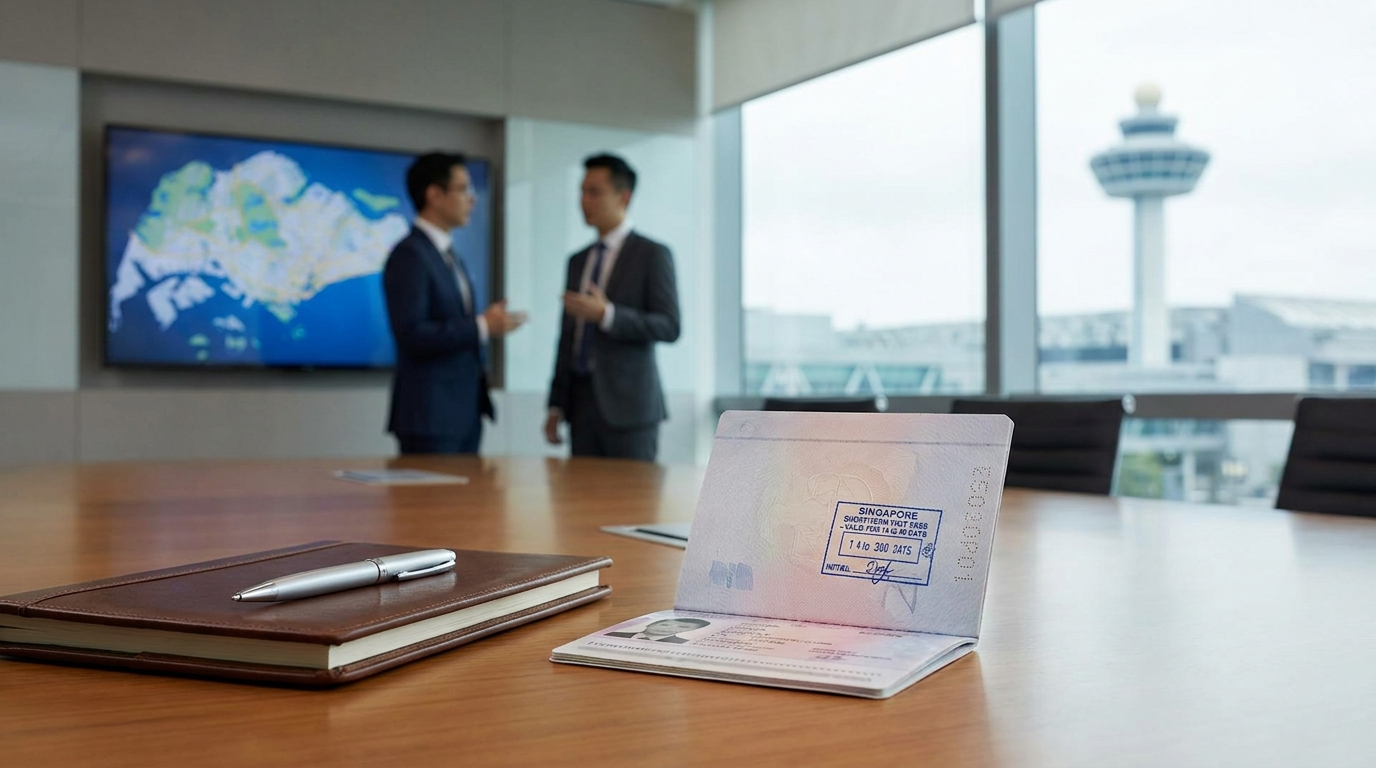
There is no separate “business visa” class in the Singapore system. ICA doesn’t issue one. A foreign visitor coming for meetings, conferences, or contract negotiations enters on a Short-Term Visit Pass just like a tourist. The only thing that distinguishes a business visit is what supporting paperwork the file carries and what the visitor is allowed to do once stamped in.
This page covers the two routes business visitors take, what business activities ICA and MOM actually permit on a Visit Pass, the activities that cross into work-pass territory, and what the V39A Letter of Introduction does for a visa-required applicant. If you’re new to the wider visa system, start with the parent Singapore visa guide on requirements and application.
Visa-exempt vs visa-required: same pass, different path
A visa-exempt business visitor (UK, US, Canada, Australia, EU, Japan, Philippines and around 150 other passports) does nothing special before flying. Passport, onward ticket, SG Arrival Card filed within three days before arrival (including the day of arrival), that’s it. The ICA officer at Changi grants a Short-Term Visit Pass on arrival, usually 14 to 30 days for most passports and up to 90 days for UK citizens.
A visa-required business visitor (Assessment Level 1 nationalities such as India, China, and CIS countries, and Assessment Level 2 nationalities) has to clear ICA before boarding. The same SAVE application that runs for tourist applications is what runs for business visits. The only differences are in the documents attached: instead of a tourist itinerary, the file carries a Letter of Introduction from a Singapore-registered business sponsor.
The SGD 30 government fee, ICA’s stated three working day processing SLA (sometimes longer in peak season), and the SAVE submission mechanics are identical to the tourist route. Business filings don’t get a separate queue or a faster track. Full mechanics for the application itself live in our Singapore visa for Indians guide, which covers the AVA route most visa-required applicants use.
What you can do on a Visit Pass without crossing into work
This is the part business visitors most often get wrong. The Visit Pass covers a specific list of business activities, and the Ministry of Manpower (MOM) publishes that list. Anything not on it counts as work and needs a work pass.
The activities MOM allows on a Short-Term Visit Pass without notification are narrow but cover most genuine business visits: attending company meetings, corporate retreats, or meetings with business partners; attending training courses, workshops, seminars, and conferences as a participant; and attending exhibitions as a trade visitor. Signing contracts and conducting negotiations during these meetings is generally understood to fall under “meetings with business partners”.
A second tier of activities is permitted but requires the visitor to file a Work Pass Exempt Activity e-notification with MOM after arriving in Singapore (once the Short-Term Visit Pass has been issued at the checkpoint) and before starting the activity: exhibition participation as an exhibitor (manning a booth, selling on the show floor), speaking at seminars and conferences, arbitration and mediation work, location filming, specialised technical services for new plants or equipment, and a handful of others. The cumulative cap across all exempt activities is 90 days per calendar year.
What you cannot do without a work pass
The line is whether economic activity is being performed for a Singapore-based party. A few patterns that look harmless and aren’t:
Working remotely from a Singapore office for a Singapore-registered client. Even if the contract sits with an overseas employer, performing the work physically in Singapore on a Visit Pass is a problem. The host needs to sponsor an Employment Pass, S Pass, or Work Permit.
Selling at a trade show. Manning the booth is one thing. Closing transactions on the show floor crosses into work and requires the WPEA notification at minimum.
Sponsored hospitality or junket work, performances at non-government venues, hands-on installation or commissioning at client sites beyond the narrow technical-services exemption, and any role that resembles employment by a Singapore entity. These all need a work pass.
The practical test ICA and MOM apply: who is paying for what is happening on Singapore soil. If a Singapore entity is paying for the visitor’s labour rather than reimbursing travel and incidentals for a meeting, that’s work.
Not sure if your planned activities fit the Visit Pass scope or need a work pass? We assess the activity list against ICA and MOM rules before you book the trip, then file the right application.
The V39A Letter of Introduction
For a visa-required business applicant, the substantive requirement is a Letter of Introduction (LOI) from the Singapore sponsor. Form V39A is one acceptable format for that letter and is downloadable from ICA’s site; a company-issued letter on the sponsor’s letterhead with equivalent content is equally accepted per ICA’s own FAQ. Whichever carrier is used, the LOI gets attached to the SAVE submission alongside Form 14A.
The sponsor signing the V39A has to be a Singapore citizen or PR aged at least 21, acting on behalf of a Singapore-registered business entity. A sole director who is also a citizen or PR can sign for their own company. An overseas applicant whose Singapore counterpart isn’t a citizen or PR can ask the Singapore embassy or High Commission in their home country to issue a letter instead, though that route is slower.
The letter sits on company letterhead and confirms the purpose of the visit, the dates, the host’s contact details, and the relationship to the applicant. ICA treats the LOI as a case-by-case requirement: it’s not always mandatory, but its absence on a business file is the most common reason applications come back with additional document requests. Attaching it from the start saves a round trip.
A meaningful detail: the V39A is the document that often pushes a first-time applicant from a Single Journey Visa into a Multiple Journey Visa on grant. ICA reads a credible local sponsor with a documented recurring purpose more generously than a one-off tourist application. Travellers who’ll be coming back for regular client visits should ask the sponsor for the V39A even when MJV isn’t the explicit goal.
Where business applications go wrong
A few patterns we see on business files that don’t go through cleanly:
The sponsor doesn’t actually exist as a registered Singapore entity, or the entity is too newly registered to have any track record. ACRA-registered companies less than six months old without revenue tend to attract scrutiny. ICA reads the sponsor profile alongside the applicant’s.
The applicant’s stated purpose doesn’t match the activity list. “Coming to set up the office” or “starting client work” describes work, not a business visit. Reframe the purpose around meetings, contract finalisation, training, or due-diligence calls if those are what’s actually happening, and adjust the trip plan if they aren’t.
The supporting documents contradict the LOI. A V39A that says “five-day training course” alongside a hotel booking for two months is going to get questions. The file has to tell one coherent story.
The applicant has prior overstay history or refused-entry stamps from other developed countries. ICA pulls travel history and assesses on the full picture. Clean travel records to Australia, the UK, Schengen, the US, or Japan make business files smoother. The flip side, a refused US B1 or a Schengen overstay, can sink an otherwise routine application.
For business travellers planning recurring visits, the application strategy is to start with a Single Journey Visa supported by a solid V39A, complete the trip cleanly, then apply for a 1- or 2-year Singapore Multiple Entry Visa on the next file. The wider cost picture is in our Singapore visa fees and costs guide.
Need a Singapore sponsor with the V39A ready to support your business visa application? We act as the local contact, sign the Letter of Introduction, submit through SAVE, and follow up with ICA if questions come back.