

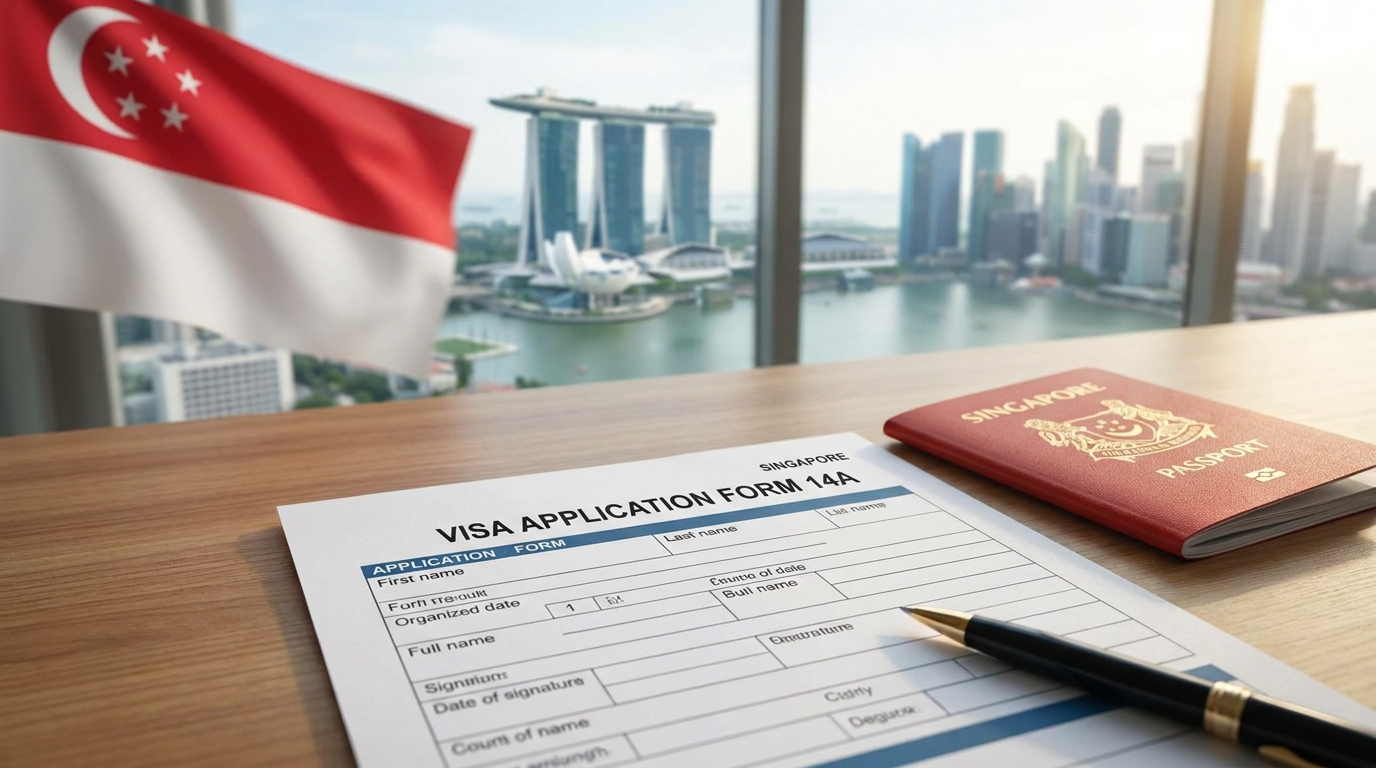
Indian passport holders sit on the ICA’s Assessment Level I list, which means a visa is required for every visit to Singapore. The fee is small and the answer usually comes back inside a working week. The catch is that an Indian applicant in Mumbai or Delhi cannot file the application directly. ICA’s SAVE system only accepts submissions from a Singapore-based contact or an Authorised Visa Agent (AVA) in the home country.
This guide covers what an Indian traveller actually needs to do: who can submit, what it costs, how long it takes, what the e-Visa allows once it’s granted, and alternatives like the Multiple Journey Visa and the 96-hour transit option.
Why Indian applicants can’t apply to ICA directly
ICA classifies Indian nationals as Level I, the administrative tier rather than the high-scrutiny one. The application is processed through SAVE, ICA’s online visa system, but SAVE is closed to overseas applicants. Only three parties can submit on an Indian applicant’s behalf.
A Singapore citizen or PR with a SingPass account can file as a local contact. This is the cheapest route because there’s no agent service charge, and works well when a relative, friend, or business host in Singapore is willing to log in and submit Form 14A.
An Authorised Visa Agent in India is the standard route. VFS Global and IVS Global are the two largest AVA networks, with submission centres in Delhi, Mumbai, Kolkata, Chennai, Bangalore, Hyderabad, Ahmedabad, Pune, Kochi, and Chandigarh. BTMS and certain IATA-approved travel agents are also on the AVA list.
The Singapore High Commission in New Delhi and the Consulate-General in Chennai handle higher-complexity cases, but they don’t take routine tourist visa applications at the counter. For most Indian travellers, the practical question is which AVA to use, not whether to go through one.
What it costs
The government fee is SGD 30, payable to ICA through the AVA. For applications submitted on or after 1 January 2026, the Singapore High Commission sets this at a fixed INR 2,100 regardless of the day’s exchange rate. The fee is non-refundable. If the application is unsuccessful or the applicant withdraws, the money is gone.
The AVA adds a service fee on top. The Singapore High Commission has set a fixed service charge of INR 1,000 across all authorised handlers in India, so the all-in cost through VFS Global or IVS Global is typically INR 3,100. Some agents bundle express handling or courier services into a higher figure, usually INR 1,500 to INR 2,000 in service charge.
Filing through a Singapore-based relative or sponsor skips the agent fee entirely. The only cost in that case is the SGD 30 government charge. The wider breakdown is in our Singapore visa fees and costs guide.
Documents and photo specs
The document list is short and the same regardless of which AVA handles the file.
A scan of the passport biodata page, with at least six months of validity from the date of entry into Singapore. A recent colour passport photograph: 35mm by 45mm, plain white background, taken within the last three months, full face, no glasses. Form 14A, completed and submitted electronically through SAVE. An introduction letter from the local contact, or, where an AVA is filing without a Singapore sponsor, a covering letter explaining the purpose of the visit.
For business visits, add a Letter of Introduction. ICA’s Form V39A is the standard template, signed personally by the Singapore local contact through SingPass. Per ICA guidance, a company support letter on Singapore letterhead can substitute for Form V39A provided it includes the local contact’s NRIC details and the other information ICA requires. For routine tourist filings sponsored by a Singapore citizen or PR relative, V39A is not typically required.
ICA can ask for supporting documents on individual files: bank statements, the return flight booking, hotel confirmation, or past travel history. These are case-by-case. A clean travel record to other developed countries generally smooths the assessment.
Need a Singapore-based contact to sponsor your visa through SAVE? We file on your behalf, handle the document checks, and manage the ICA follow-up so you can plan the trip with the e-Visa already in hand.
Processing time and how to plan around it
ICA’s published target for routine Level I applications is three working days. In practice, three to five working days is the realistic planning figure for Indian applicants, excluding Saturdays, Sundays, and Singapore public holidays. Files that ICA flags for further review can sit longer, sometimes a week or more.
Express service through AVAs can turn a clean file around in two to three working days when ICA is not running a backlog. Peak periods, particularly the run-up to Chinese New Year, the June school break, and December, push timelines closer to seven to ten working days.
Don’t book non-refundable flights or hotels before the e-Visa is in hand. The most common avoidable loss we see is an Indian applicant who booked the trip the day they submitted, then watched ICA take a slower-than-expected look. Two to three weeks before travel is the safer submission window.
What the e-Visa actually grants
Singapore stopped issuing physical visa stickers years ago. What gets issued now is an electronic visa, a PDF printed and carried with the passport. It’s tied to the passport number, so renewing the passport after the visa is granted means going through the application again.
The e-Visa has two separate clocks running, and Indian applicants get caught by the distinction more than any other group. Validity is the window during which the visa can be used to enter Singapore, usually three months for a Single Journey Visa or one to two years for a Multiple Journey Visa. Period of Stay is what the ICA officer at Changi grants at the checkpoint, and that’s a Short-Term Visit Pass of up to 30 days, regardless of how long the visa itself runs.
A two-year MJV does not give you two years of staying in Singapore. It gives you two years of being allowed to enter, with each visit capped at 30 days. Stays beyond 30 days require a different pass entirely.
The Multiple Journey Visa for repeat travellers
The MJV is the visa Indian applicants tend to want most. The standard route is to apply first for a Single Journey Visa, use it cleanly, then apply again with a request for multiple entry. After one or two successful trips, a two-year MJV is now common for Indian passport holders with a clean record.
The government fee for an MJV is still SGD 30, the same as a single-entry visa. ICA’s assessment criteria aren’t published, but a stable purpose for repeat visits, a credible local sponsor, and a clean travel history all help. Business travellers with documented reasons to return often get the MJV on a first application when the LOI is solid. The per-visit cap remains 30 days. Wider context sits in the parent Singapore visa requirements and application guide.
The 96-hour Visa Free Transit Facility
For Indian travellers passing through Changi on the way to a third country, the VFTF can replace the e-Visa entirely. It grants up to 96 hours in Singapore for transit purposes, free of charge, and is open to Indian passport holders who hold a valid visa or long-term pass for Australia, Canada, Germany, Japan, New Zealand, Switzerland, the UK, or the US, with at least one month of validity from the date of entry into Singapore.
The onward flight has to be to a third country, not back to India, and departure has to be by air or sea. Entry can be by any mode. The VFTF is generally usable once per journey, on either the outbound or return leg, not both. ICA carves out one exception relevant to Indian travellers: a holder of a Single Journey Visa from one of the eight qualifying countries may still be granted VFTF on the return leg after that SJV has been used and expired, provided they travel directly from the country that issued the SJV, through Singapore, back to India, and have not returned to India since last using it. ICA officers at the checkpoint make the final call, and extensions are not allowed.
For a multi-stop itinerary that includes Singapore as a layover, the VFTF is cheaper and faster. For a direct visit to Singapore as the destination, the e-Visa is still required. Application detail is in our Singapore e-Visa application guide.
Common mistakes Indian applicants make
Timing trips up most first-time applicants. Filing more than a month ahead of travel risks ICA questioning the timing; filing inside a week leaves no buffer if the file gets flagged. Two to three weeks ahead works best.
The photo is the next pitfall. ICA’s spec is strict on background, dimensions, and recency. AVA counters check photos at submission, but applicants who upload self-printed photos through online filing are the most common source of file holds.
Mistaking visa validity for stay length is the third. An applicant who lands at Changi with a two-year MJV and assumes they can stay two months will be stamped in for 30 days only. Overstays are taken seriously under the No-Boarding Directives that came into effect on 30 January 2026.
The SG Arrival Card sits on top of the e-Visa and applies to every traveller. It’s free, digital, and has to be submitted within the three-day window before arrival. Skipping it, or submitting outside the window, can now stop you at check-in.
Planning a trip from India to Singapore? We handle the SAVE submission, document checks, and Letter of Introduction so the e-Visa is sorted before you book the flight.