

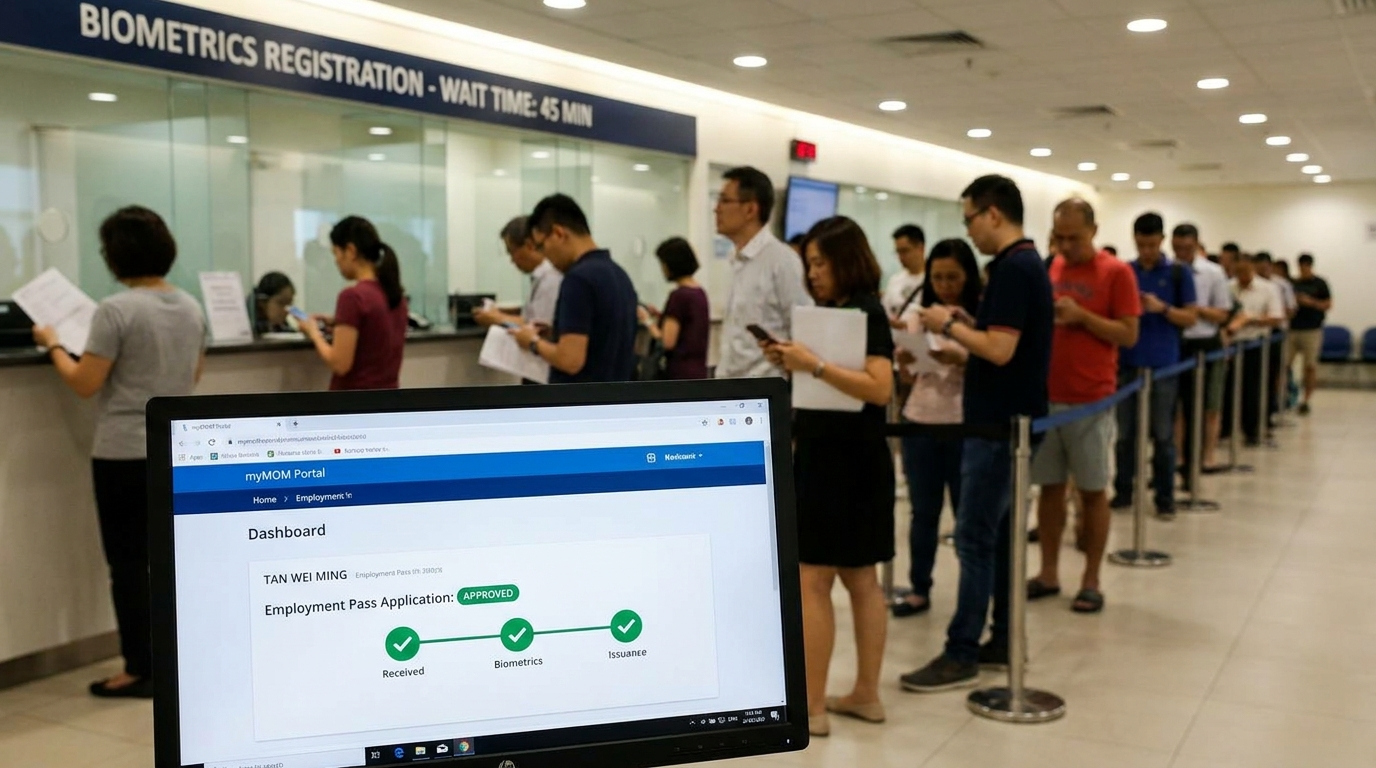
If you are sponsoring a hire into Singapore or waiting on your own application, the first thing worth knowing is that “Singapore work permit processing time” is not one number. Each pass has its own queue, its own portal, and its own things that go wrong. MOM’s headline target is 10 business days for most online cases, but the realistic range is closer to one week for a clean Work Permit and up to eight weeks for a complicated Employment Pass.
This guide walks through the timeline for every work pass MOM issues, what happens during the wait, and the parts of the process that quietly add weeks before anyone tells you anything is wrong.
How processing time is counted
The clock starts when the employer hits submit on myMOM Portal (for EP, S Pass, Dependant’s Pass) or WP Online (for Work Permit). Until the submission goes in, nothing is counted. A request from MOM for additional documents stops the clock until the employer responds, then restarts it.
Status is checked through MOM’s Check a Work Pass enquiry portal at service2.mom.gov.sg/workpass/enquiry, which needs the candidate’s date of birth plus FIN or passport number. The SGWorkPass mobile app shows the same data once an IPA is issued. ICA-issued passes route through the ICA e-Service portal with Singpass instead. Mixing the two portals is a common reason people think their application has disappeared when it has not.
Employment Pass: three weeks if the file is clean
MOM’s official target for an EP application filed through myMOM Portal is 10 business days. In practice, three weeks from submission to in-principle approval is what most employers should plan for. A clean COMPASS score and complete documents bring it closer to two weeks. A C1 score below the local PMET benchmark, a generic job description, or a credential that needs Dataflow verification can push the timeline to six to eight weeks.
Manual paper submissions, which only apply to overseas companies with no Singapore entity, run up to six weeks. Almost nobody files this way now.
The IPA letter is valid for six months. The candidate uses it to enter Singapore, then has the EP card issued by giving biometrics at an Employment Pass Services Centre. Card issuance adds another working week on top of the IPA timeline.
What slows an EP down
The single biggest delay in 2026 is COMPASS. Since the September 2023 rollout, every new EP has to clear a 40-point bar across salary, qualifications, employer diversity, and support for local hiring. COMPASS has also applied to EP renewals since 1 September 2024, and the C1 salary benchmarks were re-set in January 2026 against last year’s PMET data. The updated benchmarks apply to renewal applications assessed from 1 July 2026 onwards. A profile that cleared comfortably in 2024 may now sit a band lower without anyone changing anything on the file.
Documents that trigger follow-up requests include unverified degrees from schools that do not respond to Dataflow, gaps in employment history that the candidate did not explain, and salary structures that mix fixed and variable pay in ways MOM cannot read on a single line. For the broader picture of which pass to file in the first place, see our Singapore work visa and permits overview.
Want a COMPASS pre-score before the file goes in? Send us the candidate’s salary, age, sector, and your local-foreign headcount and we will tell you what the score looks like and what to fix before MOM sees it.
S Pass: similar to EP, but quota is the choke point
S Pass processing through myMOM Portal runs on the same 10 business day target and the same three-week practical timeline as EP. There is no COMPASS check, but the bottleneck is different.
S Passes are capped at 10% of total workforce in services and 15% in manufacturing, marine shipyard, construction, and process. The Local Qualifying Salary used to count locals toward that quota rises from S$1,600 to S$1,800 on 1 July 2026. An employer who was at quota in June may find the application bounces back in July, not because the candidate is wrong but because the headcount maths shifted overnight. MOM does not let you stage S Pass applications over quota and pick the strongest one. The system drops the surplus.
S Pass IPAs are valid for 60 days from issue, one of the tighter windows and roughly a third of what EP gets. The candidate enters Singapore, completes a medical examination where required, gives biometrics, and the physical card follows about a week later.
Work Permit: one to two weeks for IPA, plus medical and arrival
Work Permit applications through WP Online are the fastest of the headline passes. The IPA decision typically comes through in one to two weeks, with a published MOM target of around seven business days for clean cases.
The slow part is everything around it. Once the IPA is issued, the employer has to arrange entry and pay the levy from the date the candidate lands, book a medical examination within two weeks of arrival for workers not required to undergo MOM’s Onboard programme, submit biometrics and a photo at MOM’s Work Permit issuance facility, then pay the issuance fee and collect the physical card.
End to end, from submission to a worker holding a physical Work Permit and starting on site, three to five weeks is the realistic number. Source-country processing can add weeks before any of this starts. Workers from Bangladesh, Bhutan, Cambodia, India, Laos, Myanmar, the Philippines, Sri Lanka, and Thailand have to clear pre-departure formalities at home before they fly, and that timeline sits with the source country, not MOM. Bhutan, Cambodia, and Laos were added to the Non-Traditional Source list on 1 June 2025. A licensed Singapore work permit agent can sequence the source-country steps against the Singapore-side approvals.
What slows a Work Permit down
The two reasons Work Permits stall on the Singapore side are quota and compliance. Quota is automatic and visible at submission. Compliance is where most surprises happen. Even one month of unpaid foreign worker levy on file is enough to trigger a refusal. An open EFMA case, an AWOL report against the employer, accommodation that has not been declared or does not meet the housing rules, or a worker with a prior adverse immigration record in Singapore will hold up an otherwise clean application.
ONE Pass: four weeks, sometimes longer
The Overseas Networks and Expertise Pass runs on a separate MOM workflow. The published indicative timeline is around four weeks from submission to decision. Applications under the outstanding-achievement track, where there is no fixed monthly salary to verify but a portfolio of evidence in business, technology, sport, the arts, or academia, can run six to eight weeks.
ONE Pass IPAs are valid for six months. The pass is self-applied — there is no employer sponsor — so the holder controls entry and issuance timing directly.
Dependant’s Pass: three weeks for EP families
DP applications filed by EP, PEP, ONE Pass, EntrePass, or Tech.Pass holders earning at least S$6,000 fixed monthly run on the same three-week timeline as the main pass. DPs sponsored by EntrePass or Employment Pass (Sponsorship) holders take up to eight weeks because the underlying compliance check is heavier. S Pass holders earning at least S$6,000 in fixed monthly salary can sponsor a DP on the same terms as EP holders. S Pass holders below that threshold can bring family only on a Long-Term Visit Pass (LTVP), subject to the LTVP salary bar and MOM’s discretion.
A DP cannot be filed before the main pass is approved. The standard sequence is: main pass IPA, candidate enters Singapore, candidate’s pass is issued, then DP is filed. Couples trying to land together usually file the DP while the candidate is still overseas, accept the wait, and arrive on staggered IPAs.
What happens during the wait
For the candidate, the wait is mostly silent. MOM does not send progress emails. The status on the workpass enquiry portal moves from “Pending” to “In-Principle Approval Issued” or “Application Unsuccessful” with little narrative in between.
For the employer, the wait is where most preventable delays surface. The portal will flag a request for additional documents that only appears under the application reference, not in any inbox. HR teams who do not check the portal every two or three working days lose a week at a time on follow-ups that took ten minutes to clear.
Once an IPA is issued, the six-month validity window is real. A candidate who delays entering Singapore past month six has to apply again from scratch. The pass card is only issued after entry, the medical (where required), and the biometrics appointment.
Why applications get refused
The shape of a refusal is different per pass. For EP, it is almost always a COMPASS score below 40 or a salary that sits under the local PMET benchmark for the role and age. Generic job titles that do not match the listed duties — a “Senior Manager” doing what reads as analyst work — get caught at C1.
For S Pass, refusals are mostly quota and salary. For Work Permits, they concentrate on the employer’s compliance record and the candidate’s immigration history: levy arrears, EFMA debarment, and housing that does not meet MOM’s standards are the recurring three.
For ONE Pass, the salary documentation is what most refusals trace back to. The S$30,000 has to be fixed monthly. A package built on bonus and equity does not clear the bar, regardless of total compensation.
After a refusal, the employer has three months to file an appeal through myMOM Portal, or can reapply once the underlying issue (salary, COMPASS score, FCF posting) has been addressed. Practitioner advice usually points to three to six months before reapplying, to give the file time to genuinely change. Filing the right pass the first time matters more than chasing the fastest one, and for foreign professionals thinking past the work pass, our Singapore PR, LTVP and long-term passes guide covers what comes after.
Working out a realistic timeline before you commit to a start date? Send us the pass type, sector, and source country and we will give you a week-by-week projection that holds up against real MOM and source-country queues.