

Most citizenship applications go through a long quiet stretch before anything happens, and that quiet is the source of more nervous calls than the outcome itself. ICA publishes a twelve-month processing target. Six to twelve months is the realistic window for an adult application, and it can run longer when foreign documents need verification or when the applicant has been a PR for a relatively short time.
This guide covers where to log in, what each portal status means, what to do during the wait, and what comes after either outcome. It sits under the wider Singapore visa and pass status guide.
Where to check: MyICA with your own Singpass
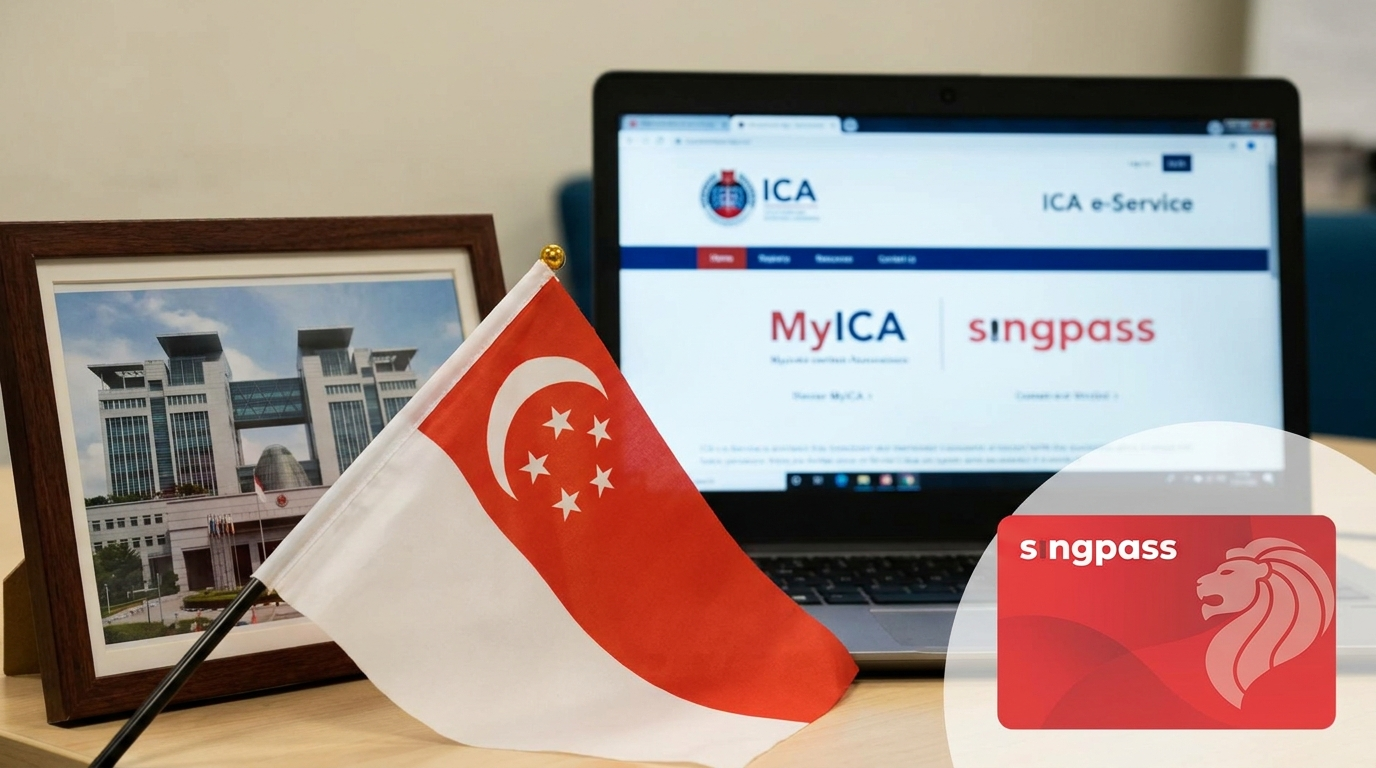
Citizenship applications submitted from 26 June 2024 onwards check through MyICA at eservices.ica.gov.sg. The login is Singpass, and for nearly every adult applicant that means the applicant’s own Singpass — you are almost always already a PR by the time you file, which means you already have one.
Once you are in, choose Enquire Application Status from the dashboard. The portal returns one of a short list of states: Received, Under Processing, Additional Documents Requested, or Decision Issued. The system does not show queue position or any estimate of how much longer the file will sit, and refreshing more than once a week is wasted effort.
For sponsor-filed cases, such as a Singaporean parent applying for a child, the sponsor uses their own Singpass rather than the child’s.
If you do not have Singpass, or the application was filed before 26 June 2024, the older ICA e-Service route is the way in. You need the application reference ID from the acknowledgement email and the applicant’s FIN or UIN. MyICA is only available for citizenship applications filed from 26 June 2024 onwards, but the no-Singpass legacy route is open to current applicants without Singpass as well. The status labels are the same.
Status labels and what they actually mean
Received is the first state. ICA has the file and the fee has cleared. No officer has looked at the case yet. This usually lasts a few weeks.
Under Processing is where the bulk of the wait happens. An officer is reviewing the application, and ICA is pulling supporting records in the background — CPF history, IRAS tax records, NS status for male applicants, and any prior immigration records. Most cases sit at Under Processing for the longest single block of time.
Additional Documents Requested means ICA needs something specific. The portal flags it, and an email goes to the address on file. The response window is firm. Late or partial replies can extend processing or, in some cases, push the file into a state where you are asked to reapply.
Decision Issued means ICA has reached an outcome. The detail — approval or refusal — lands by email and post. The portal mirrors that, but the email is the primary channel. Check spam folders weekly through the entire processing period.
Stuck at Under Processing past the twelve-month mark with nothing else moving? Send us the reference number and submission date and we can tell you whether a follow-up is worth filing or whether the case is still on a normal track.
What to do during the wait
A citizenship application is not a passive document. ICA expects the applicant’s situation to stay broadly consistent with what was declared at filing, and there are practical things worth doing and not doing while the file is open.
Avoid extended periods abroad. Spending months out of Singapore during processing weakens the case, especially if you do not have a strong tie like a Singaporean employer or family here. A two-week holiday is fine. A six-month overseas assignment is not.
Do not change marital status or sponsor a separate immigration application during the wait. If you marry, divorce, or have a child between filing and decision, inform ICA through the application’s update channel. The file can be re-evaluated on the new facts.
If ICA invites you for an interview, treat the appointment as fixed. Reschedules are possible for genuine reasons, but repeated changes are read poorly. Bring originals of every document referenced in the application.
Renew your PR re-entry permit on time if it lapses during processing. A lapsed PR while the citizenship file is still open creates an avoidable gap.
After approval: SCJ, renunciation, and the oath
A successful application returns an In-Principle Approval (IPA) rather than instant citizenship. Three steps then sit between the IPA and the pink IC.
The Singapore Citizenship Journey is the first. The SCJ is mandatory for applicants aged 16 to 60, and has three components: an online e-Journey module, a half-day Singapore Experiential Visit to historical landmarks and national institutions, and a Community Sharing Session run at the constituency level. Most applicants finish the SCJ within about two months of the IPA.
Renunciation of your existing citizenship is the second. Singapore does not recognise dual citizenship for new adult citizens, who must renounce their existing citizenship as part of the Oath of Renunciation, Allegiance and Loyalty taken at registration. Renunciation is typically effected through your current country’s embassy or consulate, in most cases via the mission in Singapore, though a few countries require the paperwork to go through the home-country authority directly. Timelines vary: some embassies process a renunciation in a few weeks, others take several months and require a personal appearance. Start the embassy step as soon as the IPA is in hand, because the next step depends on it.
The Oath of Renunciation, Allegiance and Loyalty is the third. ICA schedules the oath appointment once your SCJ is complete and your renunciation paperwork is ready. The appointment takes place at the ICA building at Kallang Road. You take the oath, register as a citizen, and leave with citizenship status confirmed and an appointment to collect your pink NRIC. Most new citizens apply for the Singapore passport at ICA on the same registration visit — you do not need to wait for the GRC ceremony.
The Citizenship Ceremony at your GRC follows three to six months after registration. Attendance is mandatory and the ceremony includes the National Pledge, the National Anthem, and the formal presentation of the Citizenship Certificate.
If the application is refused
Refusals on citizenship are issued by email and post, and most arrive without a specific reason. ICA’s published position is that the decision is at the Minister’s discretion and that detailed grounds are not disclosed. Asking for a written reason rarely produces one.
Reapplication is open. There is no formal cooldown set out in legislation, but the practical guidance from ICA officers and immigration consultants is to wait at least six months before refiling, and longer if nothing material has changed in your circumstances. A second application with the same profile and the same supporting documents will usually return the same outcome.
What does shift outcomes is a meaningful change between applications — a longer tax record at a higher band, a marriage to a Singaporean, a sustained employment record in a sector ICA assesses favourably, or the addition of qualifying family ties. Filing again purely because time has passed is the most common reason for a second refusal.
PR status is not affected by a citizenship refusal. Your re-entry permit, employment, and family arrangements continue unchanged.
Quick reference
For applications filed on or after 26 June 2024, log in to MyICA at eservices.ica.gov.sg with your Singpass and use Enquire Application Status. Older applications use the ICA e-Service with the reference ID and FIN or UIN. The realistic processing window is six to twelve months for most adult cases, and ICA’s published ceiling is twelve months. Approval triggers the SCJ, renunciation, oath, and GRC ceremony in sequence. Refusal arrives without a reason and a reapplication should usually wait at least six months and reflect a real change in your situation.
The portal answers the narrow question of where the file sits. The harder questions — whether the timing is normal, whether something is worth flagging, what to do after an In-Principle Approval — usually need a closer look at the specifics of your case.
Got an In-Principle Approval and not sure how to sequence the SCJ, embassy renunciation, and oath appointment? Send us your IPA date and home-country citizenship and we will sketch the steps and timing for you.