

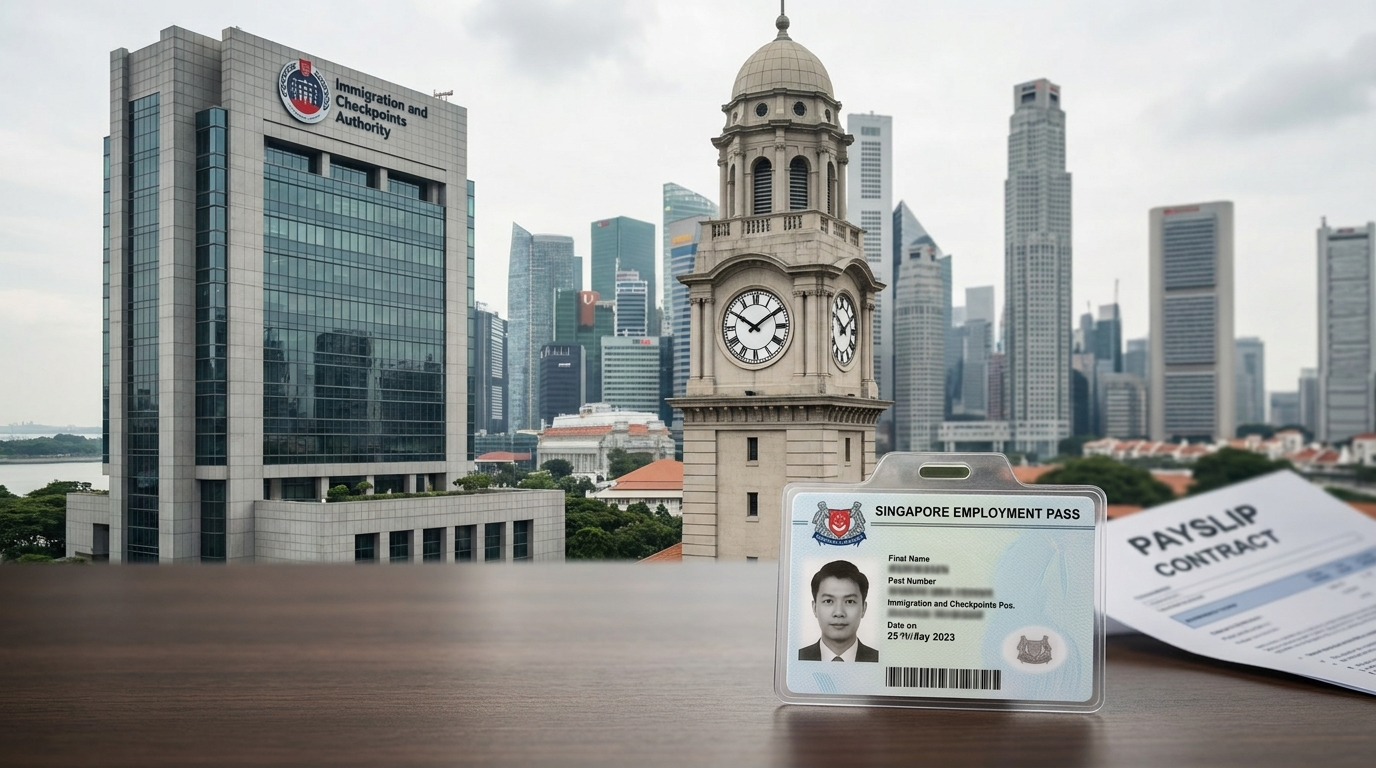
ICA states six months. Most applicants in 2026 wait closer to six to twelve. The gap between the headline number and the real number is where most of the anxiety lives, and the part nobody quite explains is what is happening on ICA’s side during those months, and what you can or cannot do without disturbing the file.
This page is the standalone read on processing time, sitting underneath the broader Singapore PR application guide and the parent Singapore PR, LTVP and long-term passes guide. The numbers below are the 2026 ones, drawn from the ICA portal and the patterns most consultants are seeing this year.
The stated timeline vs the real one
ICA’s official figure is six months from submission to outcome. That is the answer the e-Service portal gives, and it is the answer the front desk gives if you call.
The realistic spread for 2026 is wider. Six months is closer to the median. Nine to twelve months is common for files with mixed-country income, recent job changes, or dependants applying from overseas. In surge periods, even straightforward profiles can run past twelve months. ICA does not publish a backlog count and does not flag your file as “delayed”. Your status stays the same until a decision lands.
Three things move a file faster:
- A clean PTS profile with two to three years on one EP, one full Year of Assessment of Singapore tax on record, and no recent employer change
- A complete submission on the first try, with current payslips, a clear employer support letter, and no missing pages
- An employer in a sector ICA reads as stable and locally rooted
Three things slow it down:
- Foreign tax assessments still being collected, especially for applicants with income split across countries
- A spouse or child applying from overseas, where ICA wants to see the relationship documents and the dependant’s history
- An employer support letter that reads as thin, or a salary figure that sits at the edge of the unwritten PTS baseline
A file that goes in at fourteen months and gets a decision at four is not a sign that the system is broken. It is a sign that the profile sat comfortably above the line and the documents were clean.
What ICA actually does during those months
The e-Service portal makes it look like the file goes into a box and stays there. It does not. ICA pulls several records once the application is logged.
IRAS tax data is the big one. ICA pulls Singapore tax data directly from IRAS once you consent on the application form, so what you declare in the portal is matched against IRAS records on ICA’s side. A mismatch, like a declared salary above what IRAS sees or a year of filings missing, usually means a query through the portal.
MOM employment records are checked the same way. Your current work pass, your employment history through past CPF contributions, and any gaps between passes are visible to ICA without you submitting anything extra. A job change you didn’t mention in the application is a common reason a file flips into a longer queue while ICA asks for an update.
Criminal records, both Singapore and overseas, are run during processing. Singapore records come through internal channels. Overseas records are checked against what you declared on the application form, which is why honesty about minor offences matters more than people think. A small declared issue is usually less of a problem than a small undeclared one that surfaces later.
Family information is checked for the dependants on the file. Marriage certificates are cross-referenced, birth certificates are matched against the parent’s records, and family already in Singapore on PR or citizenship is read as a tie that strengthens the case.
Checking status on the e-PR portal

For applications submitted from 26 June 2024, the primary status-check route is MyICA via Singpass, using the “Enquire Application Status” function. Applicants without Singpass can fall back to the ICA e-Service using the application reference number and FIN or UIN from the acknowledgement. There are no interim updates between submission and decision. The portal shows a high-level state, typically “Received” or “Under Processing”, until ICA either requests additional documents or issues the decision.
A few rules that save trouble:
- ICA does not respond to “how is my application going” emails. The standard reply is to wait for the portal to update.
- Calling the hotline rarely speeds anything up. The agents see the same status you do.
- A status that has not moved at the four-month mark is not a problem. A status that has not moved at the nine-month mark is also not a problem on its own. Long does not mean bad.
- For applications submitted from 26 June 2024 onward, status checks and outcome notifications run through the MyICA portal, with the outcome itself notified by email or post.
Stuck at the seven-month mark and unsure whether to follow up? Send us your application reference and submission date and we will tell you whether the wait is normal for your profile or worth a check.
What to do while you wait
The wait is the period most applicants underestimate. A few choices during the months between submission and outcome can either protect the file or quietly weaken it.
Stay on a valid work pass at all times. If your EP renewal falls inside the PR window, file the renewal on time and do not let the pass lapse. A gap in pass coverage is one of the cleaner ways to have an in-flight PR application invalidated. ICA does not warn you about this. The file simply closes.
Avoid changing jobs unless the move clearly strengthens your profile. A lateral move at similar pay during processing is read by ICA as instability and often triggers a query. A promotion to a higher salary band at the same employer is fine, and a clean move to a better role with documented continuity can also work, but expect to update ICA through the portal either way. The safest path is to hold the existing role until the outcome.
Avoid long stretches out of Singapore. Short business trips and the usual one to two week leave do not register as a problem. Multi-month absences during the assessment window read as someone who is not fully resident, which is exactly what the PR scheme is trying to assess. If a long trip is unavoidable, keep documentation that it was employer-mandated.
Report material changes through the portal. A marriage, a new child, a divorce, or a change of address should be filed through the e-Service rather than left to surface at the IC collection stage. ICA reads honesty as a positive signal. Surprises at collection are harder to recover from.
Keep tax filings clean. If a new Year of Assessment falls during the wait, file it on time and accurately. ICA will pull the updated figures.
How the outcome lands
When the decision is made, the portal status flips. Approved applicants see the new outcome in the e-Service portal and receive an email pointing to the In-Principle Approval letter for download. The IPA letter spells out the next steps: appointment booking at ICA, document collection, photographs, payment of the Entry Permit fee, the Identity Card fee, and the Re-Entry Permit fee. A short window applies for completing the formalities, typically around two months from the IPA date.
Declined applicants used to receive a posted letter. The current standard is the same portal notification plus an email, with the decline letter available to download. The letter does not give reasons. It states the outcome and the appeal window.
If the answer is no, two paths open up. The first is an appeal, which is typically filed within six months of the decline (the rejection letter states the exact window) through the same e-Service. Appeals work only when something new can be brought forward, like a promotion, a salary jump, or a marriage. An appeal that simply restates the original case is almost always declined.
The second path is a fresh application. There is no formal cooling-off rule from ICA, but the working practice is to wait at least six months and use the time to strengthen the profile: another full Year of Assessment, a clearer salary trajectory, more time at one employer. Most consultants recommend a reapply over an appeal unless the file has materially changed inside the appeal window.
If both an appeal and a reapply are declined in quick succession, the practical wait stretches to twelve to twenty-four months before another attempt is worth the cost. ICA has now reviewed the same profile twice and will be reading for what has actually shifted.
Already past the stated six month window, or got a no and weighing appeal versus reapply? A free profile review covers your current status, your timing options, and what to fix before the next move.