

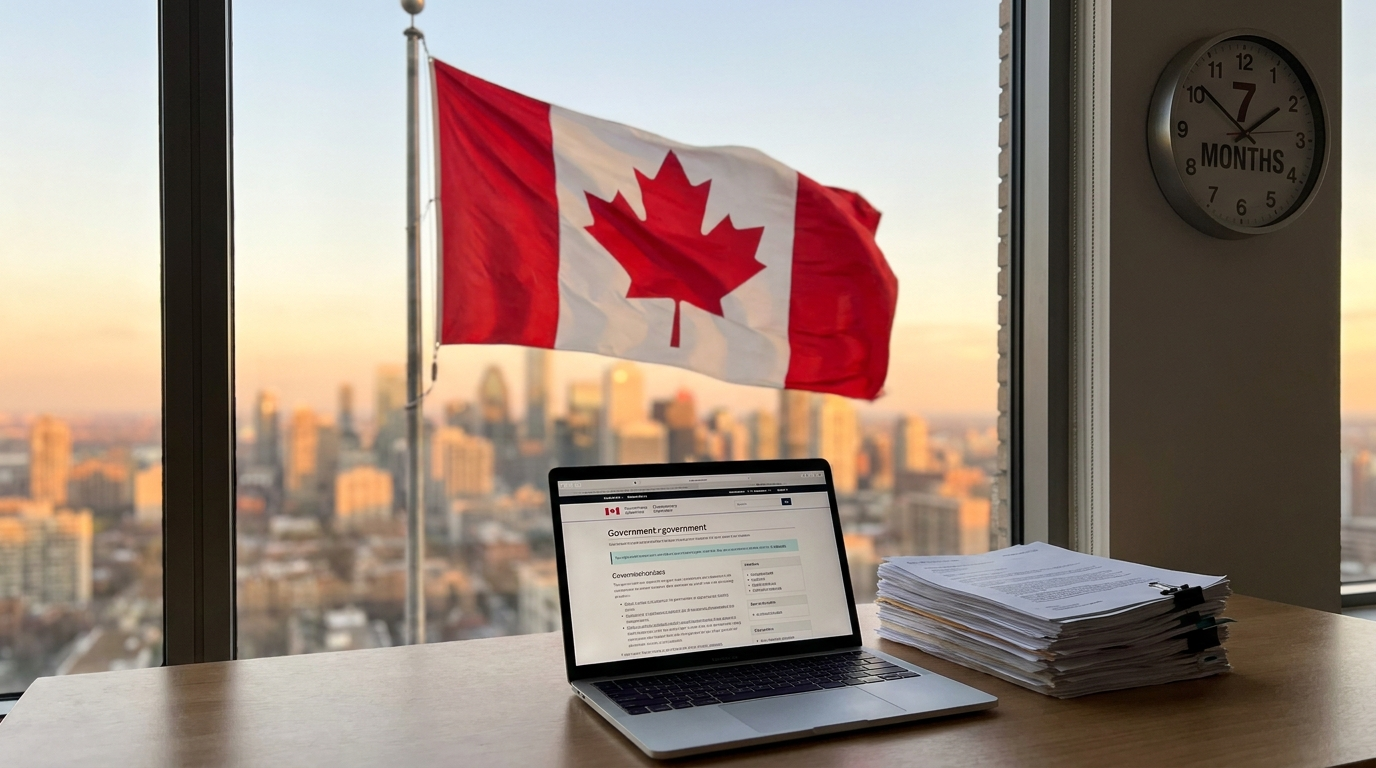
IRCC’s published processing times for Express Entry permanent residence sit at seven months as of May 2026, the figure that covers 80% of finalised applications over the previous six months. Canadian Experience Class, Federal Skilled Worker, and Express Entry PNP are all at seven months. Provincial nominees outside Express Entry sit at fourteen months.
For Singaporeans, the canada pr visa processing time depends less on geography and more on which lane you are in. Singapore does not have its own queue. Your file is handled by IRCC’s centralised network the same way an applicant in Manila or London would be, and the variation comes from program type, document quality, and how often your category gets drawn.
What the official numbers say in 2026
IRCC publishes processing times monthly, calculated by checking how long it took to finalise 80% of applications over the previous six months. The May 2026 figures for the main economic routes:
- Express Entry CEC: 7 months
- Express Entry FSW: 7 months
- Express Entry FST: no time published by IRCC
- Express Entry PNP: 7 months
- Non-Express Entry PNP: 14 months
- Spousal sponsorship (outland): 16 months
- Spousal sponsorship (inland): 25 months
The central economic programs have held at seven months through the first half of 2026 because IRCC has been steadily clearing Express Entry inventory, including about 60,900 CEC and 52,000 FSW applications still in the queue as of mid-May. These figures change month-to-month, so check the IRCC processing-times page before locking in a plan.
Express Entry: what seven months actually looks like
Seven months is the figure for files that reach the Confirmation of Permanent Residence stage. The clock starts at Acknowledgement of Receipt (AOR), which is usually generated automatically within minutes to a day of submitting the e-APR following your Invitation to Apply.
Most Singaporean CEC applications would clear in four to six months if Singapore had its own bucket, because document verification is clean. Federal Skilled Worker tends to sit at six to nine months because IRCC verifies the foreign education credential assessment and overseas work references, both of which add weeks. Real Singaporean files we see usually break down like this:
- AOR to medical request: 2 to 4 months
- Medical and biometrics clearance: 2 to 4 weeks
- Background and security checks: 1 to 3 months
- Final decision and CoPR: 2 to 6 weeks
If everything is in the first submission, the file moves through without extra requests. Procedural fairness letters, missed translations, or a stale police certificate can each add a month.
Before AOR: the part most people forget
The seven months IRCC quotes only covers post-submission processing. The Singaporean side of the timeline runs longer than that and is where most applicants lose ground.
Language testing through IELTS or CELPIP takes two to four weeks from booking to results. WES credential assessment timelines depend on how fast NUS, NTU, SMU, or your overseas university issues sealed transcripts, and in our experience the document-gathering side is the bottleneck rather than WES itself. Sitting in the Express Entry pool waiting for an ITA varies widely: high-scoring candidates in a healthcare or French-language category have been picked up within weeks of entering the pool, while profiles below the category cut-off can wait open-ended given that IRCC has not held a general all-program draw in 2026. Singapore police certificates take 7 to 14 days from SPF once the application has full documentation, matching what SPF publishes on its Certificate of Clearance page, but any other country you lived in for six months since age eighteen runs its own clock.
A realistic end-to-end timeline from deciding to apply to landing in Canada is twelve to eighteen months for an organised single applicant. Families and applicants who need to resit language tests stretch past twenty.
Want a realistic timeline mapped to your profile? Our consultants benchmark your CRS, occupation, and category against current 2026 draw cadence so you can plan around real dates.
Why CEC is faster than FSW
The gap between Canadian Experience Class and Federal Skilled Worker processing is structural, not random. CEC applicants are already in Canada on a work permit, so IRCC already has their biometrics, fingerprints, medical, and verifiable Canadian employment history. The file is mostly reviewing what is already on record.
FSW files involve a foreign education credential, foreign work references that have to be verified through employer letters and sometimes phone calls, and police certificates from multiple jurisdictions. Singaporean FSW files are cleaner than most because Singapore’s institutions respond quickly to verification requests, but the file still has more moving parts than a CEC one.
The practical implication: if you have any path into a Canadian work permit before applying, CEC will get you through faster. If you are applying from Singapore without ever having worked in Canada, plan for the seven-month side of the range, not the four-month side. The canada pr requirements breakdown covers which program your profile actually qualifies for.
Provincial Nominee Programs add or subtract time
A Provincial Nominee Program nomination adds 600 points to your CRS score, which functionally guarantees an ITA at the next PNP-specific draw. But the processing time depends on whether your PNP is run through Express Entry or outside it.
Express Entry-aligned PNPs follow the seven-month federal timeline. The provincial nomination itself takes another two to six months on top, depending on the province and stream. As of mid-2026, Ontario, Alberta, and Saskatchewan have been running the longest provincial queues at roughly four to six months, while British Columbia and Nova Scotia have been closer to two to three. Each province publishes its own current processing times and they shift with intake caps, so check the provincial site you are applying through before banking on a number.
Non-Express Entry PNP streams sit at fourteen months at the federal stage, plus the provincial nomination time. The combined timeline can reach eighteen to twenty-four months. The trade-off is real: lower CRS thresholds and access to streams without language minimums, but a much longer wait.
What slows a Singapore file down
Three factors account for most delays we see on Singaporean Express Entry files.
The first is incomplete employer references. IRCC wants letters on company letterhead with specific job duties matched to the National Occupational Classification, dates, hours per week, and salary. A standard HR confirmation letter does not meet the bar and triggers a request for additional documents, which adds four to eight weeks.
The second is stale documents. Medicals are valid for one year, police certificates for the duration of the application, and proof of funds is checked again at landing. Files that move slowly through pre-submission often need medical retakes, which costs another SGD 300 to 450 and two more weeks.
The third is unreported overseas history. Anyone who studied or worked in the UK, US, Australia, or anywhere else for more than six months since turning eighteen needs a police certificate from that country. Forgetting one and having IRCC catch it during background check is a six to ten week delay.
What you can actually do to move faster
You cannot speed up IRCC’s queue, but you can avoid being the file that gets stuck in it.
Front-load language testing and aim for CLB 9 on the first sitting rather than the third. Get the WES assessment started the moment you decide to apply, not after the ITA. Order police certificates from every country you have lived in before you start the e-APR, because they take the longest. Use a checklist that maps every claimed point on the CRS to a document, so there is nothing to clarify after lodgement.
If your CRS is close to the cut-off, work the categories. Recent 2026 category draws have come in with cut-offs as low as 467 for Healthcare and Social Services (February), 397 for French-language proficiency (March), and 477 for Trades (April). Cut-offs move with each round, but cracking a category-based draw has been faster than grinding IELTS up to chase a program-specific cut-off. The budget breakdown for a Canada PR application is worth running before you commit to a route, because adding French or a second language sitting changes the cost picture.
Ready to start your Canada PR application with a clear timeline? We will map your documents, language plan, and category fit against the current 2026 draw schedule.
Have a question about your own situation? Tell us on WhatsApp and a consultant will reply.
Chat with an OCSC consultant