

Singaporeans travel to Canada without a visa, but that goodwill stops at the PR door. Anyone applying for Canada permanent residence from Singapore goes through the same federal economic programs as everyone else, and 2026 brought a round of fee hikes, new draw categories, and a tighter immigration levels plan that quietly reset the bar.
Most Singaporean applicants come in through Express Entry, which is the umbrella for three economic programs and ten category-based selection streams. The canada pr requirements you actually need to hit fall into four buckets: program eligibility, language, education, and the Comprehensive Ranking System score that decides whether you get invited.
Program eligibility under Express Entry
Express Entry runs three programs, and you have to qualify for at least one to enter the pool. The Federal Skilled Worker Program (FSWP) is the main route for Singaporeans without prior Canadian work experience. It needs one year of continuous, full-time skilled work experience in a TEER 0, 1, 2, or 3 occupation within the last ten years, plus a minimum of 67 out of 100 points on the FSW selection grid.
The Canadian Experience Class (CEC) needs one year of skilled work experience in Canada within the last three years, which rules it out for most Singaporeans applying from home. The Federal Skilled Trades Program (FSTP) covers specific trades and needs either a Canadian job offer or a Canadian trade certification, so it is a narrow lane.
Provincial Nominee Programs sit alongside Express Entry. A nomination from a province adds 600 points to your CRS score, which almost guarantees an invitation to apply. Each province runs its own streams with their own criteria, and some still allow applications without a job offer if your occupation is on their target list.
The language requirement is non-negotiable
Every program needs an approved language test. For English, IRCC accepts IELTS General Training, CELPIP General, or PTE Core. Most Singaporeans take IELTS because the test centres are everywhere and the results transfer cleanly into the CLB scale Canada uses.
The minimum for FSWP is CLB 7 in all four bands, which works out to IELTS 6.0 in listening, reading, writing, and speaking. CEC needs CLB 7 for TEER 0 and 1, or CLB 5 for TEER 2 and 3. Below the minimum your application is rejected, full stop.
The CRS rewards going further. CLB 9 across all four bands is where single applicants should be aiming, and CLB 10 is meaningfully better still. Adding French at NCLC 7 on top of strong English unlocks up to 50 extra points and access to the French-language category draws, which have repeatedly cleared in the 390s and low 400s through 2025 and the first half of 2026 (the 4 March 2026 round cleared at CRS 397). Most Singaporeans who hit a wall at CRS 480 to 500 cannot get past it without French.
Education credential assessment
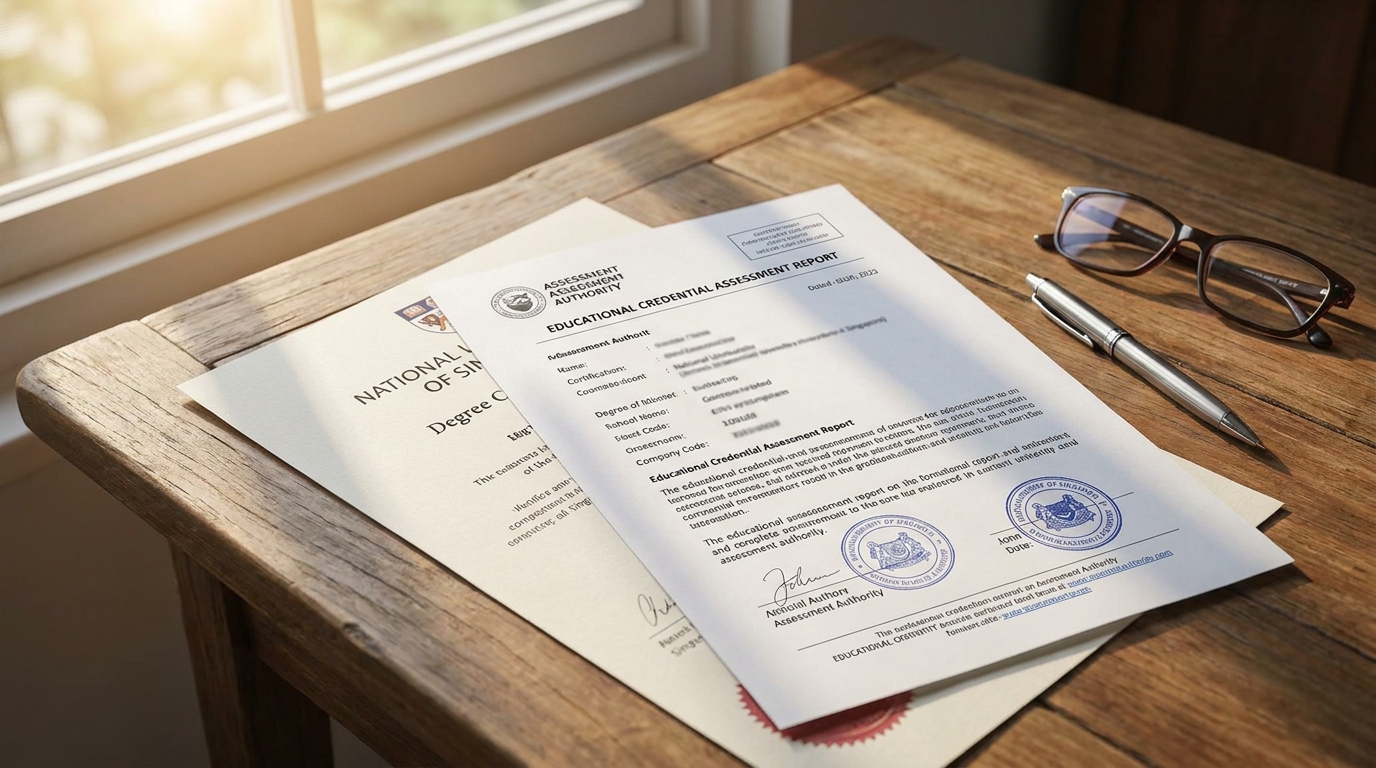
Your degree has to be assessed by an IRCC-designated organisation before it can earn CRS points. World Education Services (WES) is the most common choice, and the typical turnaround from Singapore is three to seven weeks once your university sends the documents.
NUS, NTU, SMU, and the polytechnics are well known to WES, so assessments come back without complications most of the time. A bachelor’s degree maps to one ECA point band, a master’s to a higher one, and a PhD to the top. Diplomas from local polytechnics get assessed too, but the resulting band is lower and the CRS impact reflects that.
CRS scores and what they look like in 2026
The CRS score out of 1,200 decides who gets invited from the pool. CEC draws in the first five months of 2026 came in between CRS 507 and 518, which is high. General all-program draws that would include FSWP candidates have not run since 23 April 2024, so IRCC is running CEC, PNP, and category-based draws instead, and the categories have lower cut-offs.
The most recent healthcare draw (20 February 2026) cleared at CRS 467, with earlier 2025 healthcare rounds ranging from the 460s to the 510s. The April 2026 trades draw came in at CRS 477. STEM has not had a dedicated draw in 2025 or so far in 2026. Senior managers had their first dedicated draw on 5 March 2026 at CRS 429. The February 2026 physicians draw cleared at CRS 169. If your occupation matches a category, the practical bar is much lower than the headline CEC or PNP score suggests. CRS cut-offs move from round to round, so check the current numbers before benchmarking.
One thing worth checking: every occupation-based category (healthcare, STEM, trades, education, transport, the Canadian-experience ones) requires at least 12 months of full-time equivalent experience in the past three years in a qualifying occupation. The French-language category is the exception and goes off your NCLC 7 test result instead. If you are close to the line on the occupation routes, count your hours carefully before lodging.
Want to know which category your profile fits? A 30-minute review with our Canada-focused consultants maps your occupation, language, and experience against the live 2026 draw data.
Proof of funds, medicals, and police checks

Unless you have a valid Canadian job offer or are already working legally in Canada, you need to show settlement funds. The current amounts (last updated by IRCC on 7 July 2025) are CAD 15,263 for a single applicant, CAD 19,001 for two, and rising in steps of CAD 4,112 for each additional family member beyond seven. The bank letter has to follow IRCC’s specific format and show your average balance over the past six months. Fixed deposits work; CPF balances do not.
Every applicant and every accompanying family member, even those not coming, does a medical with an IRCC panel physician. In Singapore there are several panel clinics around Tanglin, Novena, and the CBD, and the package typically runs SGD 250 to 450 per adult. Police certificates are needed from Singapore and from every country you have lived in for six months or more since age 18, which can be the slowest piece if you have worked in multiple jurisdictions.
The 2026 fee structure
IRCC raised PR fees on 30 April 2026. The principal applicant processing fee for economic programs is now CAD 990, up from CAD 950. The Right of Permanent Residence Fee (RPRF) rose from CAD 575 to CAD 600 and applies to the principal applicant and accompanying spouse. Dependent children sit at CAD 270. Spouse processing is also CAD 990.
A typical Singaporean couple with one child looks at CAD 990 plus CAD 990 plus CAD 270 in processing, plus CAD 600 plus CAD 600 in RPRF, for a total of CAD 3,450 in government fees alone. Add language tests, ECA, medicals, police certificates, and translations, and the canada pr application budget realistically sits between SGD 5,000 and SGD 8,000 before any consultant fees.
Timeline for a 2026 Singapore application
Working backwards from an ITA, IRCC’s service standard for completed PR applications is six months and they generally hit it for clean files. Before the ITA, an EOI can sit in the pool for weeks if you are in a category, or indefinitely if you are sitting below the CEC and PNP cut-offs without a category match. The realistic end-to-end timeline from deciding to apply to landing in Canada is twelve to eighteen months for an organised applicant, longer if your CRS score needs work or your category does not draw often.
The 2026-2028 Immigration Levels Plan caps total PR admissions at 380,000 per year, with the economic class share at about 63% in 2026 and rising to 64% in 2027 and 2028 (about 239,800 economic admissions in 2026 and 244,700 in 2027), up from the 59% share IRCC was working to in the previous plan. Express Entry remains the biggest single channel inside that economic share, and Singaporeans with strong English, a recognised degree, and a category-eligible occupation are well placed within it. The work is in stacking the points before you enter the pool, not in fixing things after.
Ready to start your canada pr application? Our team will sort your eligibility, run a CRS estimate, and plan the document pack so nothing stalls your file.