

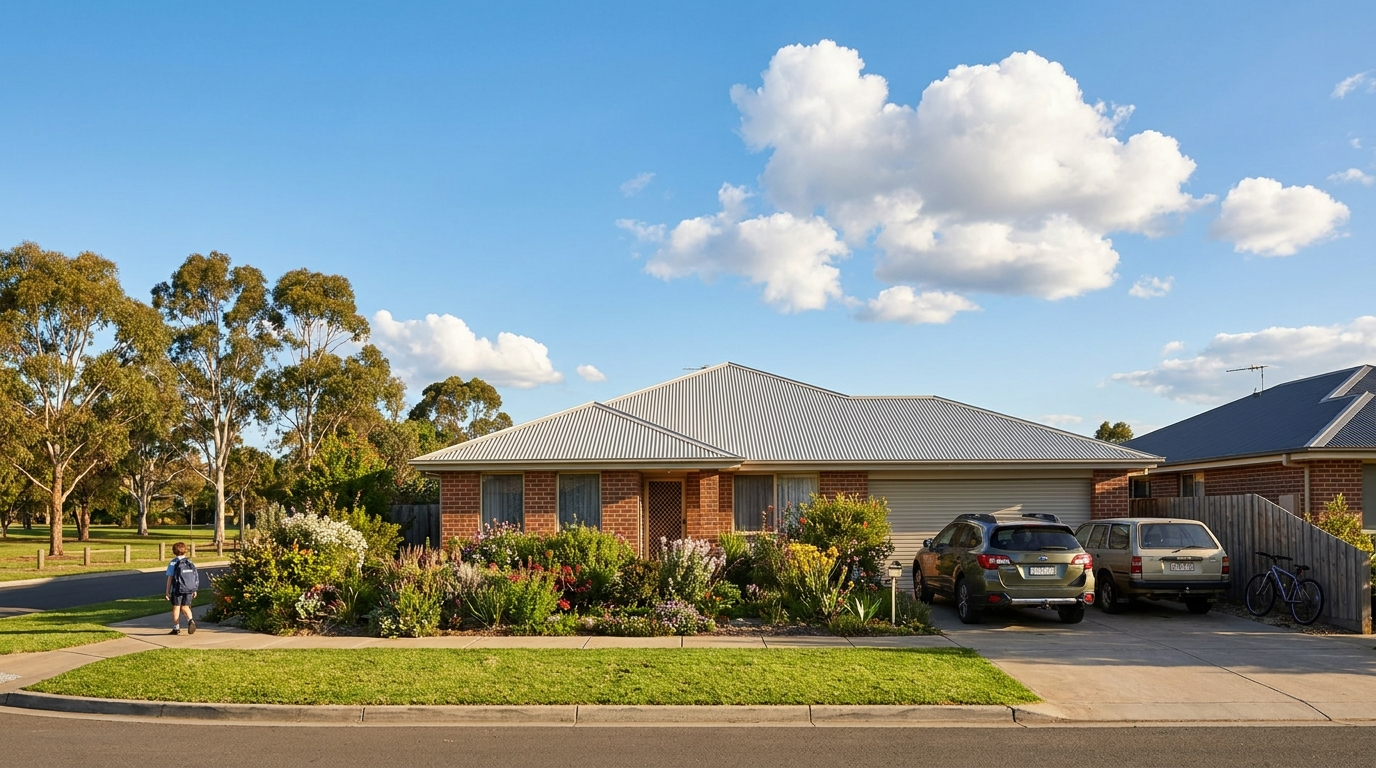
The Singaporeans who move to Australia rarely do it for one reason. Some want a house with a garden and a kid who can walk to a park without jaywalking across three lanes. Some want a career where “aunty how old you now” never comes up in a job interview. A lot of them just want weekends where they are not in a shopping mall by default.
Australia is the single most common long-term destination we see in our Singapore office, which is partly geography, partly language, partly that it remains one of the last developed countries where a middle-class family can still buy a house on two professional salaries. Deeper pieces on each pathway live under this one, linked where it makes sense to go further.
Why Singaporeans actually move
The honest reasons cluster into four buckets, and most families have at least two of them running at once.
Space and cost of living come first. A three-bedroom house in an outer suburb of Perth or Adelaide runs roughly AUD 600,000 to AUD 900,000 in 2026, which is a fraction of what the same footprint costs in Singapore. Groceries are cheaper once you account for portion sizes. Petrol is expensive by Asian standards but nothing near European levels. Daycare runs AUD 120 to AUD 180 a day, which is steep, but the Childcare Subsidy knocks that down to something comparable to a Singapore PCF centre for median-income families.
Schooling is the second. Australian public schools are uneven, but a good government school in Melbourne or Sydney will not ask your child to sit a high-stakes exam at age 12, and the ATAR ranks at 18 are based on more than one bad day. Families with a kid who is not academically competitive tend to feel the contrast most.
Career ceilings are the third. Tech, finance, and engineering in Singapore pay well, but the top of the tree is often held by regional HQ types cycling through from elsewhere. In Australia, local hires reach senior and director-level roles on roughly the same timelines as anyone else. This matters more at age 40 than at 28.
The fourth is the weather, the climate, and the sky. This sounds soft until you live through a Melbourne spring or a Perth summer evening. Singaporeans who have only experienced Australia on brief holidays tend to underestimate how much a different sky changes the feel of a week.
The main visa pathways
There is no single “migration visa” to Australia. Singaporeans move through four doors, and which one fits depends on age, occupation, and how much time you are willing to spend on the process.
Permanent residence through skilled migration
The skilled migration system is the workhorse. General Skilled Migration covers Subclass 189 (independent), 190 (state-nominated), and 491 (regional provisional), all scored on the same points test. Employer-sponsored migration runs on a separate track, with Subclass 482 (Skills in Demand) leading to Subclass 186 (Employer Nomination Scheme) after two years of sponsored work.
For most Singaporean professionals under 40, the skilled route is the obvious one. For senior executives, business owners, and anyone with an Australian employer already interested, employer sponsorship is usually faster. Our Australia PR from Singapore complete guide covers the permanent residence side in detail, including the points test, skills assessments, and the sequencing most applicants get wrong.
Study, then stay
Thousands of Singaporeans move to Australia first as students and convert to PR later. The Subclass 500 student visa is relatively clean for Singapore passport holders, who sit in Assessment Level 1 with a lighter documentary burden than applicants from most other countries. The catch is the price: the application fee rose to AUD 2,000 on 1 July 2025, and tuition for international students at a Group of Eight university runs AUD 45,000 to AUD 55,000 a year for an undergraduate course.
The post-study pathway matters more than the degree itself for anyone using study as a migration route. The Subclass 485 Temporary Graduate visa gives two to four years of work rights after graduation, which is where skills assessments and points accumulate. Our Australia student visa from Singapore guide covers the application side, and if you are weighing this pathway, read the student visa piece alongside the PR guide rather than in isolation.
Work and Holiday
The Subclass 462 Work and Holiday visa is a 12-month option for Singaporeans aged 18 to 30 who want to test the country before making a full move. The annual cap is 500 places, and it resets each 1 July. It does not lead directly to PR, but it gives you Australian work experience, local references, and a clearer view of which city you actually want to live in. That context alone saves people from expensive mistakes later.
The 462 is a popular first step for NUS and NTU graduates between jobs, and for ORD’d NSmen wanting a gap year before starting a career. Our Australia Work and Holiday visa guide walks through the eligibility rules and the common pitfalls Singapore passport holders run into.
Partner visas and other streams
Partner visas (Subclass 820/801 onshore, 309/100 offshore) sit outside the points test and run on their own rules. The National Innovation visa replaced the old Global Talent stream in early 2025 but remains narrow and invitation-only. A handful of Singaporeans move on Business Innovation visas, though the bar there has risen considerably since 2024. None of these are the typical path, and if one fits your situation you usually know already.
Not sure which pathway matches your age, occupation, and timeline? A 20-minute consultation with our registered agents saves a lot of wasted motion on tests and assessments.
The tradeoffs people underestimate
No honest overview skips this part. Moving to Australia solves real problems, but it creates others that Singaporeans tend to not think about until they arrive.
The distance from family is the biggest. A flight from Sydney to Singapore is seven and a half hours plus airport time. Making it back for Chinese New Year, a parent’s 70th birthday, and the occasional funeral adds up to AUD 6,000 to AUD 10,000 a year in flights for a family of four, and that assumes you book ahead. The first year is usually fine. The second year, when the novelty has worn off and your parents are a year older, is harder.
Winter is real. Melbourne, Sydney, and Canberra have genuine winters. Indoor heating in Australian houses is worse than in most developed countries because the building stock was not designed for cold. Singaporeans who assume a Melbourne winter is “like highlands Malaysia” usually get their first July wrong, sometimes expensively if the heating bill surprises them.
Tax rates bite. The Australian top marginal rate is 45% plus 2% Medicare levy, which kicks in at AUD 190,000. A Singaporean accustomed to a 22% top rate will feel this for roughly a year before adjusting. The flip side is that public services, from Medicare to public schools to parks, are actually funded by this, which is a trade some find worthwhile and others do not.
Healthcare is generally good but works differently. Medicare covers a lot, but specialist wait times in the public system can be months, and private cover (around AUD 200 to AUD 400 a month for a family) is practically necessary if you want the Singapore speed you are used to. GP visits are cheap or free; surgery and dentistry are not.
Career-wise, the Australian market is smaller. A specialist who was one of 30 people doing her job in Singapore might be one of 3 in Perth, which is good for standing out and bad if that particular employer does not work out. The professional network you spent 15 years building in Singapore is not quite portable.
Singaporean advantages in the system
Singapore passport holders sit at the favourable end of most Australian immigration categories, which is worth factoring in when comparing timelines and fees to what you read online from applicants elsewhere.
Student visa processing is in the fastest decile globally. Tourist visa eligibility is automatic through the ETA. Work and Holiday caps are small but rarely exhausted in the first few months the way they are for some other 462 countries. Police and health checks are cheap and quick to obtain in Singapore. Bank statements and employer references need less authentication than applicants from most countries face.
Professional credentials transfer reasonably well. Singapore-trained doctors, engineers, accountants, IT professionals, and most allied health roles have clear assessment pathways through AHPRA, Engineers Australia, ACS, and CPA Australia. Lawyers have it harder because admission is state-based and Singapore common law has diverged from Australian common law in ways that matter for practice.
English is the quiet advantage. Singapore’s official-English-medium education closes the door on a test requirement that trips up applicants from many other countries, though most migration candidates will still take IELTS or PTE to score the higher Proficient or Superior bands on the points test.
When to get professional help, and when not to
A lot of Singaporeans handle their own Australia applications without paid help, especially on the tourist, student, and Work and Holiday side. PR is where this shifts. The skilled migration points test has enough moving parts that a borderline profile often has 10 to 20 unclaimed points sitting in places the applicant did not think to look, from partner skills assessments to NAATI credentials to state nomination strategy.
If your case is straightforward, no partner complications, clean documents, clear occupation match, comfortable points margin, you can work through the PR process yourself. If any of those are shaky, an agent usually earns the fee on the first strategy call by pointing out either a cheaper route or a fatal problem you did not know you had.
The main rule worth remembering: anyone charging for Australian migration advice, in Singapore or anywhere else, needs to be either a MARA-registered migration agent or an Australian lawyer. Singapore itself does not regulate this, so those two credentials are the only real check. Our Australia migration agent Singapore guide covers what to look for and what to avoid when choosing one.
Thinking about migrating to Australia from Singapore in the next 12 to 24 months? We can map your age, occupation, and family situation against the live pathways and tell you which visa to aim at, usually in a single conversation.
Have a question about your own situation? Tell us on WhatsApp and a consultant will reply.
Chat with an OCSC consultant