


Most Singaporeans who ask about Australian permanent residence start with the wrong question. They ask whether they qualify. The real question is which of four or five different pathways fits their age, occupation, and time horizon, because the answer to “do I qualify” depends entirely on which door you walk through.
Australia runs a points-tested skilled migration system on top of an employer-sponsored track, a partner track, and a small discretionary innovation stream. For Singaporeans, the skilled and employer-sponsored routes absorb almost everyone, and the rules on both have shifted enough between late 2024 and early 2026 that anyone working off an older plan should recheck the basics. If the short-term side is what you actually need, start with our Australia visa from Singapore complete guide instead.
The pathways that actually apply to Singaporeans

There are three lanes that cover the vast majority of Singapore applicants. The first is General Skilled Migration, which includes Subclass 189 (Skilled Independent), Subclass 190 (Skilled Nominated), and Subclass 491 (Skilled Work Regional Provisional). The 189 gives you immediate PR with no sponsor or location tie. The 190 grants immediate PR but commits you to two years in the nominating state. The 491 is a five-year provisional visa that converts to PR via Subclass 191 after three years of living and working regionally.
The second lane is employer-sponsored. The Subclass 482 Skills in Demand visa replaced the old TSS in December 2024, and two years of continuous sponsored work opens up the Subclass 186 Employer Nomination Scheme, which grants direct PR. If you already have an Australian employer or an offer in hand, this is usually the faster path.
The third lane is the Partner Visa (Subclass 820/801 onshore, or 309/100 offshore), which sits outside the points test entirely and follows its own rules. There’s also the National Innovation visa that replaced Global Talent, but it is narrower and invitation-only, so most Singaporeans will land in one of the first two lanes.
What actually qualifies you
Four things decide whether a skilled PR application gets off the ground. You need an eligible visa subclass, a positive skills assessment from the authority that covers your occupation, enough points on the skilled migration points test, and clean health and character checks. Miss any one and the rest of the file is academic.
The skills assessment is the quiet killer. ACS handles most IT, Engineers Australia takes engineering, VETASSESS covers most other professions and trades, and AHPRA with its associated boards takes healthcare. Each has its own fees, paperwork, and turnaround running from four weeks to four months. A Singapore software engineer at NUS nominating ANZSCO 261313 generally passes cleanly, but the same person nominating a broader role without matching duty descriptions often gets bounced. Reference letters that merely say “managed projects and team” are useless; the ones that pass specify project type, team size, methodology, and the percentage of time each activity took.
Health and character are usually straightforward for Singaporeans. Panel physician medicals in Singapore run SGD 300 to 500 per adult, and the Certificate of Clearance from the Singapore Police Force covers the character requirement for local-only applicants. The fuller rundown of 2026 settings lives in our Australia PR requirements article.
The points test is where applications succeed or stall

The skilled migration points test is scored out of 130. The official pass mark to submit an Expression of Interest is 65, but 65 rarely wins an invitation in 2026. Real invitation cut-offs for Subclass 189 sit in the high 80s to high 90s for most occupations, and “competitive” rather than “eligible” is what matters.
Age is the heaviest category and the one you cannot negotiate. The brackets pay 30 points for 25 to 32, 25 for 33 to 39, 15 for 40 to 44, and zero from 45 onward. The cliff between 32 and 33 costs five points with no warning; the one at 40 costs another ten. Points are calculated at the day of invitation, not lodgement, so if your birthday lands mid-process, the invitation you get may be scored on an older and younger you.
English is the cheapest recoverable ground on the test. Proficient (IELTS 7 each band) adds 10 points; Superior (IELTS 8 each band) adds 20. Most Singaporeans sit between the two on paper and can close the gap with a PTE Academic resit for a few hundred dollars and a month of prep. The full breakdown, including the bonus categories that matter for borderline applicants, sits in our Australia PR points calculator.
The application sequence people usually get wrong
Australia PR is less about filling forms and more about ordering a long list of steps correctly. Skills assessment before EOI. English test early enough that you can resit if the first attempt lands at Proficient. State nomination application before the SkillSelect invitation for Subclass 190 and 491. Health and police checks after invitation but as early as the system allows. Step out of order and you burn weeks waiting for artefacts you could have already had.
A realistic timeline for a 2027 move starts around 18 months out. Skills assessment runs four to sixteen weeks. English testing and retesting adds a month or two where needed. EOI to invitation runs from a few weeks for 95+ point profiles to more than a year for competitive occupations at 80. Department processing for a lodged Subclass 189 or 190 runs six to fifteen months on current public data. Partner and employer-sponsored tracks run on separate clocks.
Most Singapore applicants lose time in two places. They start the skills assessment before the reference letters are usable and have to resubmit. They sit the English test once, land at Proficient, and lodge the EOI without retaking. Both are avoidable if you plan the sequence before you pay for anything. The step-by-step walkthrough lives in our how to apply for Australia PR piece.
Trying to work out which PR pathway actually fits your profile? A short consultation with our registered agents maps your age, occupation, and English against the live invitation data before you spend money on tests or assessments.
Skilled migration in context
General Skilled Migration is the default route for Singaporeans without an Australian employer. The 2025-26 permanent program caps skilled places at 132,200 inside an overall 185,000 ceiling, with Subclass 189 trimmed to about 16,900 and state-nominated places allocated at 20,350 in the November 2025 round. That scarcity is why invitation cut-offs have risen for generalist occupations and why the 491 has become a more realistic target for applicants in their late thirties or with borderline scores.
Picking the right subclass matters more than it used to. Subclass 189 works if you’re young, have strong English, a recognised degree, and an in-demand occupation (most IT, engineering, and healthcare). Subclass 190 works if a state will nominate you and you’re willing to live there for two years. Subclass 491 adds 15 points but commits you to a regional area, where “regional” means Adelaide, Hobart, Perth, Canberra, Newcastle, the Gold Coast, or smaller cities, for at least three years before Subclass 191 converts you to PR.
The employer-sponsored track bypasses the points test entirely. A Subclass 482 with a sponsoring employer for two years opens Subclass 186, which is direct PR. The 482 also now carries a 180-day window to find a new sponsor if you lose your job, up from the old 60 days, so the track is less fragile than it used to be. The full map of subclasses and tradeoffs is in our Australia skilled migration guide.
Keeping PR alive once you have it
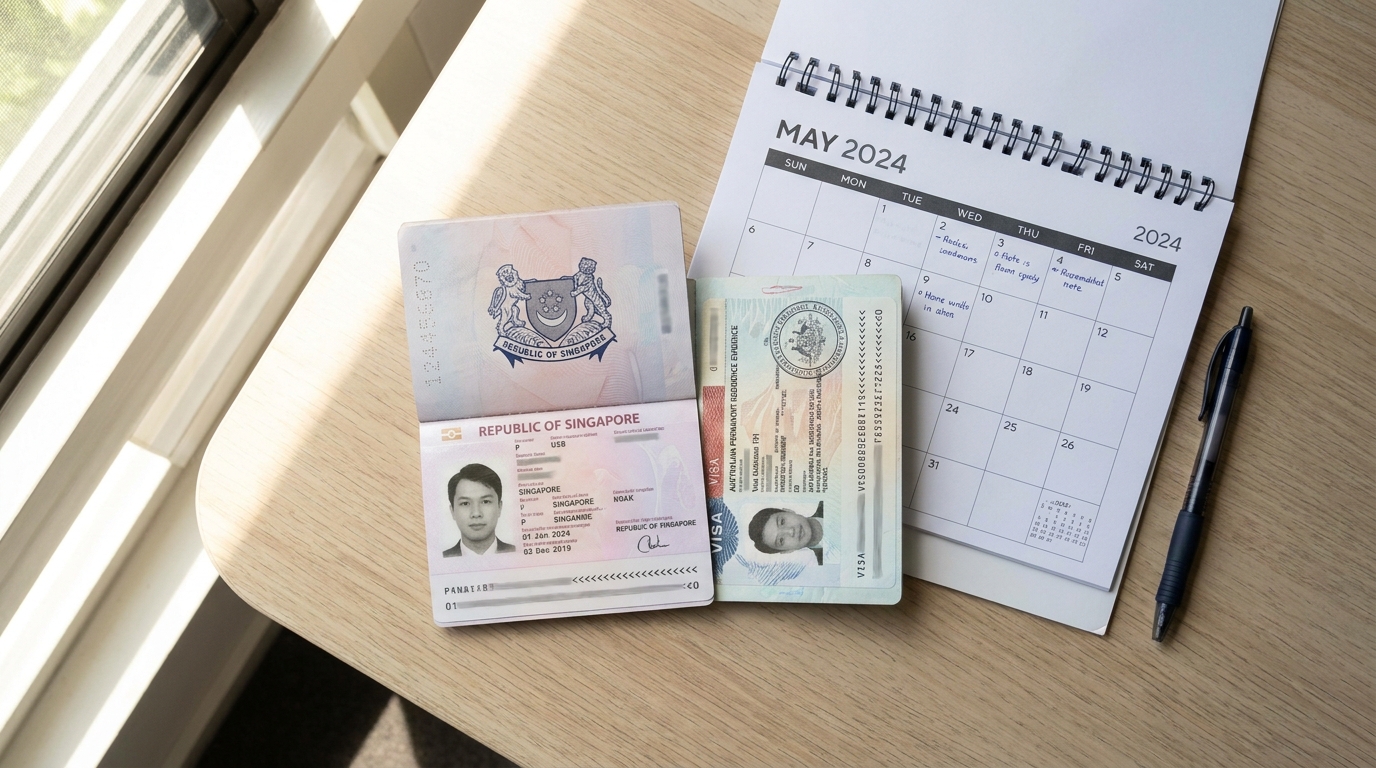
A detail plenty of Singaporeans miss until it’s almost too late. Your Australian PR visa does not expire, but the travel facility on it does. Every permanent visa grants five years of unlimited travel. Once those five years run out, your PR status still stands inside Australia, but you can no longer leave and come back as a resident until you have a Resident Return Visa.
This matters in practice because plenty of Singaporean PR holders spend most of their time in Singapore for work or family, only visiting Australia periodically. The five years pass faster than expected. The RRV Subclass 155 grants another five years of travel if you’ve spent two years physically in Australia out of the last five, or one year if you can show substantial ties rather than days. The Department checks residence against border movement records to the day, and ties are read strictly. Holding an Australian bank account you rarely use won’t cut it.
The application is lodged online through ImmiAccount, costs AUD 490, and typically processes quickly for the straight five-year grant. Lodge before the facility expires, not after, especially if you’re overseas when the clock runs out. The full rundown and the discretionary ties test sits in our resident return visa Australia page.
What changed between 2024 and 2026
Most of the legwork on Australia’s PR framework has happened quietly since late 2024. The old Temporary Skill Shortage visa is gone, replaced by Skills in Demand. The Global Talent visa closed and became the narrower National Innovation visa. ANZSCO retired on 6 December 2024 and OSCA took its place as the occupation standard, which affects how skills assessments match your duties to occupation descriptions. The Core Skills Income Threshold rose to AUD 76,515 on 1 July 2025 and moves again to AUD 79,499 from 1 July 2026. The points test is under review with a proposed EOI floor of 70 instead of 65, though nothing has been legislated yet.
None of this is catastrophic for a Singapore applicant, but planning off a 2023 baseline is probably wrong about something material. The state nomination allocation came in well below the planning level in 2025-26, the 189 has been tightened, and the one-year work experience rule on Skills in Demand has brought earlier-career applicants into the frame who previously didn’t qualify. The full change log, with dates and numbers, lives in our Australia PR news and policy updates.
If you’re starting from scratch in 2026, the practical advice is straightforward. Verify your occupation against the current OSCA-based Core Skills Occupation List before paying for a skills assessment. Sit your English test early and plan for a resit. Check state nomination criteria at the moment you plan to apply, not when you first read about them, because they change annually. And work backwards from your age bracket, because five points at 33 costs more than almost anything else you can do to lift your score.
Ready to build a realistic Australia PR plan for your situation? Our registered consultants review your age, occupation, English, and work history against the current 2026 invitation rounds and lay out a concrete pathway from where you are now to lodgement.
Have a question about your own situation? Tell us on WhatsApp and a consultant will reply.
Chat with an OCSC consultant